patterns motifs
Rose Medallion Vases: A Collector's Guide
Key Takeaways
- Baluster, trumpet-neck, rouleau, and bottle forms are the vase shapes you’ll see most often, and sizes range from small mantel pieces to floor-standing pairs.
- Many antique Rose Medallion vases were drilled through the base to convert them into table lamps, and that hole generally lowers value even after a lamp is un-wired.
- Vases were frequently made and sold in pairs or as part of a garniture set, and a genuine matched pair usually brings more than two singles.
- Painting quality, condition, size, and whether the base was ever drilled tend to matter more for value than age alone.
- Where a true pair or a specific size isn’t out there to find, a hand-painted commission can fill the gap.
Vases are where a lot of new Rose Medallion collectors start, and it’s easy to see why. They’re bold, they anchor a shelf or a mantel on their own, and they turn up at estate sales and auctions more often than some of the smaller forms. But they also carry a wrinkle that catches a lot of buyers off guard: the base. Before we get into forms and value, that’s worth flagging early, because it changes how you should look at almost every vase you come across.
What vase forms come up most in Rose Medallion collecting?
Rose Medallion vases show up most commonly as baluster, trumpet-neck, rouleau, and bottle forms, ranging from small mantel-sized pieces to tall floor vases meant to anchor a room. Canton export workshops produced these shapes across a wide range of sizes, so “vase” covers a lot more ground than a single silhouette.
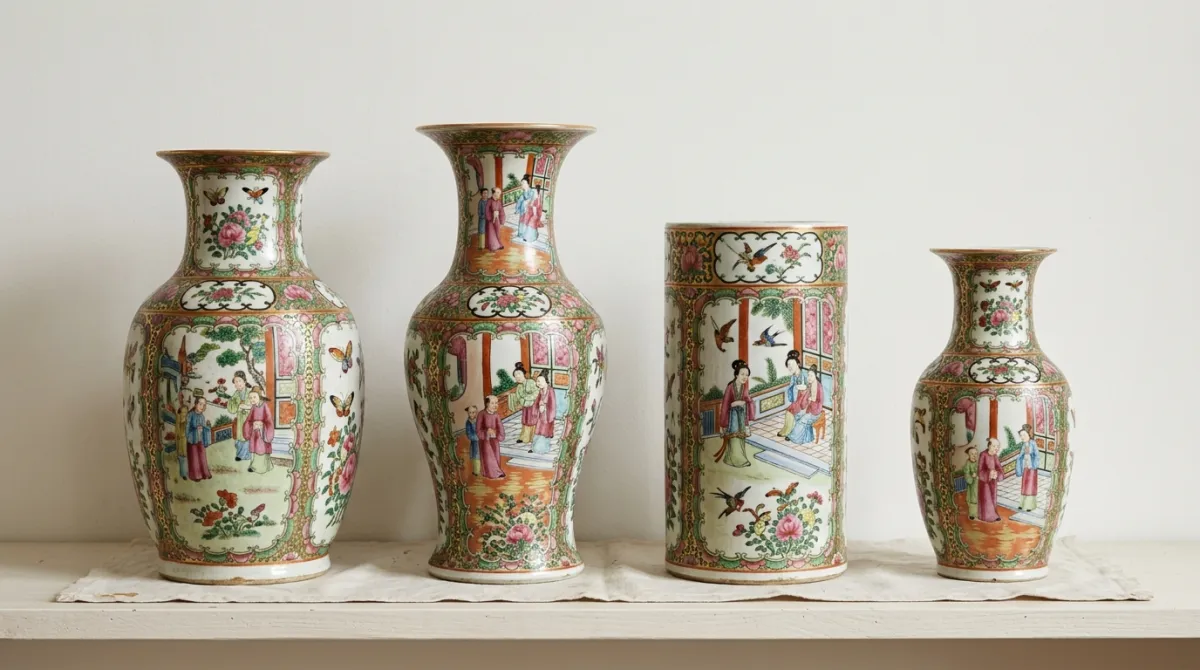
The baluster form, with its swelling body narrowing toward a shorter neck, is probably the shape most people picture when they think “Chinese export vase.” It’s a versatile silhouette that gives the painter a generous curved surface for the pattern’s figure panels and floral ground.
Trumpet-neck vases flare outward at the top, which changes how the eye reads the painting; the flared neck often carries its own narrower band of decoration separate from the body. Rouleau vases, sometimes called cylinder vases, keep a straighter, more architectural profile with minimal waisting, and they tend to read as a pair particularly well because that straight-sided shape repeats cleanly. Bottle vases have a narrow neck rising from a rounder body and show up less often than the other three, which makes a genuine one worth a second look.
Sizes vary enormously. You’ll see small vases barely taller than a bowl sitting comfortably on a side table, mid-size pieces meant for a mantel, and large pairs, sometimes three or five feet tall, that were built to flank a doorway or a fireplace. In our experience, first-time buyers tend to assume there’s a “standard” vase size, and there really isn’t one.
Were Rose Medallion vases sold in pairs or as garniture sets?
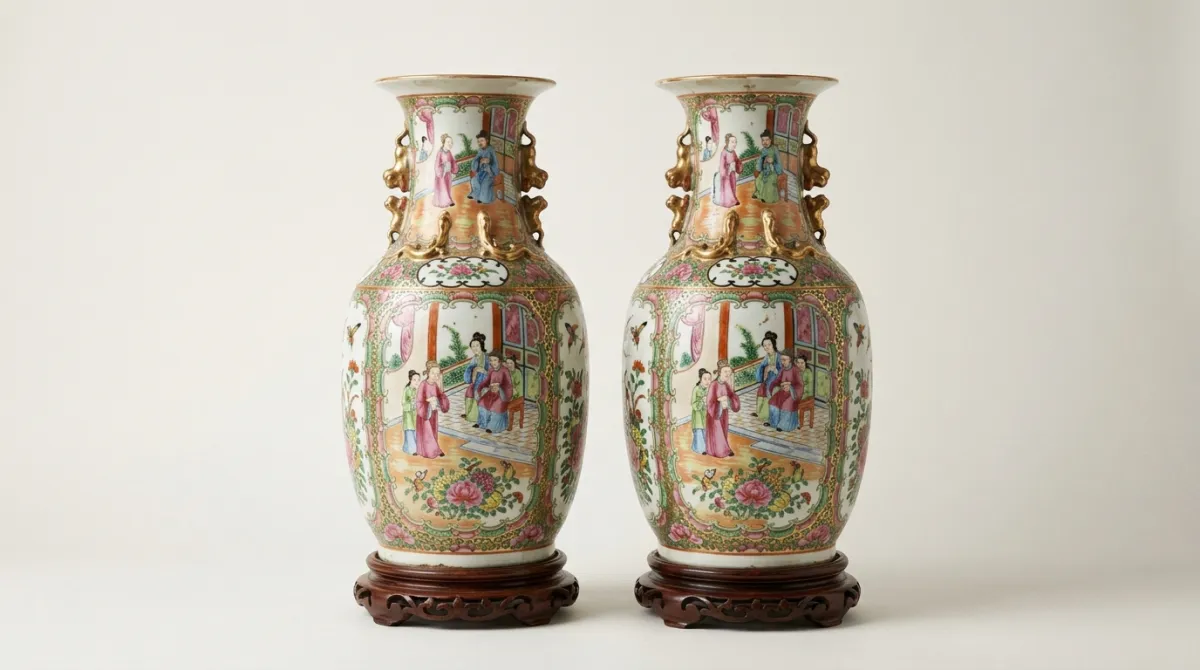
Yes, quite often. Vases were commonly produced and sold in matched pairs, and sometimes as part of a larger garniture set alongside jars of related forms. A genuine matched pair generally brings more together than the same two vases would fetch sold individually, simply because intact pairs are harder to find.
That scarcity comes down to survival math more than anything mysterious. Two vases have to make it through a century or more, undamaged, staying together through however many households and estates they passed through along the way. Plenty of once-paired vases get split up: sold off separately, divided between siblings, or broken up when only one half survives a move or a fall.
If you’re hunting for a pair specifically, compare the painting closely rather than trusting a dealer’s “pair” label at face value. Kerry has seen plenty of so-called pairs that turn out to be a marriage of two similar but not identical vases, painted by different hands or in different decades. The faces on the court figures and the exact palette of the peonies are usually where a mismatch shows up first. For more on how pairs and garniture groupings fit into the broader pattern’s history, our Rose Medallion complete guide covers that ground in more depth.
Why does a drilled base matter so much?
A drilled base is one of the biggest value issues specific to vases, and it’s worth checking on every single piece before you buy. Many antique Rose Medallion vases were drilled through the base at some point, usually to convert them into table lamps, and that hole generally lowers the vase’s value as a collectible object even once the lamp fittings are gone.
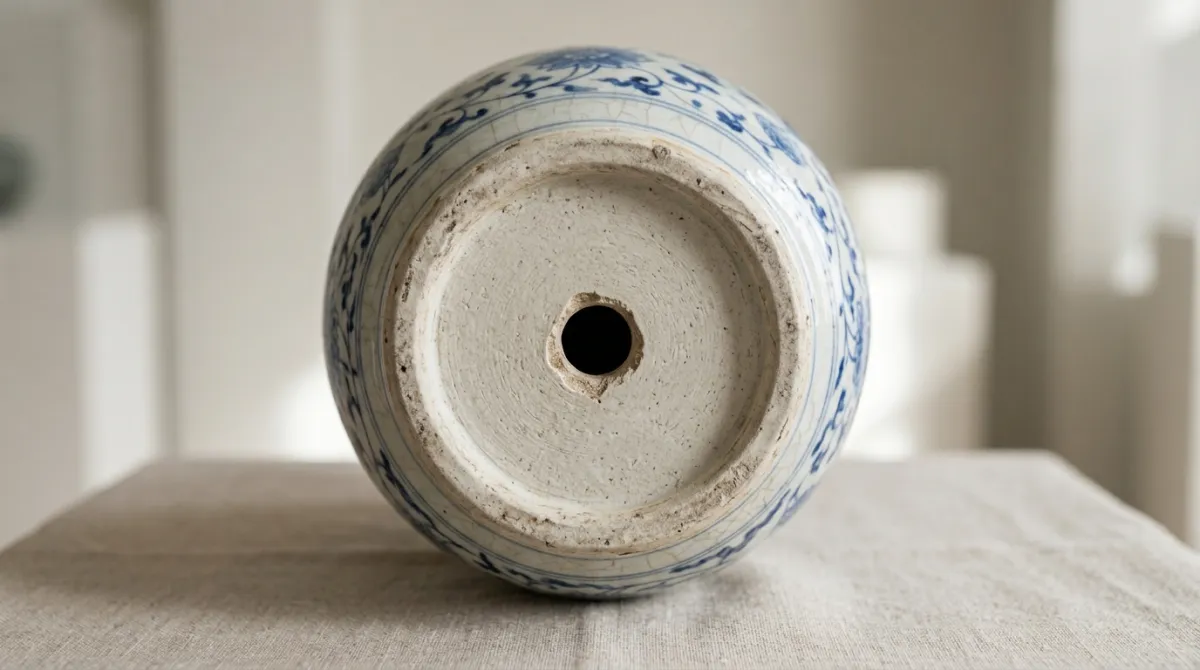
It’s an easy thing to miss if you’re only looking at the painting. Turn every vase over and look at the base itself: a small, neatly bored hole, sometimes with a bit of hardware or a plugged remnant still in place, is the telltale sign. Lamp conversion was extremely common through the mid-20th century, when Rose Medallion vases were widely repurposed as decorative lighting, and a huge number of pieces in circulation today carry this modification.
Here’s the part that trips people up: a vase can be “un-wired,” meaning the lamp fittings and cord are removed and the piece is returned to display as a vase again, but the hole in the base doesn’t go away. It’s a permanent alteration to the original object, not a temporary accessory. Collectors generally treat a drilled base the same way they’d treat any other modification, as something that pulls value down relative to an undrilled example of comparable quality and condition, even if the vase now looks perfectly intact from the front. We’ve written more on this specific issue, including how to spot a repaired or disguised hole, in our piece on Rose Medallion lamps, which is worth reading before you buy anything described only as a “vase” in a listing photo that doesn’t show the base clearly.
What condition issues should you check before buying?
Rim and neck chips, hairline cracks, gilt wear, and past repairs all affect a vase’s value, and they’re worth checking systematically rather than glancing over a piece once. Necks are the most vulnerable part of a vase, so start there before you even look at the painting.
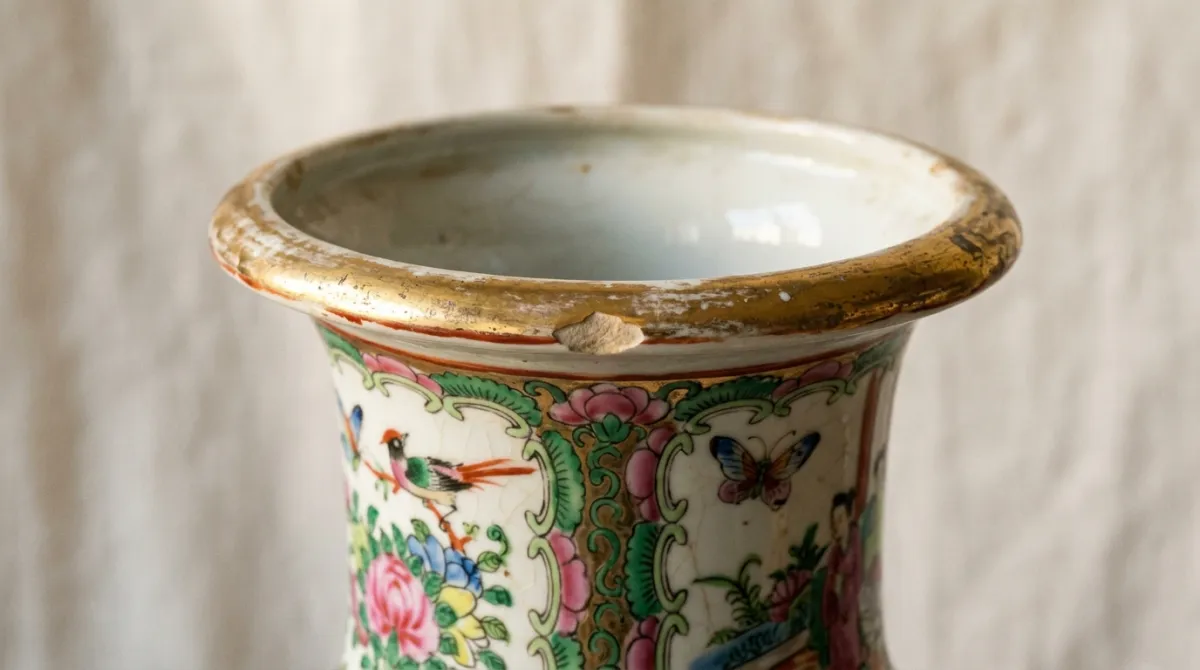
Run your fingers slowly around the rim and down the neck, since a small chip can hide easily in normal light, especially near a gilt line. Hold the vase up to strong light and look through the neck and upper body for hairline cracks that don’t always show from the outside; a fine crack running down from the rim can be almost invisible until it’s backlit. Tap the body gently, too. A sound, undamaged vase tends to ring with a clear tone, while a cracked one usually sounds duller, though this takes some practice to read reliably and shouldn’t be your only test.
Look closely at any repair as well. A professional, honestly disclosed restoration is a different situation than an amateur glue job or an undisclosed fill hiding under new paint. Gilt wear should look honest and uneven where the piece was actually handled, not suspiciously bright and even all the way around. None of these signs proves anything on its own; read them together, the same way you’d read condition on any Rose Medallion piece, and pair them with a careful look at the base for that drilled hole we just covered.
What drives the value of a Rose Medallion vase
Value on a Rose Medallion vase tends to track painting quality, condition, size, whether the base was ever drilled, and whether it’s part of a matched pair, more than any single factor on its own. A large vase with fine painting, an undamaged undrilled base, and a genuine matching partner will generally outvalue a smaller or single example, even between two vases of similar age.
Painting quality is the biggest lever across the whole pattern, and vases are no exception. Confident brushwork, individually rendered faces on the court figures, and rich, even enamel color separate a fine vase from a merely decent one at almost any size. Kerry can usually tell within a few seconds of raking light across a vase’s body whether it was painted by a skilled, practiced hand or something more routine.
Condition and that drilled-base question come next, and they stack. A chipped neck, a hairline crack, and a drilled base together pull value down considerably more than any one issue alone would. Rarity plays a role too; very large vases, unusual forms like true bottle vases, and intact matched pairs are scarcer than mid-size singles, and that scarcity shows up in what serious collectors are willing to pay. Genuine age adds value on top of quality and condition, but it doesn’t override them; an older vase with a rough drilled base and mediocre painting isn’t automatically worth more than a beautifully painted, undrilled, complete later piece.
Antique vase or later reproduction: how can you tell?
Reading age on a vase relies on the same clues used across the pattern: body weight, foot-rim wear, brushwork texture, and gilding condition, read together rather than trusted individually. None of these signs proves age on its own, which is exactly why we’d hedge on any quick judgment made from a photo alone.
Turn the vase over and feel the foot rim the way you would on a plate or bowl, checking for soft, rounded wear on an older piece versus sharp, uniform sanding on something newer. Look at the reserves under raking light, too; hand-applied enamel tends to show slight texture and brushstroke variation, while printed or transfer decoration reads flatter and more mechanically uniform. Our full identification guide walks through this comparison in more detail, and everything in it applies to vases just as it does to plates and jars.
Isn’t it a little frustrating that no single test settles the question? It genuinely doesn’t, at least not reliably from a photo, and that’s part of why we’d always recommend an in-person look, or at minimum close, well-lit photos of the base and the reserves, before treating any online listing’s “antique” claim as settled fact.
Displaying and caring for a Rose Medallion vase
Most Rose Medallion vases in circulation today live as decorative pieces rather than functioning containers, and that’s generally the safest way to treat an antique or fine hand-painted example. The overglaze enamels and gilding weren’t designed for standing water or daily handling, so keeping a vase dry and undisturbed protects both the piece and its appearance.
If you do want to display fresh flowers in a vase, we’d suggest using a plastic liner or an interior glass insert rather than filling the porcelain directly, especially on an antique piece. Standing water against old glaze and enamel for extended periods isn’t worth the risk. Dust gently with a soft, dry cloth, and if you do need to clean one, hand-wash carefully with lukewarm water rather than anything abrasive. For a fuller routine on handling antique porcelain without damaging the enamels or gilding, our guide on cleaning antique Rose Medallion covers the details we’d apply to a vase as much as anything else in the pattern.
Commissioning a matching vase or pair
Genuine antique pairs and specific sizes are scarce enough that commissioning a hand-painted vase is often the practical route when you need something particular. Whether you’re missing one vase from a broken pair, chasing a size that just doesn’t turn up on the antique market, or trying to complete a garniture set, a custom order sidesteps a search that can otherwise drag on for years.
This is one of the requests Kerry hears most at GoodTime Studio Macau: a client with one surviving antique vase from a pair, wanting a matching companion painted to echo the original’s palette and reserve layout as closely as possible. It’s slower, more deliberate work than painting a fresh vase from scratch, since it means studying the existing piece’s brushwork and color choices before touching a brush to the new one. If that’s your situation, or you’d simply like a vase or pair made to a size you can’t find secondhand, our commissions page is a reasonable place to start that conversation.
Frequently asked questions
Were Rose Medallion vases made in pairs?
Often, yes, and sometimes as part of a larger garniture set with related jar forms. A genuine matched pair, with painting and proportions that actually line up, is scarcer and generally more valuable than the same two vases bought separately from different sources.
Does a drilled hole in the base lower the value?
Generally, yes. A drilled base usually means the vase was converted into a table lamp at some point, and that’s a permanent modification even after any lamp fittings are removed. Collectors typically value an undrilled vase of comparable quality and condition more highly than a drilled one.
How can I tell if a vase is antique?
Check body weight, foot-rim wear, brushwork texture, and gilding condition together, the same clues used across the whole pattern. None of these proves age alone, so we’d always recommend an in-person look or detailed close-up photos before trusting a listing’s claim.
What vase forms are most collectible?
Baluster, trumpet-neck, rouleau, and bottle forms all turn up, though larger sizes, true matched pairs, and less common shapes like bottle vases tend to draw the strongest interest. Painting quality and an undrilled, undamaged base generally matter more than form alone.
Can you make a matching vase for a single I already own?
Yes, this is something Kerry takes on regularly at GoodTime Studio Macau. She studies the surviving vase’s palette, proportions, and reserve layout, then hand-paints a companion piece to echo it as closely as possible. Reach out through our commissions page to talk through what’s realistic for your piece.
A last word on collecting vases
Vases reward a bit of patience and, honestly, a habit of checking the base before you fall for the painting. A drilled hole doesn’t ruin a vase, plenty of converted-lamp vases are still lovely to own and display, but it should shape what you’re willing to pay and how you describe the piece later. Whether you’re chasing a single fine vase, hunting a true pair, or considering a commission to complete a set, start with the base, then work up from there. For a related storage form worth comparing, our piece on Rose Medallion ginger jars covers similar ground on pairs and condition.
Simon Iong writes about Rose Medallion history and value. Craft insight in this piece comes from Kerry Kwok of GoodTime Studio Macau, a working 廣彩 painter trained under master Lei Iat Po.
Keep exploring
More from Rose Medallion
Identification, history, and care guides for Rose Medallion and Canton porcelain. New guides added regularly.
Explore all guides