patterns motifs
Rose Medallion Ginger Jars: A Collector's Guide
Key Takeaways
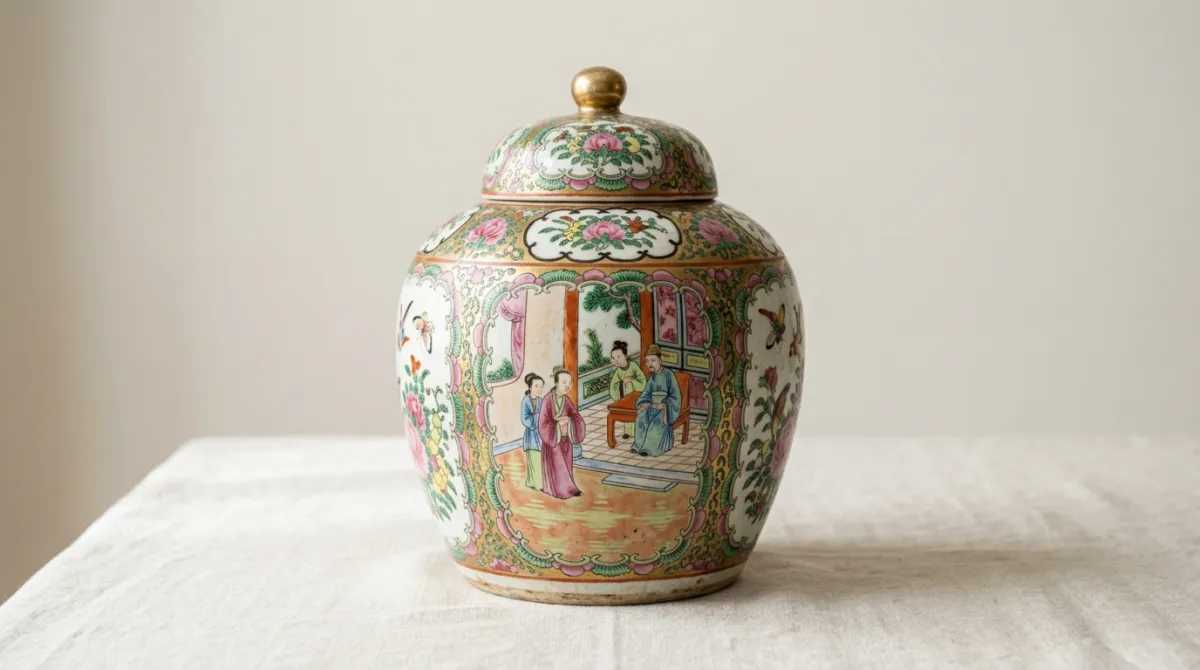
- A ginger jar is the classic high-shouldered, domed-lid storage jar. Rose Medallion ginger jars are that shape decorated with Canton famille-rose figures and flowers.
- Original lids get lost or swapped often, so check the fit and the painting on the lid against the body before you buy.
- Ginger jars were frequently made and sold as pairs, and a matched pair is usually worth more than two singles bought separately.
- Value tracks painting quality, condition, size, and whether the lid is original, alongside age and rarity, more than any one feature on its own.
- Where a true antique pair or a specific size isn’t out there to find, a hand-painted commission can fill the gap.
I’ve watched Kerry pick up more ginger jars over the years than almost any other form in the studio, and there’s a reason for that. It’s a shape people fall for on sight: that round, high-shouldered body and the small domed lid sitting on top like a cap. But the questions that come with buying one are different from the questions you’d ask about a plate or a vase, mostly because of that lid. So let’s start with the basics, then work through to what actually matters when you’re deciding whether to buy or commission one.
What is a Rose Medallion ginger jar, exactly?
A ginger jar is a rounded, lidded jar with high shoulders and a short neck. The form could be used to store dry goods such as ginger, tea, or spices, though “ginger jar” is really a modern English collector’s term rather than a record of what any given jar actually held. A Rose Medallion ginger jar is that same functional shape decorated with the pattern’s signature alternating panels of court figures, birds, and peonies over a scattered floral ground.
The form itself is much older than the pattern. Ginger jars were everyday storage vessels long before anyone was painting famille-rose reserves on them, and plain or simply glazed versions still turn up in Chinese kitchens today. What makes a jar “Rose Medallion” is purely the decoration: those alternating cartouches of figures and flowers, usually four or five to a jar, wrapped in gilt-line borders and set against a densely painted background.
Sizes vary more than people expect. You’ll see small jars barely taller than a teacup, mid-size ones that sit comfortably on a mantel, and larger jars meant to anchor a shelf or a pair of side tables. In my experience, a lot of first-time buyers assume “ginger jar” means one standard size, and it really doesn’t; that range is part of what makes the form flexible for a room.
Were Rose Medallion ginger jars really sold in pairs?
Yes, often. Ginger jars were commonly produced and sold in matched pairs, and sometimes as part of a larger garniture set alongside vases of related shapes. A genuine, matched pair generally commands more together than the same two jars would sell for individually, since pairs are harder to find intact than singles.
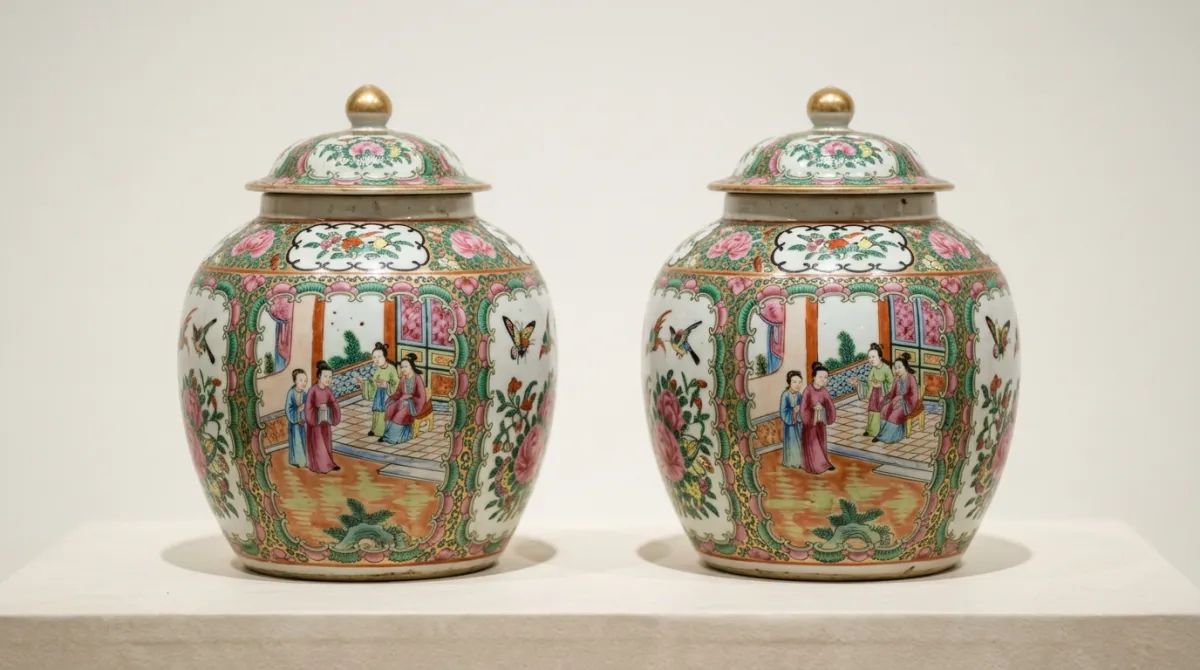
That’s partly simple math: two jars have to survive, undamaged, in the same household or the same estate, for a pair to stay together over a century or more. Plenty of once-paired jars get separated along the way, sold off individually, gifted apart, or simply broken up when an estate is divided. Finding a true pair with matching painting and, ideally, matching original lids is genuinely harder than finding one nice jar on its own.
For more on how pairs and garniture sets fit into the wider pattern, our Rose Medallion complete guide covers the history behind these traditional groupings.
If you’re shopping specifically for a pair, look closely at the painting style on both jars, not just the general pattern. Kerry points out that even jars sold together as a “pair” from a dealer sometimes turn out to be a marriage of two similar but not identical jars, painted by different hands or in different decades. The brushwork on the faces and the exact palette of the peonies are where that kind of mismatch usually shows up first.
Is the lid original, and why does that matter?
A missing or replaced lid is one of the most common issues with old ginger jars, and it matters quite a bit for both value and honesty in a listing. Lids get separated from their jars constantly, through breakage, careless handling, or simply decades of storage where a lid and its jar drift apart, so checking the lid should be one of your first moves, not an afterthought.
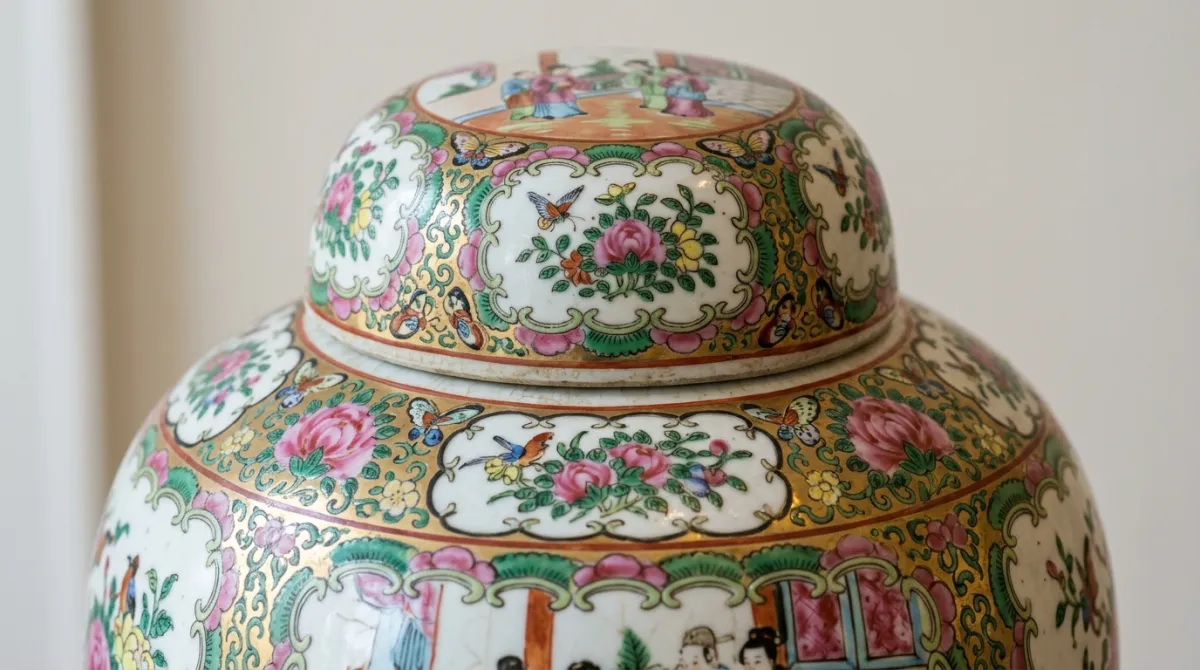
Start by checking the fit. A genuinely original lid sits snugly on the jar’s neck with minimal wobble, and the glaze color and body tone of the lid should match the jar closely, since they were made as a set. A “married” lid, one that fits well enough but actually belongs to a different jar, will often show a subtly different glaze tone, a slightly different painting style, or gilt-line borders that don’t quite line up with the jar’s own pattern rhythm.
Compare the painting itself next. On an original pairing, the reserves on the lid usually echo the jar’s palette and brushwork closely, sometimes even continuing a design motif from the shoulder onto the lid’s edge. If the lid’s peonies look flatter, brighter, or just painted by a different hand than the jar’s figures, that’s worth pausing over. Our piece on how to identify Rose Medallion covers a lot of this same brushwork comparison in more depth, and the same eye applies here.
A jar with no lid at all isn’t necessarily a disaster, especially if you love the jar and plan to display it open or with a wood or replacement top. But be honest with yourself, and with anyone you resell to later, about what you actually have. A jar sold as complete with its original lid should be priced and described differently than one with a later or missing lid, and in our experience, that distinction gets blurred more often than it should.
What condition issues should you check before you buy?
Chips, hairline cracks, gilt wear, and glaze crazing all affect a ginger jar’s value, sometimes substantially, and they’re worth checking systematically rather than glancing over the piece once. Run your fingers around the rim of both the jar’s neck and the lid’s edge, since that’s where small chips hide most easily under a glaze glare.
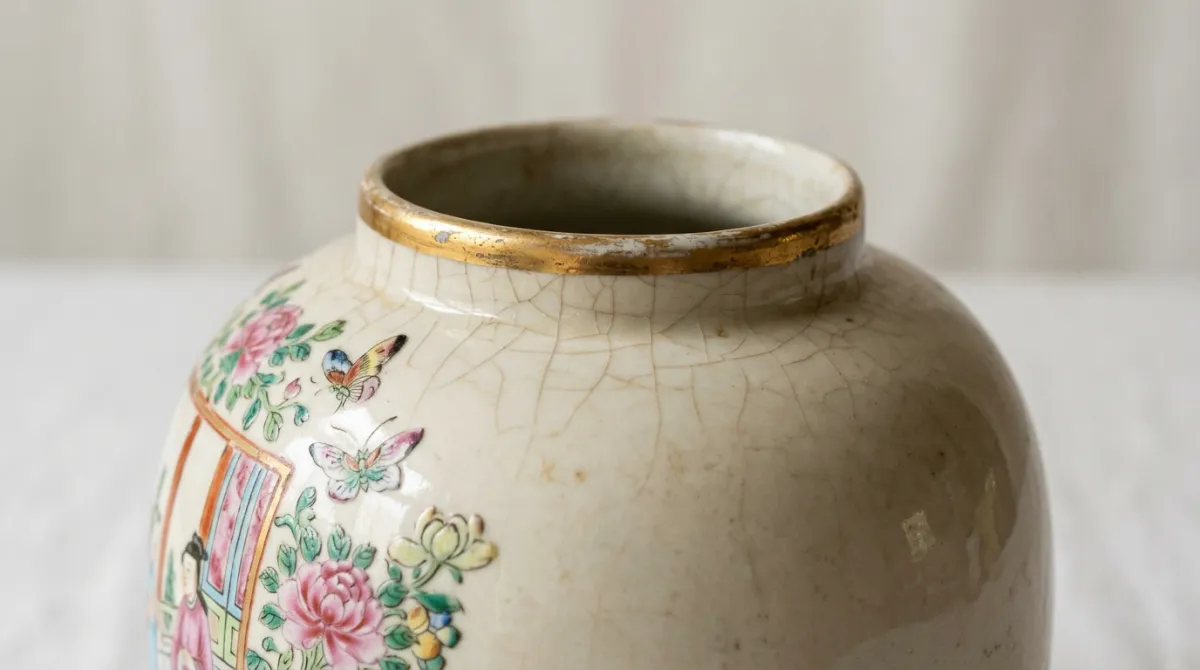
Hold the jar up to a strong light and look through the body, if it’s thin enough, for hairline cracks that don’t show from the outside. A fine crack running from the rim down into the shoulder can be almost invisible in normal light but shows as a dark thread when backlit. Tap the body gently too; a healthy, undamaged jar rings with a clear, faintly musical tone, while a cracked one tends to sound duller and shorter, though this takes some practice to read reliably.
Gilt wear on the rim, handles if present, and any raised decoration is worth reading the same way we’d read it on a plate: honest, uneven thinning where the piece was actually handled is a different story than bright, untouched gilding all the way around. Crazing, that fine network of glaze cracks, is common on older pieces and isn’t automatically a flaw, though heavy crazing combined with staining can affect both appearance and value. None of these signs works alone; read them together, the way you’d read the body and enamels on any Rose Medallion piece.
Antique jar or later reproduction: how do you tell?
Reading age on a ginger jar uses the same clues as any other Rose Medallion piece: body weight, foot-rim wear, brushwork texture, and gilding condition, read together rather than trusted individually. None of these clues proves age on its own, and that’s especially true on a jar, where the lid can confuse the picture further if it doesn’t match the body’s age.
Turn the jar over and check the foot rim the same way you would a plate, feeling for soft, rounded wear on an older piece versus sharp, uniform sanding on a newer one. Look at the reserves under raking light for the slight texture of hand-applied enamel versus the dead-flat look of printed decoration. Our full identification guide covers this comparison in detail, and it applies to jars exactly as it does to plates and vases.
One quirk specific to jars: because the lid and body can come from different periods if a lid was replaced, you may find yourself dating two objects, not one. It’s entirely possible to have a genuinely old jar body paired with a competent later reproduction lid, or the reverse. Read the lid and the body separately before deciding what you actually have.
What actually drives the value of a ginger jar?
Value on a Rose Medallion ginger jar tracks painting quality, condition, size, whether the lid is original, and whether it’s part of a matched pair, more than any single feature carries on its own. A large jar with fine painting, an undamaged body, and its correct original lid will generally outvalue a smaller or lid-less example even if both are genuinely old.
Painting quality is the biggest lever, same as it is across the whole pattern. Confident brushwork, well-drawn faces, and rich, even color in the reserves separate a fine jar from a merely decent one at almost any size or age. Kerry can usually tell within a few seconds of raking light across a jar’s shoulder whether it was painted by a skilled, practiced hand or something more workmanlike.
Condition and the lid situation come next. A chip, a hairline, or a missing original lid each pull value down, sometimes considerably, and they stack: a jar with all three issues is worth meaningfully less than one with a single flaw. Rarity of size and form matters too; very large jars and true matched pairs are scarcer than mid-size singles, and that scarcity shows up in what collectors are willing to pay. Genuine age adds value on top of quality and condition, but it doesn’t override them; a plain, damaged 19th-century jar isn’t automatically worth more than a beautifully painted, complete later one. For a deeper look at how marks factor into all this, our guide to reading Rose Medallion marks is worth a read, though on jars especially, marks tell you far less than the body does.
Displaying and caring for a ginger jar
Most Rose Medallion ginger jars in circulation today live as decorative objects rather than working storage, and that’s how we’d recommend treating any antique or fine hand-painted example. The gilt and enamel decoration that makes these jars desirable isn’t meant for daily handling or contact with food, so display use protects both the piece and its value.
If you do want a jar with a genuine lid seal, hand-wash gently with a soft cloth and lukewarm water, never a dishwasher, and dry it immediately rather than letting it air-dry with water sitting on the gilding. Avoid stacking anything on or inside a jar with an original lid in place, since that’s exactly the kind of pressure that chips a rim. For a fuller routine on handling and cleaning antique pieces without damaging the enamels or gold, our guide on cleaning antique Rose Medallion covers the details we’d apply to a jar as much as a plate.
Commissioning a matching jar or pair
Genuine antique pairs and specific sizes are scarce enough that commissioning a hand-painted jar is often the practical route when you need something particular. Whether you’re missing one jar from a broken pair, need a size that just doesn’t turn up on the antique market, or want to complete a garniture set, a custom order sidesteps a search that can otherwise drag on for years.
This is exactly the kind of request Kerry gets most often at GoodTime Studio Macau: a client with one surviving antique jar from a pair, wanting a matching companion painted to echo the original’s palette and reserve layout as closely as possible. It’s slower and more deliberate work than painting a jar from scratch, since it means studying the existing piece’s brushwork and color choices before touching a brush to the new one. If that’s the situation you’re in, or you’d simply like a jar or pair made to a size and palette you can’t find secondhand, our commissions page is the place to start that conversation.
Frequently asked questions
What is a ginger jar used for?
Historically, the form could hold dry goods such as ginger, tea, or spices, with the domed lid helping to cover and protect the contents. Today, most Rose Medallion ginger jars in circulation are decorative rather than functional, valued for their painting and form rather than for actual storage use.
How can I tell if a Rose Medallion ginger jar is antique?
Check the same clues used across the pattern: body weight, foot-rim wear, brushwork texture under raking light, and honest gilding wear, read together rather than trusted alone. Because lids can be replaced separately from the body, check the lid’s age against the jar’s age too, not just once.
Is a missing or replaced lid a problem?
Yes, generally. A missing or “married” lid affects both value and how honestly a piece can be described, since original lid-and-body pairings are harder to find than either alone. It’s not a disaster if you love the jar regardless, but it should be reflected clearly in the price and the listing.
Were ginger jars made in pairs?
Often, yes, and sometimes as part of a larger garniture set with related vase shapes. A genuine matched pair, especially with matching original lids, is scarcer and generally more valuable than the same two jars bought separately from different sources.
How much is a Rose Medallion ginger jar worth?
It varies widely and depends on painting quality, size, condition, whether the lid is original, and whether it’s a true pair, so there’s no single figure that fits every jar. A qualified dealer or appraiser who can examine the actual piece will give you a far more reliable answer than any general estimate.
Whatever you’re chasing, whether it’s a single fine jar, a matched pair, or a lid to complete one you already own, we’re happy to talk through what’s realistic to find secondhand versus what’s worth commissioning. Reach out through our commissions page, and we’ll tell you honestly which route makes more sense for your piece.
Keep exploring
More from Rose Medallion
Identification, history, and care guides for Rose Medallion and Canton porcelain. New guides added regularly.
Explore all guides