identify value
Rose Medallion Marks and Markings: How to Read Them
Key Takeaways
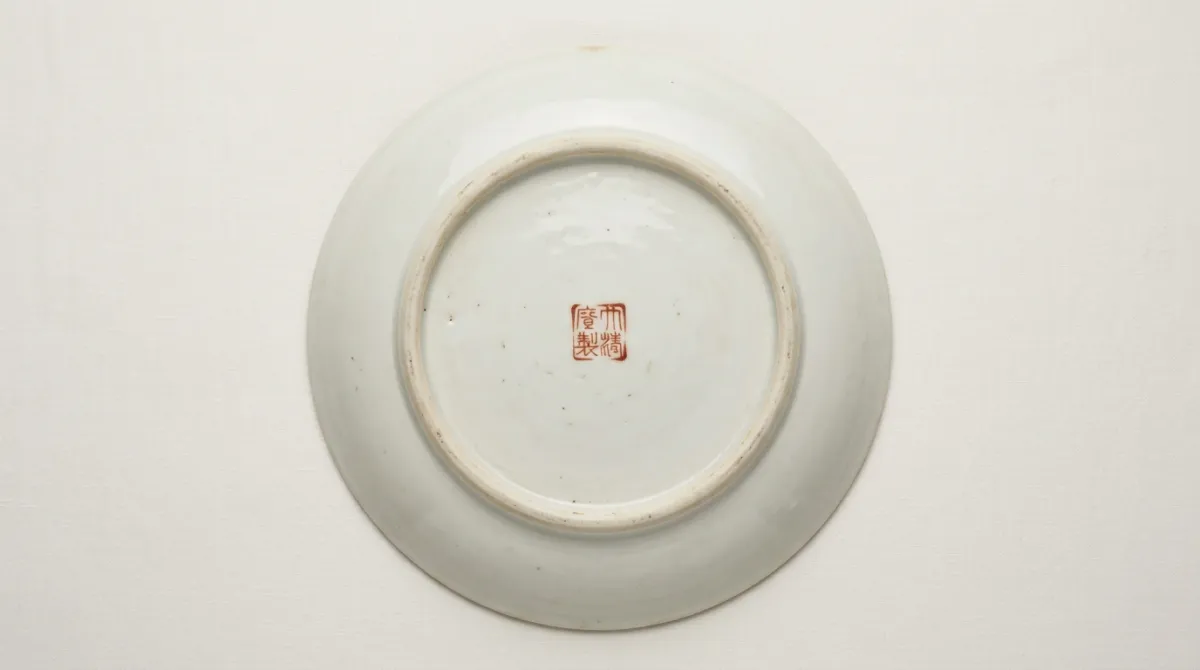
- Many Rose Medallion pieces left the kiln with no mark at all, and that’s normal, not a red flag.
- When a reign mark does appear, it’s frequently apocryphal, borrowed from an earlier, admired era rather than an honest date. See our marks and dating reference.
- A base marked simply “China” generally dates from 1891 onward, and “Made in China” from around 1919 onward, under US import labeling rules, though unmarked pieces can still predate or postdate that window.
- A mark only means something when it’s read alongside the body, glaze, enamels, and gilding wear, never on its own.
- Crisp, uniform printed marks and artificially “aged” seals are a common giveaway on later reproductions.
Kerry gets asked about marks more than almost anything else at the studio. People turn a plate over, spot a red or gold seal on the base, and assume they’ve found their answer. So can a mark actually tell you what you want to know? Not on its own, and that’s the piece of this puzzle most people get backward. If you haven’t already, our companion piece on how to identify Rose Medallion covers the body, enamel, and gilding clues that matter more than any mark.
Does Rose Medallion usually have a mark at all?
No, not necessarily, but a large proportion of Rose Medallion pieces you’ll encounter are unmarked, and that’s simply how a great deal of Canton export porcelain left China. Export wares made for the American and European decorative trade were rarely marked with a maker’s name, since the pattern and workshop, not an individual potter, carried the reputation.
That surprises new collectors, who often assume an old, valuable piece “should” carry some kind of stamp. In reality, unmarked bases are common enough on genuine 19th- and early-20th-century Rose Medallion that an unmarked plate tells you almost nothing either way about age or quality. In our experience, whether a mark shows up at all may reflect export-market or retailer paperwork requirements at the time, rather than the age or skill of the piece itself.
Kerry keeps a stack of unmarked studio samples on the shelf next to marked ones precisely to make this point to students: turn either one over, and the base alone won’t tell you which came first. You have to look elsewhere.
What types of marks actually turn up on Canton porcelain?
The marks you’ll see fall into a handful of recognizable groups: no mark, iron-red or gold seal marks, four- or six-character reign marks, and later export country-of-origin stamps. Each type carries a different, limited kind of information, and none of them work as a standalone dating tool. (Marks and dating reference, Rose Medallion)
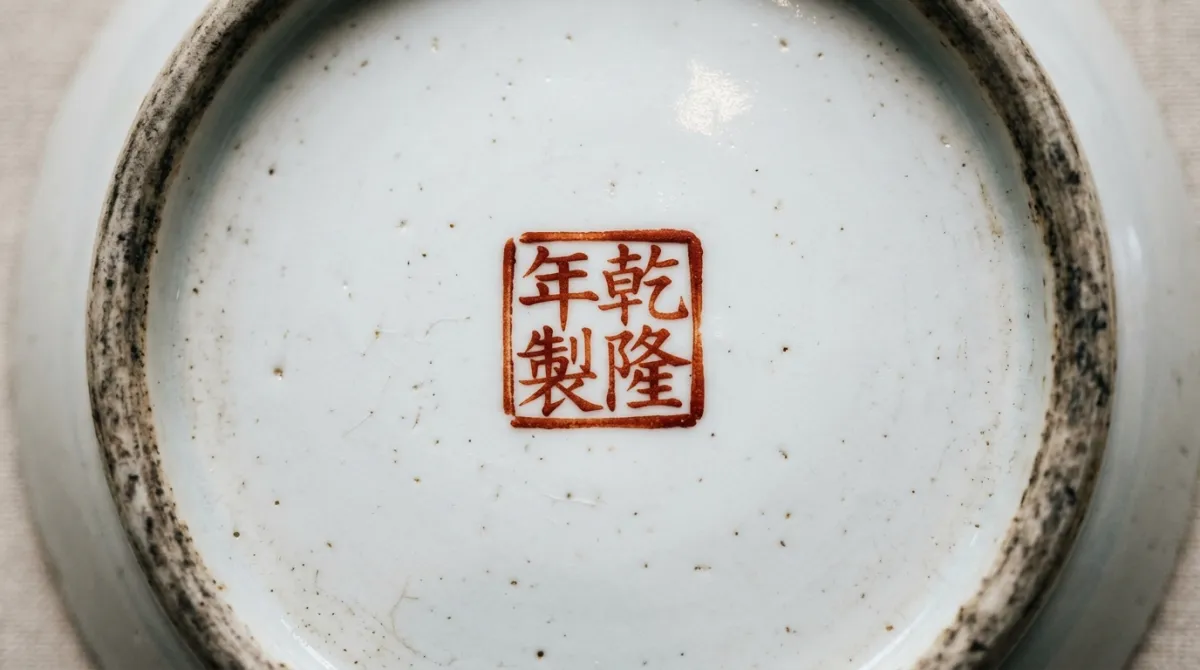
Iron-red or gilt seal marks are probably the most common decorative mark you’ll find, often a simple character or two rather than a full reign inscription. These tend to function more as a workshop flourish than a formal date claim, and they vary enormously in what they actually say.
Four- and six-character reign marks are the ones that get collectors excited, and understandably so, they read like Qianlong (乾隆), Jiaqing (嘉慶), or Guangxu (光緒). Reading these marks on genuine imperial porcelain is its own specialist topic, well beyond what we’ll cover here. On Canton export ware, though, the same-looking marks are usually apocryphal, which is the next thing worth understanding properly.
Later export marks, simple words like “China” or “Made in China,” are the plainest and, oddly, often the most reliable of the bunch for a rough date floor. More on that below.
Why don’t reign marks prove a piece is actually from that reign?
Reign marks on Canton export porcelain are frequently apocryphal, meaning a decorator added an earlier emperor’s mark as a nod of respect to a golden era rather than as an honest date. A piece bearing a Qianlong (1735-1796) mark might genuinely have been painted in the Guangxu period, a century or more later.
This wasn’t considered deceptive at the time. It was closer to a decorative convention, similar to how a modern furniture maker might reference a “Georgian style” without claiming the piece is actually 18th-century. Chinese workshops had used this practice for generations before Rose Medallion export ware existed, and it carried over into Canton production more or less as a matter of course.
I’ve watched Kerry field the same question from a first-time collector more times than I can count: “But it says Qianlong right here.” She’ll nod, turn the piece over in the light, and gently explain that the mark is honoring a reign, not reporting one. It’s rarely the answer people are hoping for, but it’s the honest one.
So what should you actually do with a reign mark once you’ve spotted one? Treat it as one soft data point among several, weighed alongside body weight, glaze tone, enamel texture, and gilding wear, never as the deciding factor by itself.
Does “China” or “Made in China” on the base actually tell me the age?
Somewhat, and this is one of the more useful mark-related clues, though it works best as a general dating floor, not standalone proof. Under the US McKinley Tariff Act of 1891, imported goods generally had to be marked with their country of origin, so a piece stamped simply “China” typically dates from 1891 onward.
<img src=“/images/blog/rose-medallion-marks-2.webp” alt=“A “MADE IN CHINA” stamp on the base of an export plate“ loading=“lazy” decoding=“async” width=“1200” height=“675” />
The distinction sharpens a bit further after 1919 or so, when US customs guidance began favoring the fuller phrase “Made in China” over the bare word “China,” so pieces carrying that longer wording generally date from around 1919 onward. This gives you a workable floor: if you see “Made in China” stamped or painted on the base, you’re very likely looking at 20th-century production, not an 18th- or early-19th-century piece.
Here’s the catch, though, and it’s an important one. Unmarked pieces are not automatically older. A piece might predate 1891 and never have needed a country-of-origin mark, or it might simply have shipped to a retailer without that stamp for reasons that had nothing to do with age. Absence of a “China” mark doesn’t push a piece backward in time; it just means this particular clue isn’t available to you. (Marks and dating reference, Rose Medallion)
How should you actually read a mark, in context?
A mark only becomes useful once you’ve already formed an impression from the body, glaze, enamels, and gilding, and you’re using it to narrow or test that impression rather than to set it. Treat the mark as the last thing you check, not the first. (Craft observation, Kerry Kwok, GoodTime Studio Macau)
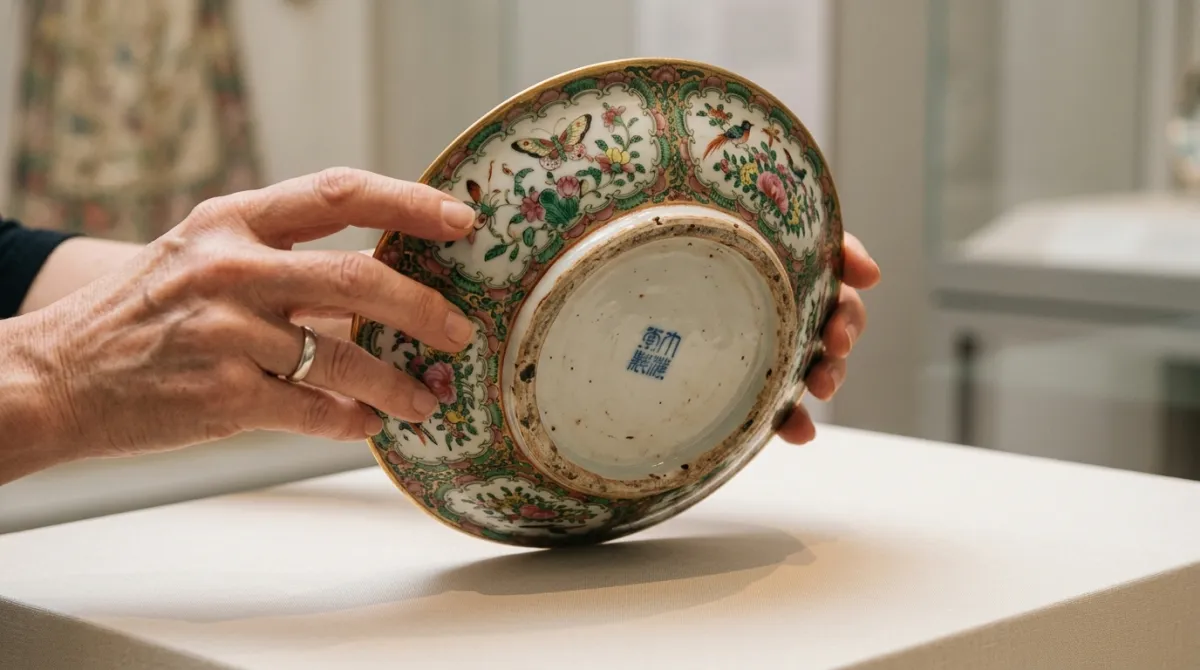
Start with weight and glaze tone, since older Canton bodies often feel a touch heavier for their size with a warm, faintly grey-white cast under the glaze. Then look at the enamels under raking light for the slight texture and pooling that hand-painting leaves behind. Only after that should you flip the piece over and read whatever’s on the base.
If the mark and the rest of the evidence agree, that’s reassuring, though still not proof. If they disagree, say a piece with sharp, mechanical gilding and a “Qianlong” mark, trust the body and surface over the mark every time. Our full marks and dating reference walks through each reign mark you’re likely to encounter and what it can and can’t tell you, and the Rose Medallion complete guide ties marks together with history, form, and care in one place.
What should make you suspicious of a mark?
A mark that’s too crisp, too uniform, or too obviously “aged” is worth a second look, since genuine old marks tend to show the same handmade irregularity as the rest of the painting. Machine-printed or stenciled marks read as flat and mechanically identical from piece to piece. (Marks and dating reference, Rose Medallion)
Hand-applied iron-red or gilt marks, even simple ones, usually show small variations in stroke width and slight unevenness in the enamel, the same brushwork tells you’d look for elsewhere on the piece. A mark that looks laser-precise, with perfectly even line weight and zero variation, is a reasonable flag for later production or a printed transfer.
Deliberately “aged” marks are another red flag Kerry watches for, marks that have been scuffed, chemically darkened, or partially rubbed to simulate decades of wear. These tend to look patchy in the wrong places, worn where a mark wouldn’t naturally see handling, rather than concentrated where a base actually touches shelving and tabletops over time.
None of these tells are absolute on their own, which is worth repeating one more time. A slightly irregular mark isn’t proof of age, and a crisp one isn’t proof of a fake. They’re one more thread in a much larger picture, the same picture our guide on how to identify Rose Medallion walks through in more depth.
Frequently asked questions
Does Rose Medallion have a maker’s mark?
Rarely. A large proportion of Canton export Rose Medallion left the kiln unmarked, since the pattern and export trade carried the reputation rather than an individual potter’s name. When a mark does appear, it’s usually a seal or reign mark, not a maker’s signature in the Western sense.
What does a red or gold seal on the bottom mean?
It usually indicates a workshop flourish or a decorative reign reference rather than a literal maker’s signature or honest date. Iron-red and gilt seals vary widely in what they actually convey, so treat one as a minor supporting detail, not conclusive evidence on its own.
Does “China” or “Made in China” on the base tell me the age?
Yes, to a useful degree. Under the 1891 US McKinley Tariff Act, imports generally needed a country-of-origin mark, so “China” typically points to 1891 or later, and “Made in China” typically points to around 1919 or later. Unmarked pieces simply lack this particular clue.
Is unmarked Rose Medallion older or more valuable?
Not necessarily either. Unmarked bases are extremely common on genuine antique export ware, since marking wasn’t standard practice for most of Canton porcelain’s production history. Judge age and value from the body, enamels, and gilding wear, not from the presence or absence of a mark.
Can a reign mark be trusted to date the piece?
Generally, no. Reign marks on Canton export porcelain are frequently apocryphal, added to honor an earlier, admired era rather than to report an honest production date. Use a reign mark as one soft supporting clue, weighed alongside everything else, never as standalone proof.
Marks can add color to a piece’s story, but they’re rarely the whole story, and sometimes they’re barely part of it at all. The body, the enamels, the gilding wear, that’s where the real evidence lives, and our Rose Medallion complete guide is a good next stop for pulling all of it together. If you’ve got a piece you’re trying to place and want a second opinion, reach out through our commissions page; we’re happy to take a look.
Keep exploring
More from Rose Medallion
Identification, history, and care guides for Rose Medallion and Canton porcelain. New guides added regularly.
Explore all guides