identify value
How to Identify Rose Medallion (Antique vs Reproduction)
Key Takeaways
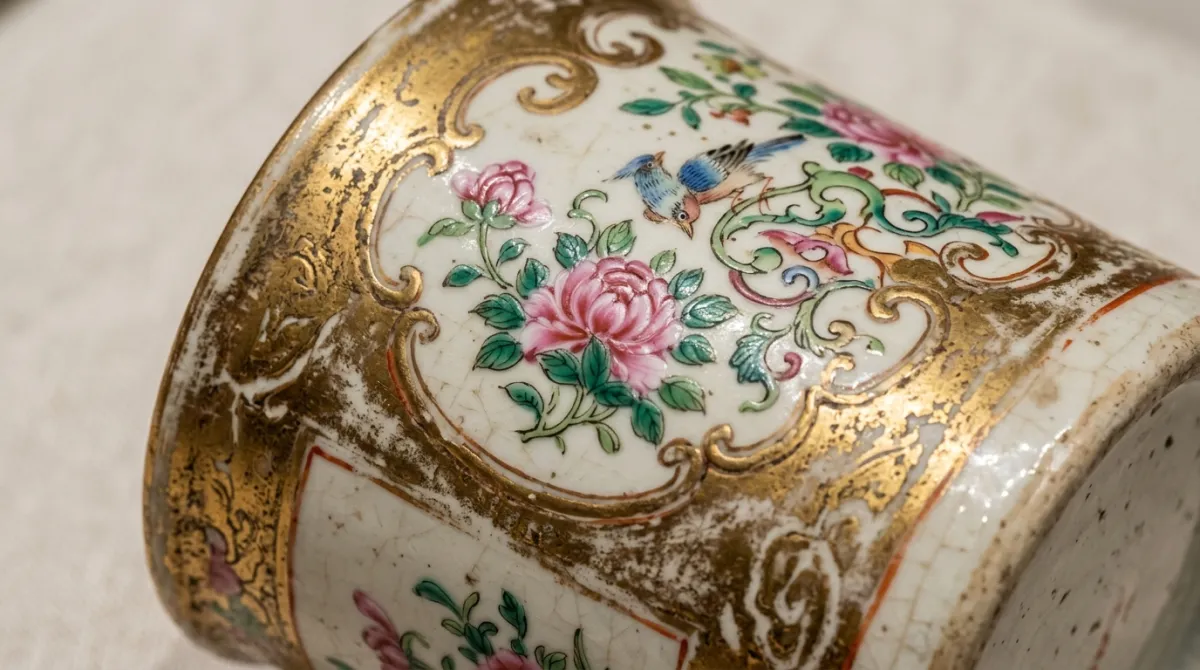
- Hand-painted enamels sit slightly proud of the glaze and show tiny brush ridges; printed or transfer decoration lies flat and looks too even under a loupe.
- Worn, honey-toned gilding on the rim and handles is a stronger age clue than the pattern itself, since Rose Medallion has been painted continuously since the 19th century.
- A reign mark on Canton export ware proves almost nothing on its own, many are apocryphal, added generations after the reign they name. See our marks and dating reference.
- Weight, foot-rim wear, and glaze character (a soft, faintly grey-white body vs. a chalky, too-bright modern one) are worth reading together with everything else, a fuller picture than any single mark, though each clue has its exceptions.
- Value tracks painting quality, condition, size, and rarity of form, not just the presence of an “antique” label.
I’ve spent enough afternoons at Kerry’s workbench watching her load a brush with rouge d’or to know that identifying old Rose Medallion is less about spotting a mark and more about reading a whole object at once. So where do you actually start, if not with the mark? Kerry Kwok trained under the Macau Canton-porcelain master Lei Iat Po and now hand-paints every custom order at GoodTime Studio Macau. When a piece comes across her table, she doesn’t reach for a mark first. She picks it up, feels the weight, tilts it to the light, and only then turns it over. That order matters, and it’s the order we’ll follow here.
What should you check first: the body or the marks?
Check the body before the marks, because the porcelain itself can offer clues, though none of them work alone. Older Canton bodies often feel slightly heavier for their size and show a warm, faintly grey-white tone under the glaze, while many 20th-century reproductions lean toward a whiter, more uniform paste, but the overlap between periods is wide enough that this is a soft clue, not a standalone test. (Marks and dating reference, Rose Medallion)
Turn the piece over before anything else. Run a fingertip around the foot rim, the unglazed ring where the piece touched the kiln shelf and, later, decades of tabletops. On a genuinely old plate or vase, that rim often shows soft, rounded wear and small chips or nicks that have themselves gone smooth with handling; occasionally you’ll also spot a faint brown residue people call “kiln grit,” though it’s not something I’d lean on by itself as an age test. A reproduction’s foot rim tends to be sharp-edged, uniformly sanded, or artificially “distressed” with scratches that all run the same direction, which is a giveaway once you’ve seen it a few times, though it’s still just one clue among several.
Hold the piece and gauge the weight against its size. This is a feel you build with handling, not something you can read off a chart, but older Canton porcelain generally isn’t as light or as thin-walled as some later export copies made to a lower cost. Kerry’s rule of thumb in the studio: if a piece feels suspiciously light for its size and the glaze has a slightly plasticky sheen, look twice before trusting the rest of the story it’s telling you.
How do you tell hand-painted enamels from printed decoration?
Look at the enamel surface under raking light or a jeweler’s loupe. Hand-applied famille-rose enamels sit slightly proud of the glaze, with visible brush direction, tiny pooling at the edges of each stroke, and small variations from one flower or figure to the next. Transfer-printed or airbrushed decoration lies dead flat and repeats with mechanical precision.
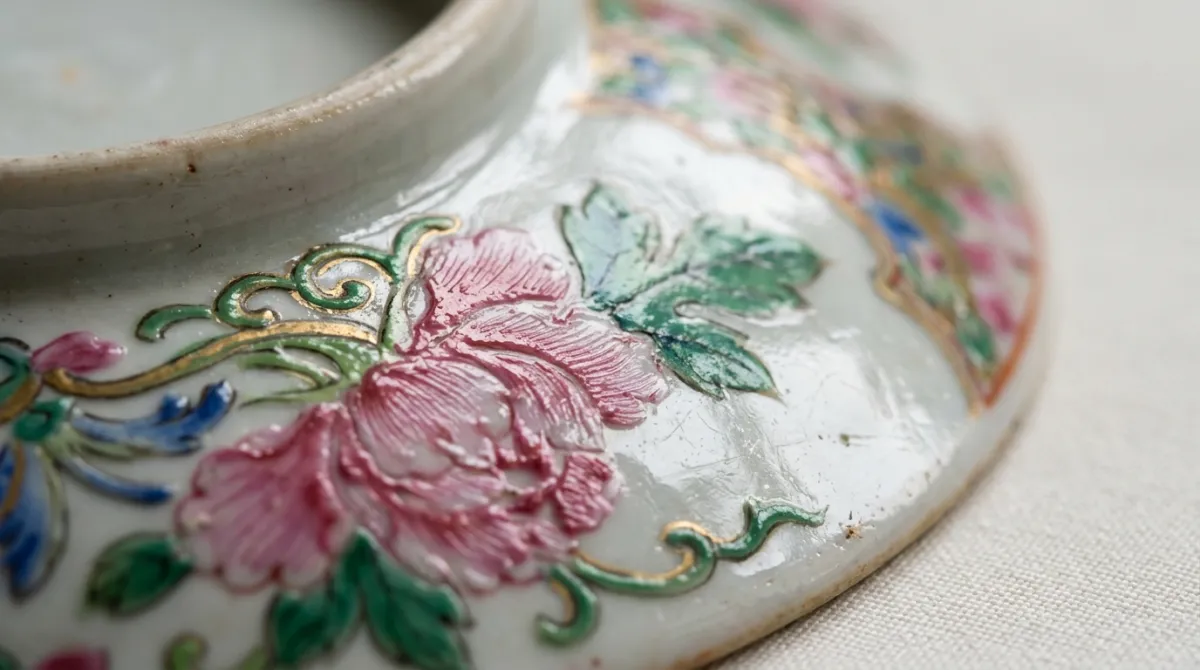
Tilt the piece so light rakes across a painted reserve, one of the panels showing court figures, birds, or peonies. On genuine hand-painted work you’ll see faint texture: a brushstroke that thickens at the start and tapers at the end, a petal where the pink deepens unevenly because the enamel pooled slightly before firing. Kerry has me do this with new students constantly. Most people miss it the first time, because we’re trained to look at the picture, not the paint.
Compare two “identical” figures on the same piece, or across a supposed pair. On old, hand-painted Rose Medallion, no two faces are ever quite the same; a court lady’s sleeve might curl slightly differently from one panel to the next because a human hand painted it, freehand, from memory and training rather than tracing a template. Uncanny sameness across every reserve is a strong signal you’re looking at a printed or transfer-decorated piece, however good the color looks from across the room.
Check the underglaze blue accents too, if the piece has any. On antique Canton ware, underglaze blue was painted before the final glaze firing and sits under a slightly soft, glassy layer. If it looks like it’s floating on top of the glaze instead, something’s off. For a refresher on what actually defines the pattern before you judge it, see what is Rose Medallion porcelain.
What does honest gilding wear actually look like?
Genuine antique gilding often wears unevenly and softens toward a warm, honey-brown tone where hands and cloths have touched it for a century or more. That said, a piece that saw little handling can keep bright gilding for well over a hundred years, and later wares were sometimes hand-gilded too, so wear pattern is a useful clue rather than a reliable, standalone test. (Craft observation, Kerry Kwok, GoodTime Studio Macau)
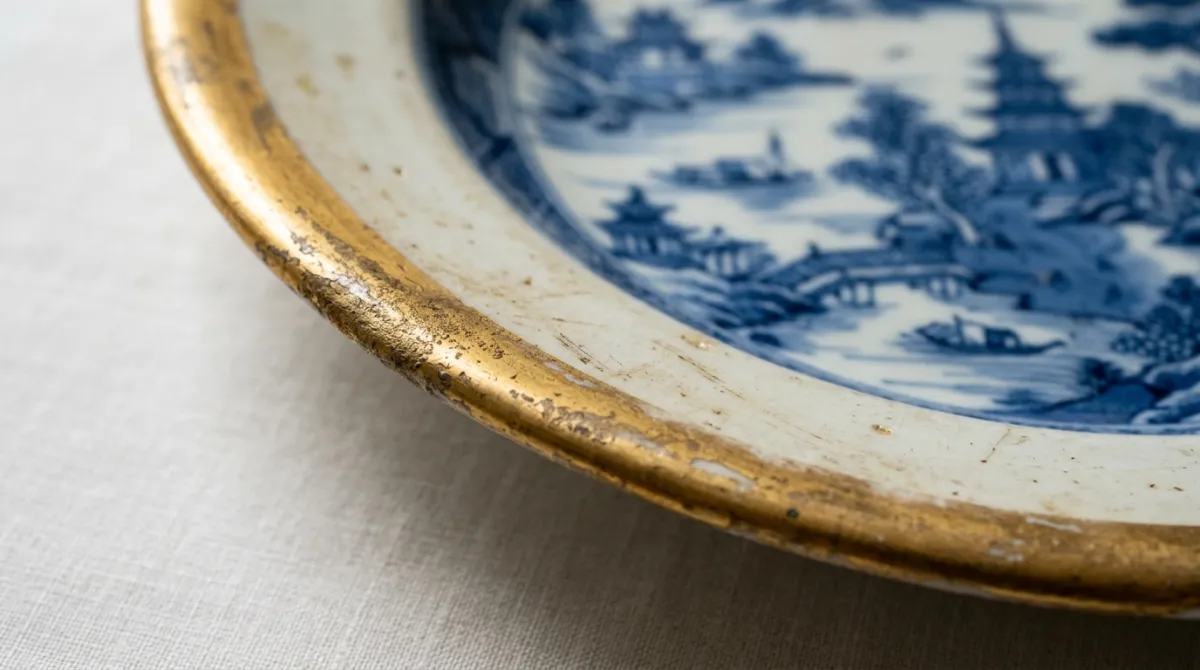
Gold on Rose Medallion has generally been applied as a low-fired overglaze preparation, with polishing and burnishing practices that varied by workshop and era. Where a piece did see real, ongoing use, that handling can leave gilding noticeably thinner along handles, rims, and any high point that got wiped or gripped repeatedly. On a well-worn example you may be able to trace where a thumb rested against a teacup handle for decades, with the gold there nearly gone while gold tucked into a low-relief groove nearby stays fuller, but plenty of genuinely old pieces simply weren’t used enough to show this.
Reproduction gilding often reads as suspiciously consistent: full coverage, bright and slightly orange or yellow rather than warm gold, with little of that selective thinning. Modern gold preparations and firing techniques can produce a very even, glossy finish, though it’s worth remembering that some later reproductions were also gilded and burnished by hand, so a bright, even rim isn’t automatic proof of a modern date. In our experience, honest wear is a genuinely useful clue and often harder to fake convincingly than people expect, but it still needs to be read alongside the body, enamels, and everything else, never on its own.
Watch for gilding that’s been “distressed” deliberately, too. Occasionally you’ll see scattered rubbing on an otherwise pristine, bright piece, an attempt to simulate age. It tends to look patchy and random rather than concentrated on the areas that would actually see handling, like handles, rims, and high points of relief decoration.
Why don’t reign marks prove a piece is old?
Reign marks on Canton export porcelain are frequently apocryphal, meaning they name an earlier emperor’s reign as a mark of respect or style rather than an honest date. A Guangxu-period (光緒, 1875-1908) piece might carry a Qianlong mark, so the mark alone tells you almost nothing about actual age. (Marks and dating reference, Rose Medallion)
This isn’t a rare quirk, it’s close to standard practice for a lot of Canton export ware, and it trips up new collectors constantly. Chinese potters and decorators had a long tradition of marking pieces with the reign name of an admired earlier era as homage, or simply because that mark style had become a decorative convention rather than a literal date claim. So a six-character mark reading “Made in the Qianlong reign” says nothing certain about when the piece left the kiln; it could be contemporary with that reign, or it could be a century or two later.
Plenty of genuine 19th- and early-20th-century Rose Medallion carries no mark at all, and that’s normal too, not a red flag by itself. Absence of a mark doesn’t mean absence of age, and presence of a famous reign mark doesn’t guarantee it either. If you want a fuller reference on script styles and rough date ranges, our marks and dating reference walks through what each mark type can and can’t tell you.
What marks are actually useful for is narrowing a range once you’ve already formed an opinion from the body, enamels, and gilding. Use the mark as a supporting data point, never as the sole piece of evidence. I’ve seen collectors talk themselves into an “1860s” attribution purely because of a Kangxi mark, then feel genuinely thrown when the wear pattern and enamel style pointed to something forty years later. Don’t let the mark write the story for you.
How do modern reproductions differ from antique pieces?
Modern reproductions, including documented 20th-century Western reproduction houses such as Mottahedeh, are typically made with whiter, more uniform bodies, brighter and more even gilding, and enamel work that’s competent but noticeably more mechanical than hand-painted antique panels. They’re honest reproductions when sold as such, but they’re regularly mistaken for antique when resold later.
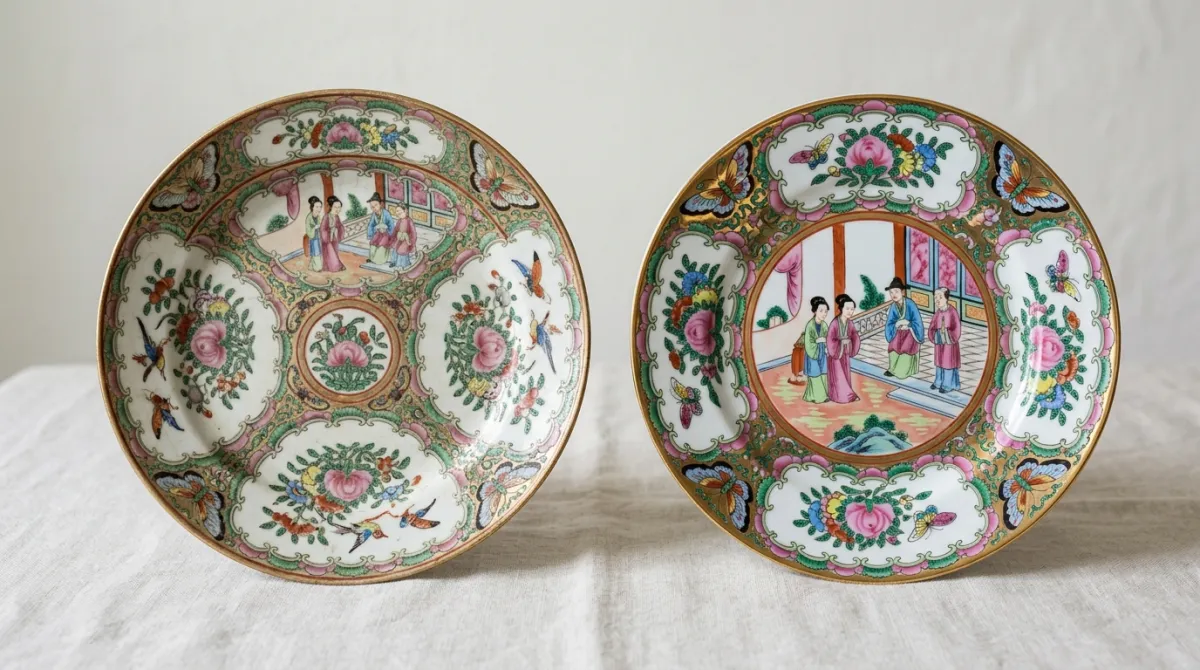
Mottahedeh and similar firms produced Rose Medallion and related Canton-style patterns for the American decorative trade, aiming for a familiar look at accessible prices rather than deceiving anyone. Pieces from these runs often carry a maker’s backstamp rather than a Chinese reign mark, which is actually helpful; if you see a clear Western trademark on the base, you’re looking at a documented reproduction, not an antique.
Where things get trickier is with pieces that have had backstamps ground off, or later production runs made specifically to mimic antique appearance more closely, sometimes with an applied (fake) reign mark and artificially distressed gilding. This is exactly why body weight, foot-rim wear, and enamel texture matter more than any single “tell.” A convincing fake mark is easy. Convincing decades of honest handling wear is much harder to fake well, and that’s where careful handling under good light pays off.
Kerry keeps a small shelf of known reproduction pieces in the studio specifically for teaching, because comparing a genuine antique reserve against a printed or later-painted one side by side, under the same light, teaches the eye faster than any written description can. If you can get your hands on even one confirmed reproduction to compare against, do it.
What actually drives the value of a Rose Medallion piece?
In Kerry’s experience and mine, value tends to track painting quality, condition, size and form, genuine age, and rarity, though dealers can and do weigh these differently, and this is general market sense rather than a fixed formula. A large, finely painted, undamaged punch bowl in an unusual form will often outvalue a small, chipped plate even if the plate is somewhat older. (Market observation, Rose Medallion)
Painting quality is the biggest lever. Finer, more detailed reserves with confident brushwork, good color saturation, and well-drawn faces command a real premium over crude or hastily painted examples from the same rough period. This is where Kerry’s trained eye becomes genuinely useful to a buyer: two pieces can be roughly the same age and still differ enormously in desirability because one was painted by a more skilled hand.
Condition matters more than most new collectors expect. Hairline cracks, chips (even small ones ground smooth and disguised), and enamel loss all reduce value substantially, sometimes by more than half compared to a comparable piece in excellent condition. Restoration, even skilled restoration, generally reduces value versus an untouched piece, though a well-restored rare form can still be worth owning.
Size and form matter too. Large platters, punch bowls, garden seats, and unusual forms (tureens, vases in matched pairs, large chargers) tend to be scarcer and more sought after than the small plates and teacups that survive in far greater numbers. Genuine age adds value on top of all this, but only once quality and condition are established; an unremarkable, damaged 19th-century plate isn’t automatically worth more than a beautifully painted, undamaged early-20th-century one.
Want the fuller picture on what defines the pattern before you start hunting for value clues? Our Rose Medallion complete guide ties identification, history, and care together in one place. And once you’ve narrowed down what you have, our guide on cleaning and displaying antique Rose Medallion covers how to care for it without damaging the very features, the gilding and enamels, that establish its age and value.
Frequently asked questions
How can I tell if my Rose Medallion is old?
Look for hand-painted brushwork sitting slightly proud of the surface, worn honey-toned gilding, and honest glaze wear on the foot rim. Together these tell you more than a reign mark ever will, since marks on Canton export ware are frequently apocryphal or absent altogether.
Does a Qianlong or Kangxi mark mean my piece is that old?
Not necessarily. Reign marks on Canton export porcelain were often applied generations later as a mark of respect for an earlier era, a practice so common it’s close to standard on this ware. Judge age from the body, enamels, and wear first, and treat the mark as supporting evidence only.
Is Mottahedeh Rose Medallion an antique?
No, Mottahedeh produced Rose Medallion and related Canton-style patterns for the 20th-century decorative market, and honestly marked pieces carry a Western backstamp rather than a Chinese reign mark. They’re well-made reproductions, collectible in their own right, but not antique Canton export porcelain.
Why doesn’t the pattern itself prove age?
Because Rose Medallion has been painted more or less continuously since the 19th century, right through to pieces made today. The same reserves of figures, birds, and peonies appear on genuinely antique porcelain and on recent hand-painted or printed reproductions alike, so the pattern alone can’t separate one from the other.
What single feature is the hardest to fake convincingly?
Honest gilding wear is, in our experience, one of the harder things to fake well. It takes decades of real handling to thin gold unevenly across handles, rims, and high points in a way that looks natural rather than deliberately distressed, but it’s still just one clue among several, never proof on its own.
If you’re trying to place an unfamiliar piece and want a second pair of eyes, get in touch through our commissions page; we’re happy to take a look and talk through what we see.
Keep exploring
More from Rose Medallion
Identification, history, and care guides for Rose Medallion and Canton porcelain. New guides added regularly.
Explore all guides