history origin
What Is Rose Medallion Porcelain? A Beginner's Guide
Key Takeaways
- Rose Medallion is Chinese export porcelain, hand-painted in Canton (Guangzhou) using famille-rose enamels, not a factory or a single dynasty’s product.
- The name describes a layout, alternating painted “reserves” of figures and florals, rather than one fixed design, colour, or maker.
- Rose-pink enamels, gilding, and the four-reserve panel structure are the pattern’s fingerprints; the body was often made in Jingdezhen and shipped white to Canton for decoration.
- It has been produced for well over a century, so dating a piece depends on the body, the enamels, and honest wear, not the pattern alone.
- See our full illustrated guide to Rose Medallion for a deeper walk-through of every element.
What exactly is Rose Medallion porcelain?
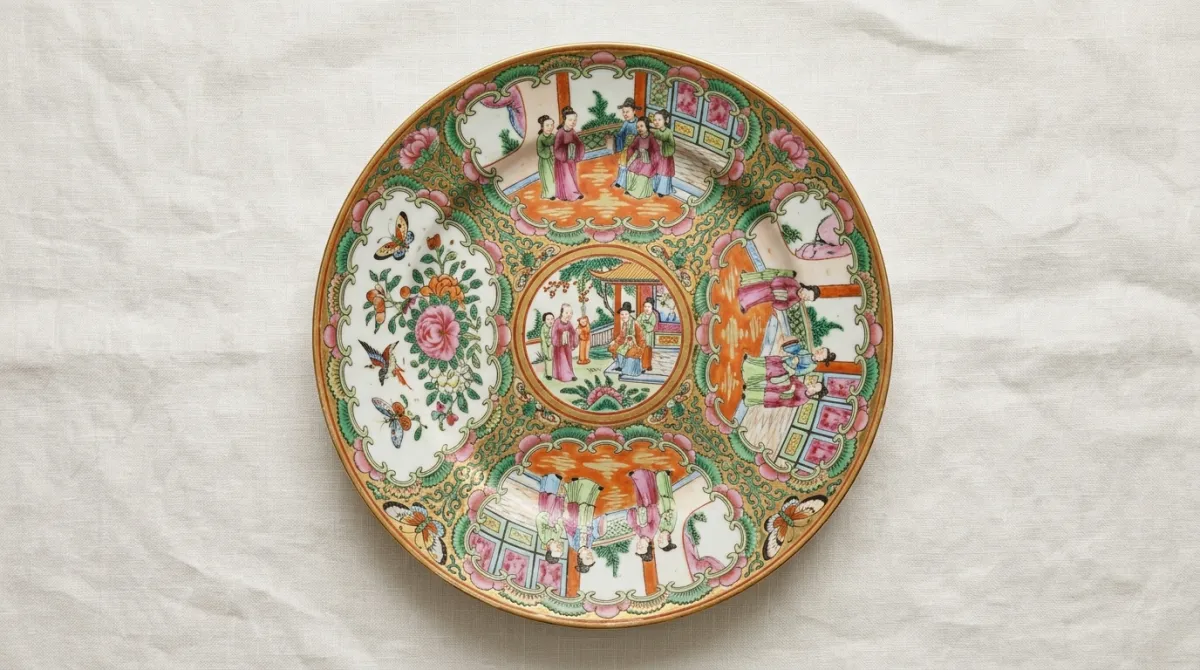
Rose Medallion is Chinese export porcelain painted by hand in Canton with alternating panels of court figures and panels of birds, butterflies, and peonies, all outlined in gold. It belongs to the broader famille-rose family of overglaze enamels, prized for its rose-pink tones and dense, colourful surface.
The name itself isn’t Chinese. Collectors and dealers in the West coined it as a trade term, though exactly when and where it first caught on isn’t firmly documented. What’s clear is that it describes a specific arrangement of decoration rather than a single factory mark or dynasty, and that distinction trips up a lot of new collectors.
What actually makes a piece Rose Medallion is the layout: four (occasionally more) reserves, or framed panels, arranged around the body of a plate, bowl, or vase. Two opposite reserves usually hold robed figures in a garden or courtyard scene. The other two hold birds perched among peonies, chrysanthemums, or butterflies. Between the reserves, the background is packed with gilt scrollwork, florals, and sometimes small vignettes, often leaving little white porcelain exposed on more heavily decorated pieces.
Is Rose Medallion a pattern name or a type of porcelain?
It’s both, in practice. Rose Medallion names a decorative scheme (the alternating figure and floral reserves) that was applied to many different porcelain shapes over a long production span. Think of it less like a single product and more like a recognisable house style, painted by hand, generation after generation, with real variation underneath the shared formula.
Where does the name “Rose Medallion” come from?
“Rose Medallion” is a Western trade term, not a Chinese one, and it entered common use through the American and European antiques market. Chinese porcelain painters and workshops never called it that; they simply knew it as one export pattern among many produced for foreign buyers.
The “rose” points to the dominant pink enamel, and the chemistry behind it is more complicated than a single dye: it traces back to gold-based pink and purple enamel technology, often linked to the “Purple of Cassius” process and to enamelling know-how that reached Canton through European trade contacts. The “medallion” likely nods to the rounded, framed reserves, since a central medallion surrounded by panelled reserves is the pattern’s typical layout, though no one can pin down exactly when a dealer settled on that word. Either way, the name describes a look you can recognise on sight, rather than any factory, region, or era.
This matters for buyers because the name alone tells you nothing about age. A plate made in the 1880s and a plate made last decade can both correctly be called Rose Medallion, since the term only describes the design layout. In our experience at the studio, Kerry Kwok, the Canton-porcelain (廣彩) painter behind our work, fields this question often: visitors regularly assume “Rose Medallion” is itself a maker’s mark. It isn’t, and that single misunderstanding accounts for a lot of overpaying at flea markets and online auctions.
Why did Western collectors need a separate name at all?
Chinese export porcelain arrived in the West with no consistent English labelling, so dealers invented working names for the patterns they saw most often. Rose Medallion, Rose Canton, and Mandarin all emerged this way, three related but distinct layouts that get confused constantly. We cover the differences in detail in Rose Medallion vs Rose Canton vs Mandarin, but the short version is that Rose Medallion is the one with both figures and florals sharing the surface.
What do the figures and flowers on Rose Medallion actually depict?
The figure reserves typically show robed court or garden scenes: women in flowing dress, children at play, or scholars in a pavilion setting, rendered in fine linework and layered enamel. The floral reserves pair birds, most often long-tailed pheasants or small songbirds, with peonies, chrysanthemums, or butterflies, all classic symbols of prosperity and long life in Chinese decorative art.
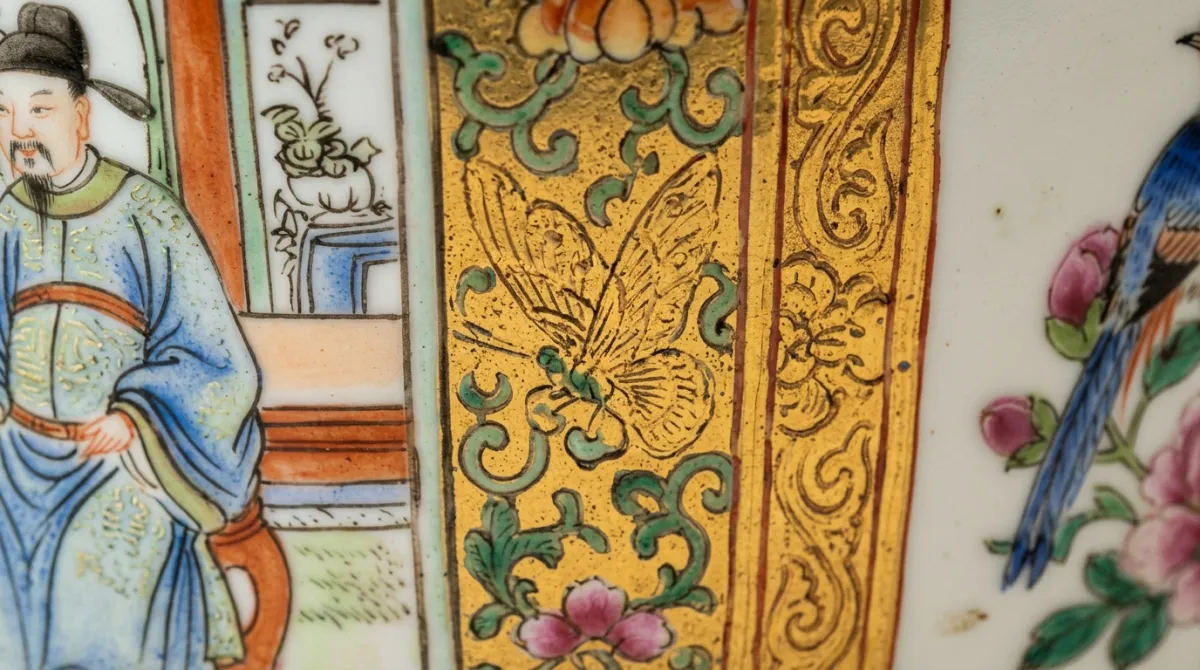
These aren’t random illustrations. Canton workshops drew from a shared repertoire of auspicious imagery that had been used on export porcelain for generations, adapted slightly by each painter’s hand and each workshop’s habits. A skilled eye can often place a piece within a rough production window just from how loosely or tightly the figures are rendered and how much shading sits inside the robes, one of several checks covered in how to identify Rose Medallion.
Why do the panels alternate rather than cover the whole surface?
Alternating reserves let painters showcase two decorative themes on one object without the surface feeling cluttered or repetitive. Court scenes and floral panels sit in their own gilt-framed compartments, so the eye can read each image clearly instead of losing it in a solid wash of pattern.
This framing device also solved a practical studio problem: figures require far more painting time and skill than repeating floral motifs. By reserving figures for two panels and filling the rest with florals and scrollwork, a workshop could balance labour cost against visual impact, something Canton studios understood well as export volume grew through the 19th century.
How were the rose-pink enamels and gilding applied?
Famille-rose enamels are opaque overglaze colours, led by a rose-pink enamel whose formulation draws on gold-based pink and purple pigment technology, that were painted onto an already-glazed and fired porcelain body, then fixed with a second, lower-temperature firing. This two-stage process is what lets the pink sit thick and slightly raised, distinct from the underglaze blue seen on earlier export wares.
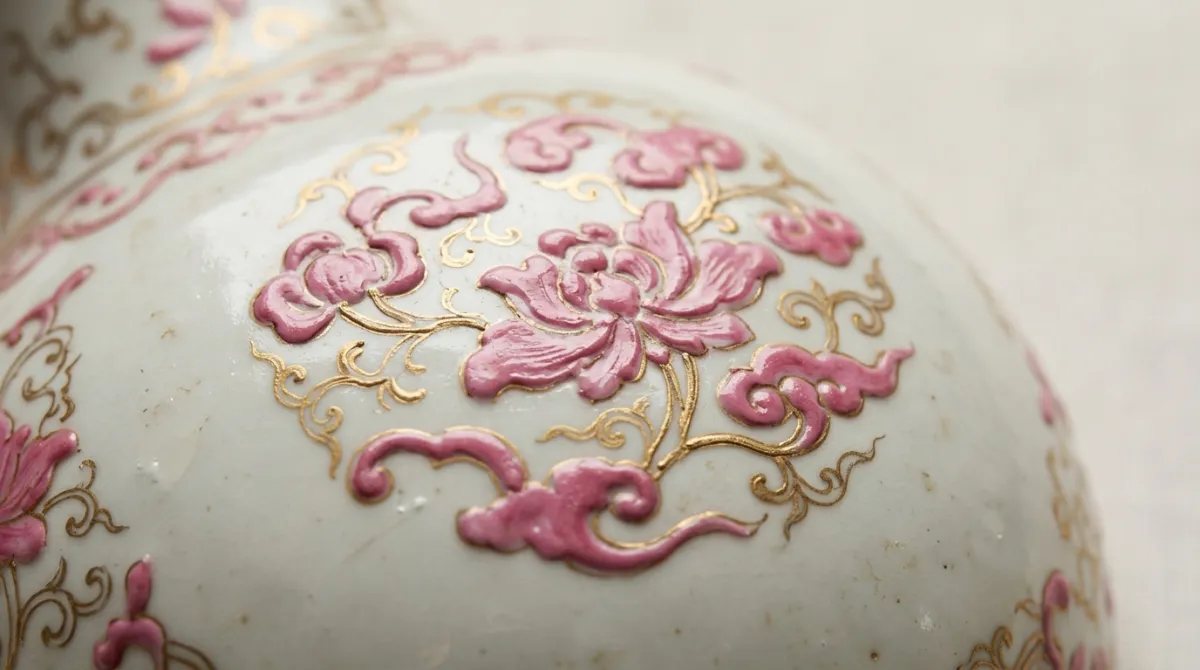
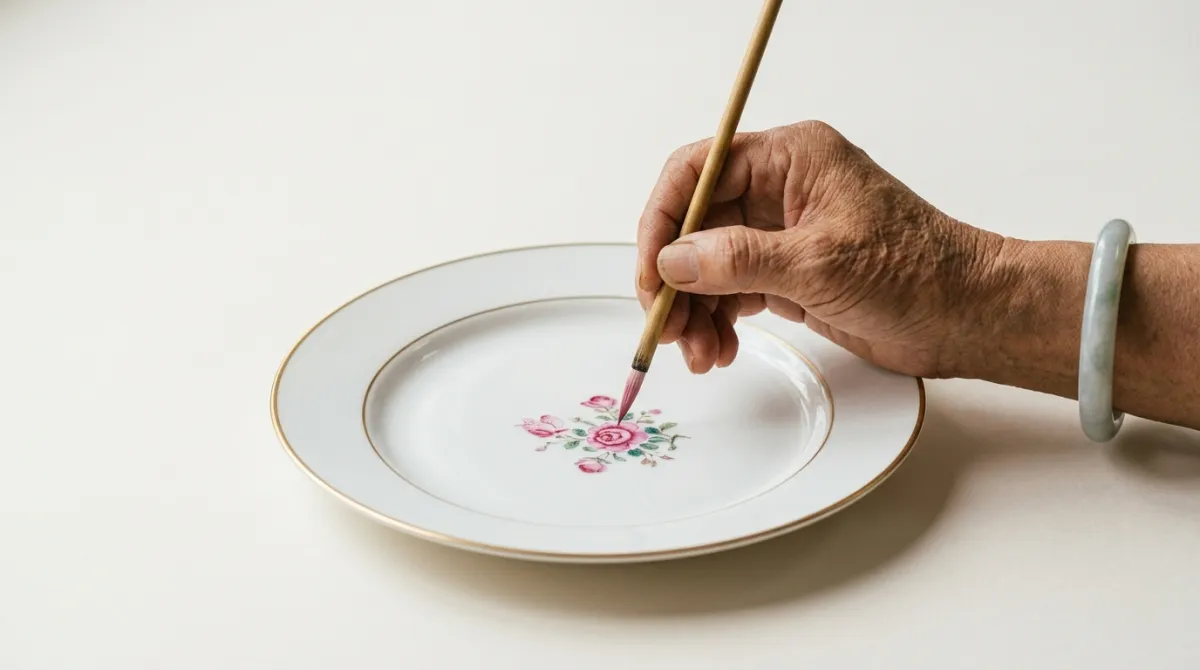
What surprises most first-time visitors to Kerry’s studio isn’t the colour palette, it’s the order of operations. The porcelain arrives already glassy and finished from the kiln. Every figure, feather, and petal is painted directly onto that hard, slippery glaze surface with a brush, entirely by hand, before the piece goes back into a smaller kiln for a gentler second firing that locks the enamels in place without melting the glaze underneath.
Gilding, the gold outlining and scrollwork that frames each reserve, is applied in the same overglaze stage, often as one of the final steps. On older, well-used pieces, that gold wears thin at the rim and high points first, since it sits on top of the surface rather than fused into it. That wear pattern, not the design itself, is one of the more reliable clues to a piece’s real age and handling history. Our marks and dating reference walks through backstamps and base characteristics alongside enamel wear, for anyone building out a fuller picture.
Does hand-painting mean every piece is one-of-a-kind?
Not exactly, since painters worked from shared patterns and repeated motifs across many pieces for a consistent export line. But hand-painting does mean genuine variation exists: brushstroke pressure, enamel thickness, and small compositional choices differ piece to piece, even within the same workshop and the same year.
Where was Rose Medallion actually made?
Rose Medallion porcelain was decorated in Canton (Guangzhou), but the white porcelain body itself usually travelled there from kilns further inland, most notably Jingdezhen, China’s long-standing centre of porcelain production. Canton workshops specialised in the overglaze enamel painting, not the clay body or the glaze firing.
This division of labour is central to understanding “Canton export porcelain” as a category. Jingdezhen produced the plain white body and the glaze; Canton painters, working closer to the port and to foreign merchants, added the famille-rose decoration that buyers in Europe and America actually wanted. It’s a supply chain that stretched hundreds of miles inland before a single plate ever reached a ship, and one of the reasons Rose Medallion reads differently from the closely related patterns covered in Rose Medallion vs Rose Canton vs Mandarin.
Why Canton specifically, and not Jingdezhen, for the painting?
Canton sat at the centre of China’s export trade with the West for a long stretch of the 18th and 19th centuries, giving workshops there direct access to foreign merchants, shipping routes, and buyer preferences. Painting the porcelain close to port let studios respond quickly to demand, adjust motifs for Western taste, and ship finished pieces without an extra inland leg of transport.
When was Rose Medallion made, and can you date it from the pattern alone?
You can’t reliably date Rose Medallion from the pattern alone, because the design has been produced continuously from the 19th century into the present. Dating instead comes from the porcelain body, the enamel texture and thickness, the gilding wear, and the base or backstamp, evaluated together rather than any single feature.
Rose Medallion saw its strongest export period in the 19th century, as American and European demand for Chinese decorative porcelain grew alongside broader trade with Canton. But the pattern never really stopped being made; later 19th-century, early 20th-century, and even contemporary workshops have all produced pieces in the same layout, sometimes to a very high standard and sometimes not.
That continuity is exactly why age claims based purely on “it’s Rose Medallion, so it must be antique” don’t hold up. In our studio’s experience, when collectors bring pieces to Kerry for repair or appraisal, a handful of features tend to come up again and again as genuinely diagnostic: glaze wear on the foot rim from decades of stacking and handling, enamel that sits proud of the surface rather than flush, and gilding worn thin only where a hand or a cloth would naturally touch it. None of that shows up in a photo of the pattern; it shows up in the object itself.
Should a newer piece be dismissed as “not real” Rose Medallion?
No, not if it’s genuinely hand-painted in the traditional Canton style with proper famille-rose enamels and gilding. A well-made contemporary piece follows the same techniques as its 19th-century predecessors; it’s simply younger, and honest sellers should describe it that way rather than implying an age the object can’t support.
Frequently asked questions
Is Rose Medallion Chinese or Japanese?
Rose Medallion is Chinese, painted in Canton (Guangzhou) specifically for export to Western markets, mostly the United States and Europe. Japanese export porcelain exists in its own related styles, but it uses different motifs, colour balance, and base marks, so the two shouldn’t be confused.
Is all Rose Medallion antique?
No. Rose Medallion has been made continuously from the 19th century through today, so a piece’s age has to be judged from its body, enamels, gilding, and wear rather than from the pattern alone. See how to identify Rose Medallion for the specific features to check.
What’s the difference between Rose Medallion and Rose Canton?
Rose Medallion includes both figure panels and floral panels in its alternating reserves, while Rose Canton drops the figures entirely and uses florals throughout. They share the same rose-pink enamel palette and gilt scrollwork, which is exactly why the two names get mixed up so often.
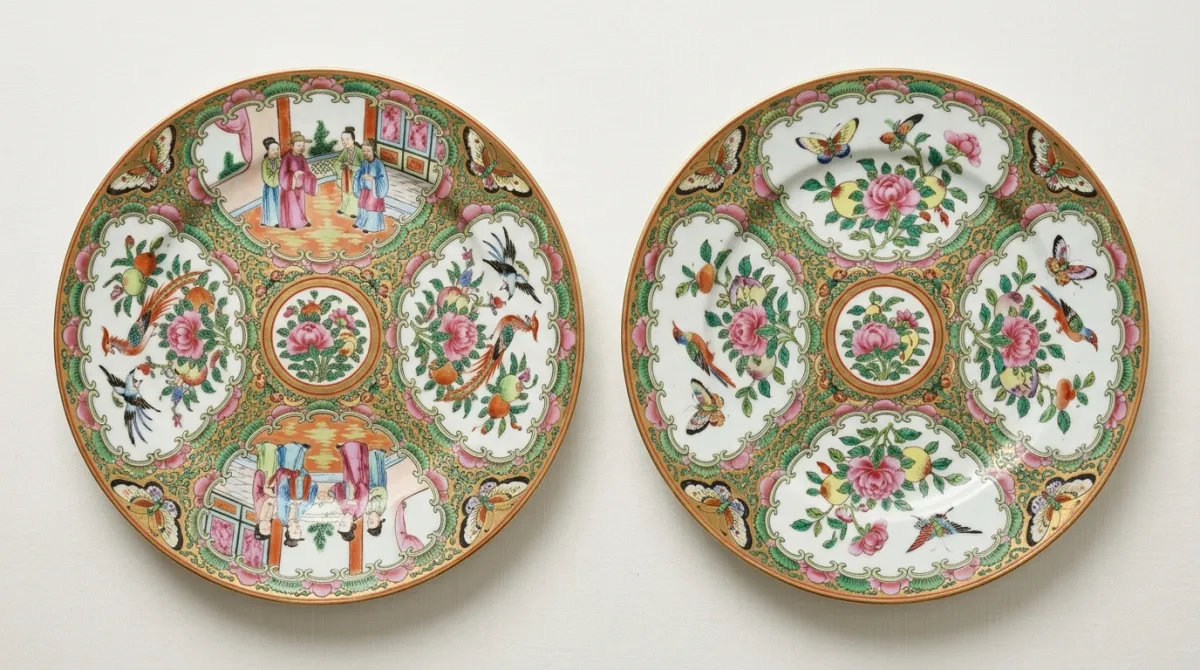
Why is Rose Medallion porcelain so heavily decorated, with almost no plain white space?
Canton export buyers in the 19th century favoured dense, richly coloured surfaces, and painters responded by filling nearly every available area with reserves, gilt scrollwork, and small floral fillers. This “busy” aesthetic became a signature of the style rather than an accident, though some earlier export wares, like late Ming kraak blue-and-white, could be just as densely patterned in their own way.
Does a Rose Medallion mark on the base guarantee authenticity?
Not on its own. Many Rose Medallion pieces, especially older ones, carry no factory mark at all, and marks have also been copied or applied to later reproductions. A mark is one data point among several; the body, glaze, enamel application, and wear pattern matter just as much, if not more. Our marks and dating guide breaks down what marks can and can’t tell you.
The short version
Rose Medallion is Canton famille-rose export porcelain: a white body, usually from Jingdezhen, hand-painted in Guangzhou with alternating reserves of court figures and birds-and-flowers, all framed in gold. The name describes the layout, not a factory or a fixed date, and the style has been painted for well over a century by workshops carrying the same tradition forward.
Once you know what you’re actually looking at, the pattern stops being a mystery and starts being a set of clues, body, enamel, gilding, wear, that you can read for yourself. If you’d like a piece painted the traditional way, by hand, in the same Canton technique Kerry learned from master Lei Iat Po, see our custom Rose Medallion commissions.
Keep exploring
More from Rose Medallion
Identification, history, and care guides for Rose Medallion and Canton porcelain. New guides added regularly.
Explore all guides