patterns motifs
Rose Medallion vs Rose Canton vs Mandarin: What's the Difference?
Key Takeaways
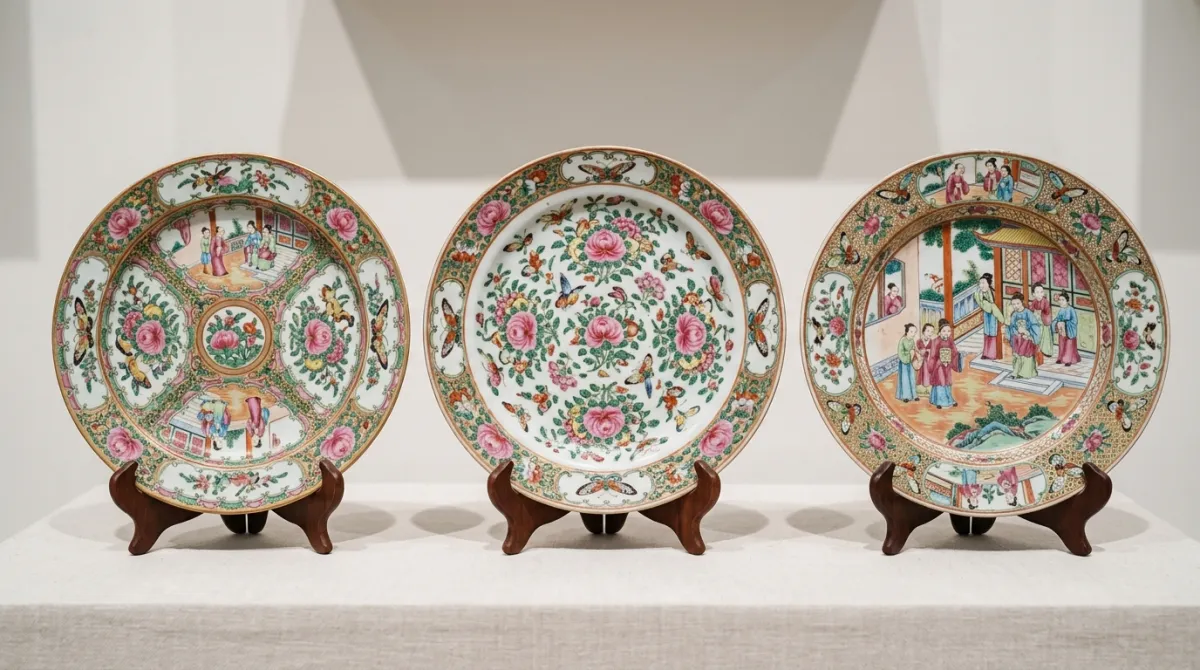
- Rose Medallion alternates figural and floral reserves, typically around a central medallion; Rose Canton keeps the same gilt-heavy style but drops human figures entirely; Mandarin flips the ratio so figures dominate.
- The quickest test is two questions: are there people in the panels, and if so, do they share space with flowers or stand alone as the main subject?
- Shop labels and estate-sale tags mix these names up constantly. A bowl marked “Rose Canton” at a flea market is sometimes true Rose Medallion, and vice versa.
- These are Western trade labels for Canton famille-rose export ware, not native workshop categories, and their timelines overlap rather than match exactly. Mandarin-style figure work reaches back further than Rose Medallion, which is mostly a 19th century trade term.
What Do Rose Medallion, Rose Canton, and Mandarin Actually Mean?
These three names are Western trade labels for Canton famille-rose export porcelain made in Guangzhou (Canton), not categories the workshops themselves used. Their timelines overlap but aren’t identical: figure-dominant Mandarin-style ware traces back to the late 18th century, while Rose Medallion is mainly a 19th century trade term. Rose Medallion mixes people and flowers in alternating panels, Rose Canton drops the people, and Mandarin makes the people the whole point. The palette, gilding, and general “busy border” look are shared across all three (our full pattern guide covers the family in depth).
Collectors didn’t invent these labels in Canton. They’re mostly American trade names that got applied decades after the porcelain was made, once dealers needed a shorthand for what they were selling. That’s part of why the boundaries feel fuzzy today. Nobody in a 19th century Canton workshop was painting to a strict rulebook that said “this plate is Medallion, that one is Canton.” Painters worked from pattern books and repeated motifs, and the names came later to sort what already existed. I’ve watched buyers at estate sales argue confidently about which term applies to a bowl, only to find the auction catalog used a third name entirely. It’s a genuinely common source of confusion.
Kerry Kwok, a Macau porcelain painter who trained under 廣彩 (Canton enamel) master Lei Iat Po and now runs GoodTime Studio Macau, put it simply when I asked him about the naming mess: “The brush doesn’t know the collector’s word for what it’s painting. It knows figures, it knows flowers, it knows how much gold goes around the border. The names are for us, not for the workshop.” That distinction matters more than it sounds. If you train your eye on what’s actually painted rather than the label on a shelf tag, the three patterns become much easier to sort, even though the categories themselves stay useful collector shorthand rather than airtight historical divisions.
How Do You Recognize Rose Medallion at a Glance?
Rose Medallion is defined by alternation: the border reserves swap back and forth between court figures and floral or bird scenes, usually four to six panels circling a central medallion. A central medallion, often a peony spray or a family crest-style motif, is a common and typical feature, though not every piece has a clearly distinct one; where the name actually comes from isn’t a settled point among collectors.
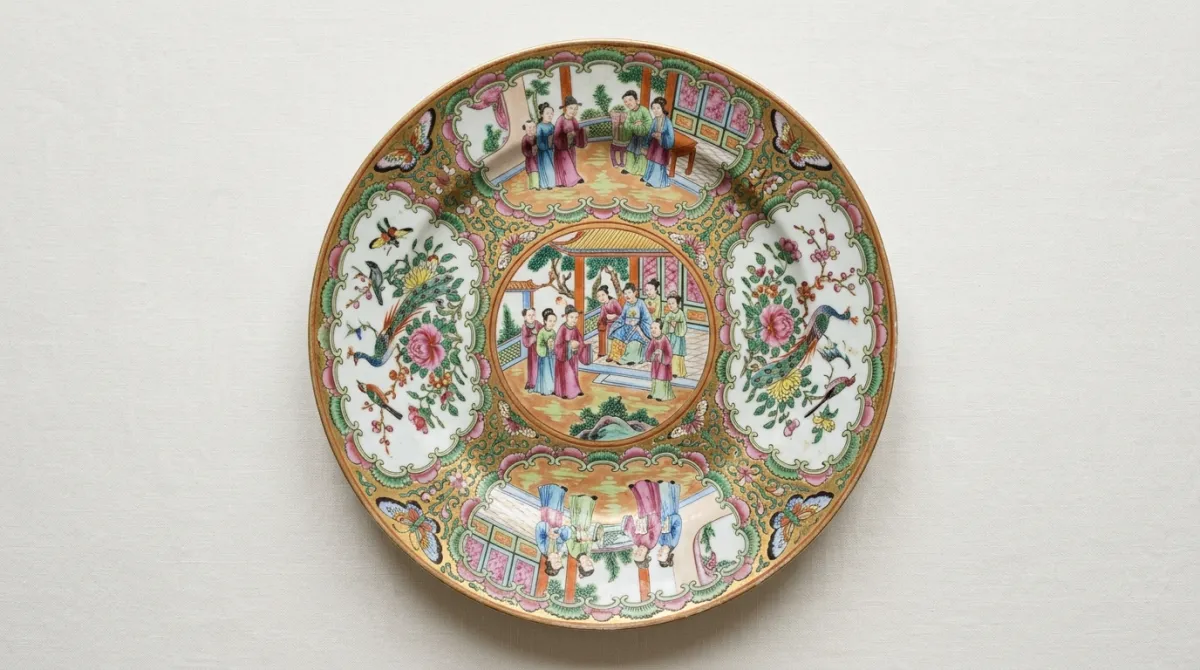
Walk around a genuine Rose Medallion piece and count the panels. You’ll typically find figures in one reserve, then flowers or a bird-and-butterfly scene in the next, then back to figures again. The rhythm is the signature. Ground color is usually a dense rose-pink or gilt lattice that fills every gap between reserves, which is why the overall look reads as “busy” compared to plainer Chinese export wares.
Most guides describe Rose Medallion by its color palette first and its layout second. In our experience, that gets the emphasis backwards. Palette alone won’t separate Medallion from Canton or Mandarin because all three share nearly identical pinks, greens, and iron-reds. Layout is what actually does the sorting. If you want a deeper walkthrough of the motifs themselves, our guide to identifying Rose Medallion breaks down the medallion center, the border style, and common shapes piece by piece.
What Sets Rose Canton Apart from Rose Medallion?
Rose Canton typically shares the same color scheme and gilt-ground style as Rose Medallion, but its reserves are entirely floral and avian. No court figures appear anywhere on the piece. That absence of human figures, rather than an exact match on every other detail, is the most dependable distinguishing feature between the two patterns.
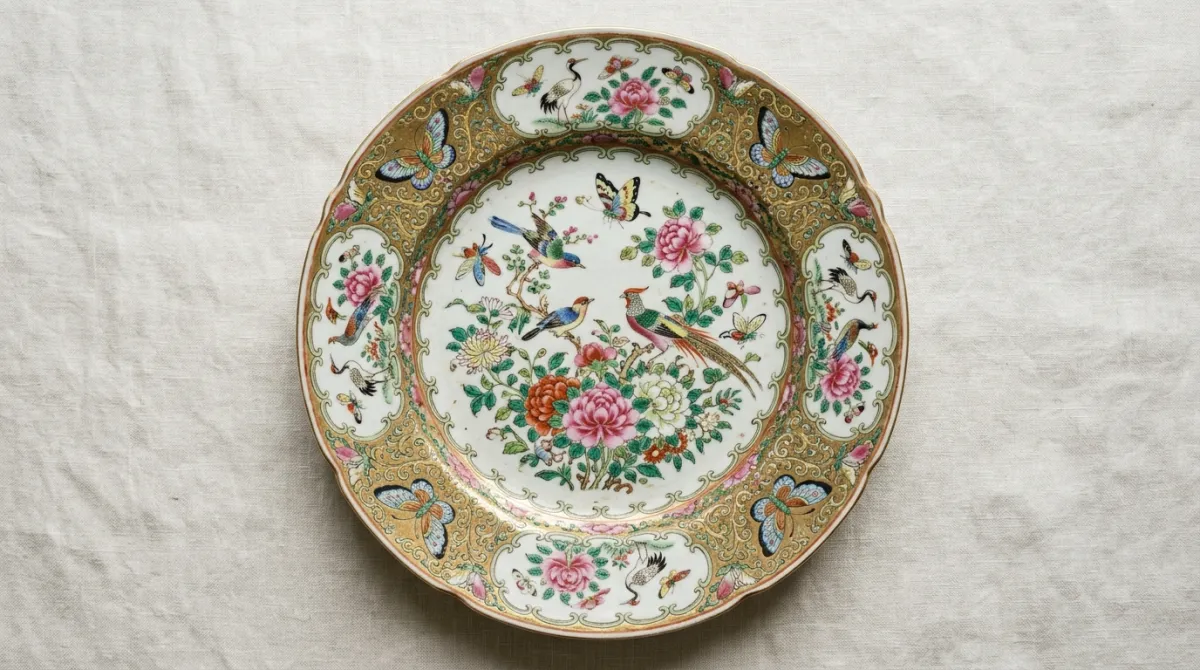
Picture the same alternating panel structure as Rose Medallion, then remove every human figure and replace those reserves with more flowers, birds, or butterflies. That’s Rose Canton. The peony sprays, the phoenix-like birds, the dense gilt scrollwork between panels: all of it stays the same. Only the people are missing.
Why would a workshop paint one and not the other? Cost and buyer preference both played a role. Figural scenes took longer to paint well since faces and robes needed finer brushwork than a repeated peony motif. A purely floral piece could move faster through a workshop, and some Western buyers simply preferred botanical decoration over scenes of court life. Kwok noted that in his own practice, floral reserves are still faster to execute than figures, “a face has to be right or the whole panel looks wrong; a peony just has to look like a peony.” That practical reality likely shaped 19th century production choices too, though it’s worth being honest that we can’t point to surviving workshop records confirming exact motivations piece by piece.
Where Does Mandarin Porcelain Fit In?
Mandarin is a trade term for figure-dominant Canton export famille rose, and it doesn’t always follow one fixed layout. Compared with Rose Medallion, robed court figures are typically the dominant, sometimes sole, subject, though panel size and arrangement vary from piece to piece. You’ll also tend to see heavier use of orange and iron-red tones alongside the gilt, giving Mandarin pieces a warmer, more saturated look than Medallion or Canton.
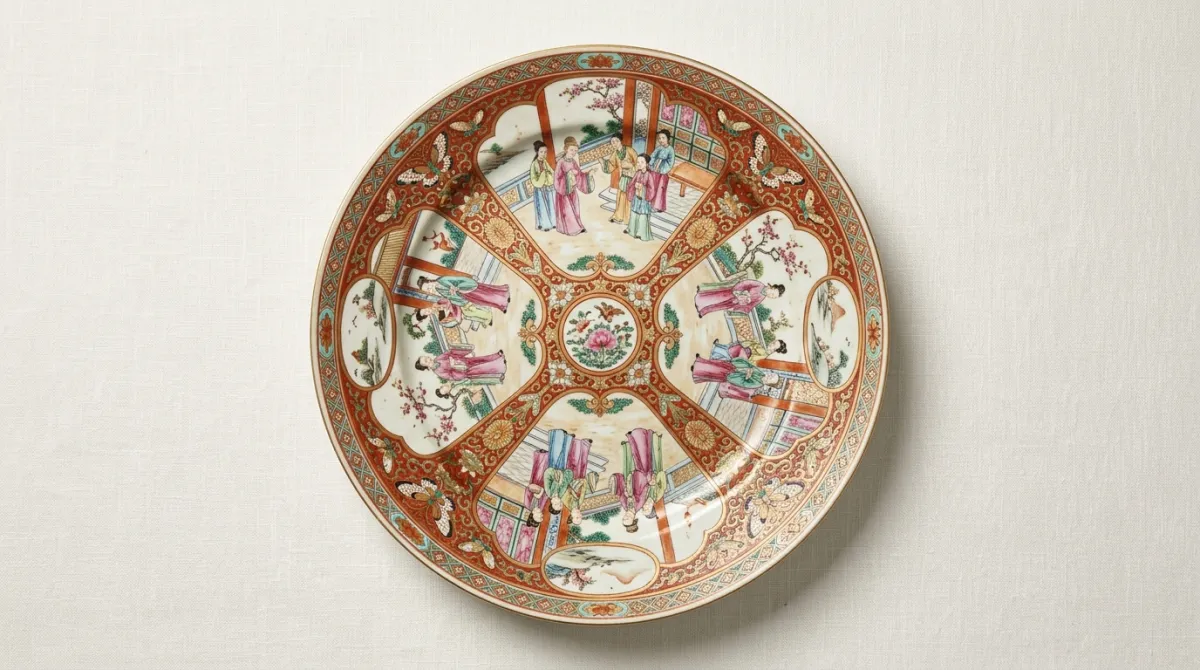
The panels themselves also tend to run larger, though not on every piece. Rather than four or five modest reserves circling a medallion, many Mandarin pieces devote most of the surface to one or two large scenes packed with figures: officials in court dress, attendants, sometimes a garden or interior setting sketched in behind them. The floral elements that anchor Medallion and Canton become secondary here, if they appear at all.
This is the pattern most likely to get mislabeled, in my experience, because “Mandarin” as a term has also been used loosely by some dealers to describe any Canton export ware with figures, including pieces that would more accurately be called Rose Medallion. If a piece looks predominantly like a portrait gallery of court life rather than an alternating pattern, lean toward Mandarin. If figures and flowers trade off evenly, it’s Medallion.
How Can You Tell the Three Apart in 10 Seconds?
Ask two quick questions in this order: does the piece have any human figures at all, and if it does, are those figures sharing panels equally with flowers or dominating the surface on their own? The answers sort a piece into one of the three categories almost every time.
Here’s the shorthand Kwok uses when training students to sort export ware quickly:
- No people anywhere, all florals and birds: Rose Canton.
- People and flowers alternating in roughly equal panels around a central medallion: Rose Medallion.
- People filling most of the surface, flowers pushed to the margins or absent: Mandarin.
It’s not a perfect system. Some pieces sit right on the border, especially where a “Medallion” plate has unusually large figural panels that start crowding out the florals, edging it toward Mandarin territory. When that happens, most dealers default to whichever term the piece more strongly resembles, and reasonable collectors can disagree. That’s normal, not a sign you’re misreading something.
Why Do Dealers Use These Names So Loosely?
Trade terminology for Canton export porcelain developed informally over decades, mostly among American and British dealers cataloging pieces long after they left China, which is why usage varies so much from shop to shop. There was no single governing body standardizing the vocabulary the way there might be for, say, hallmark systems on silver.
That history means you’ll see real inconsistency out in the wild. One auction house’s “Rose Canton” bowl might be another’s “Rose Medallion” plate if the figural panels are small enough to argue either way. Older estate inventories sometimes used “Canton” as a catch-all for any Cantonese export porcelain regardless of pattern, adding another layer of confusion for anyone searching listings today.
Isn’t that a little frustrating for buyers trying to shop by name? Sure, but it’s manageable once you know to check the panels yourself rather than trusting the label. Our beginner’s overview of Rose Medallion walks through the pattern’s history and helps explain why the naming split happened in the first place, which makes the inconsistency easier to work around once you understand where it came from.
If you’ve fallen for a particular composition, whether it’s the classic alternating Medallion layout, an all-floral Canton piece, or a figure-heavy Mandarin scene, and can’t find the exact antique you want, it’s worth knowing that hand-painted reproductions of all three patterns can be commissioned to order through our commissions page, painted using the same traditional techniques.
Frequently Asked Questions
Is Rose Canton older or newer than Rose Medallion?
Neither term reliably indicates age on its own. Both patterns were produced concurrently in 19th century Canton workshops, and the choice between figural and purely floral reserves varied from order to order rather than following a strict chronological progression.
Can a single tea set mix Rose Medallion and Rose Canton pieces?
Yes, and it happens more often than collectors expect. Mixed sets usually trace back to later assembly, replacement pieces added after breakage, or ordinary variation across a large export order, rather than any single documented workshop practice. Either way, a “matched” set can end up with both alternating figural pieces and all-floral pieces.
Does Mandarin porcelain always cost more than Rose Medallion?
Not necessarily. Value depends more on condition, age, painting quality, and rarity of shape than on which of the three pattern names applies. A finely painted Rose Medallion punch bowl can easily outvalue a mediocre Mandarin plate.
Why does the central medallion disappear on some Rose Canton pieces?
Because Rose Canton’s definition rests on the absence of figures, not on retaining every Medallion layout element. Some Rose Canton pieces keep a central floral medallion, while others use an all-over floral pattern without a distinct center, and both are still correctly called Rose Canton.
How do I know if my piece is a later reproduction rather than 19th century original?
Look closely at brushwork consistency, glaze wear, and base marks, since later reproductions often show flatter, more mechanical linework than hand-painted period pieces. When in doubt, a specialist appraisal is worth the cost before you commit to a valuation.
The Short Version
Once you stop reading these as three unrelated patterns and start reading them as one family with a sliding scale of “how many people are in the panels,” the naming makes a lot more sense. Rose Canton sits at zero figures, Rose Medallion balances figures and flowers evenly, and Mandarin lets figures take over. Dealers will keep using the terms inconsistently, so trust your own eye on the panels over whatever the tag says. And if you’re still unsure which pattern is sitting on your shelf, walk the rim, count the reserves, and ask what’s actually filling them. That’s the whole test.
Keep exploring
More from Rose Medallion
Identification, history, and care guides for Rose Medallion and Canton porcelain. New guides added regularly.
Explore all guides