patterns motifs
Rose Medallion Lamps: Antique Porcelain Made into Table Lamps
Key Takeaways
- Most Rose Medallion lamps aren’t purpose-made. They’re antique jars or vases, ginger jars especially, mounted on a base and wired for electricity.
- Whether the porcelain was drilled for the cord matters a lot. A drilled piece usually loses collector value as porcelain, even though it works better as a lamp.
- Check the mounting hardware for stress cracks and check the wiring separately. Old lamp wiring should be inspected or rewired by a qualified electrician before use.
- Pairs, undrilled pieces, and reversible mounts tend to hold value best; heavily modified singles hold the least.
- Where a matched pair or a specific size doesn’t exist on the antique market, a hand-painted jar or vase made to order as a lamp base is a clean alternative.
Kerry gets asked about lamps almost as often as she gets asked about jars, which makes sense once you realize a lot of Rose Medallion lamps started life as jars. The questions people bring to the studio are rarely about the pattern itself. They’re about the hole drilled through the base, or whether the wiring inside a lamp that’s sat in a relative’s house for forty years is safe to plug in. Fair questions, and they deserve a straight answer. So let’s start with what a Rose Medallion lamp actually is.
What is a Rose Medallion lamp, exactly?
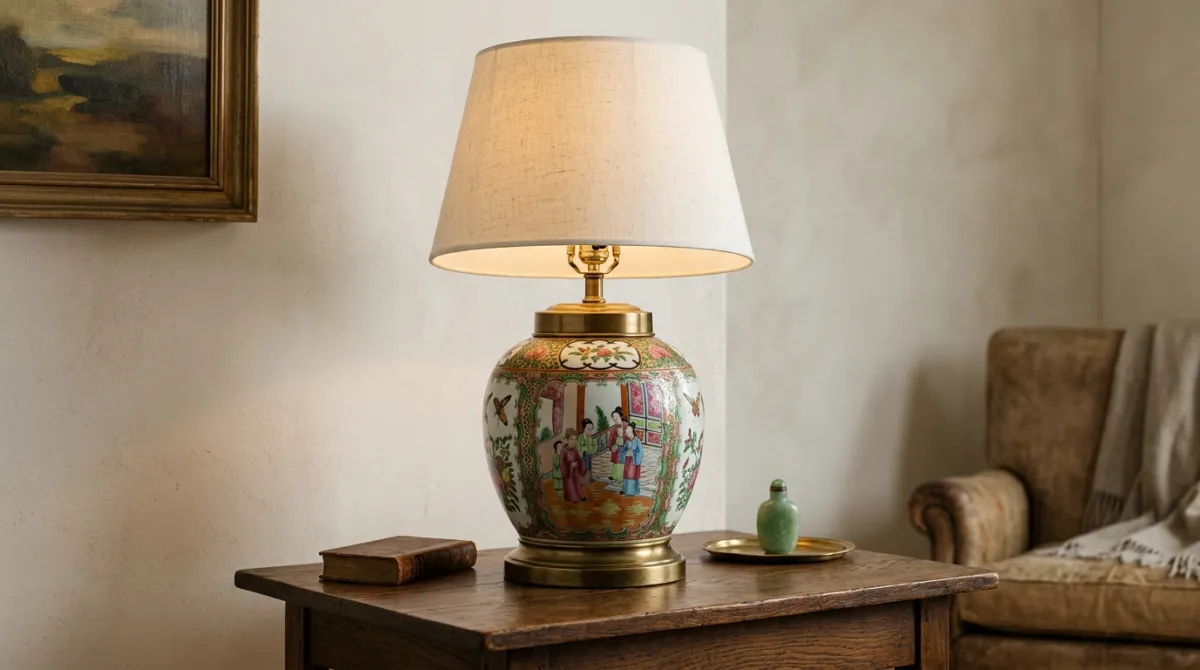
A Rose Medallion lamp is almost never a piece made from the start to be a lamp. In the overwhelming majority of cases we’ve seen, it’s an antique jar or vase, most often a ginger jar, that’s been mounted on a wooden or metal base and fitted with a socket, harp, and shade. The porcelain itself predates the electrical fitting, sometimes by decades.
That distinction trips people up constantly, and understandably so. A finished lamp looks like a single object, but it’s really two separate things bolted together: a piece of 19th- or 20th-century Canton export porcelain, and a later electrical conversion, usually done in the 20th century or after. Judging the lamp well means judging both parts, not just admiring the shade and moving on.
Ginger jars show up as lamp bases more than any other Rose Medallion form, largely because their rounded body and stable footprint suit a base mount well. Vases of various shapes turn up too, and we cover those separately in our guide to Rose Medallion vases, since a tall vase presents slightly different mounting questions than a squat jar does. Either way, the porcelain came first. The lamp came later. For the wider background on the pattern itself, our Rose Medallion complete guide is a good starting point before you shop.
Were these pieces made as lamps, or converted later?
Almost none of them were made as lamps originally. The conversion trade, taking an antique jar or vase and turning it into a table lamp, was common through much of the 20th century, done by everyone from department stores and lamp shops to individual decorators working for a client. Some conversions are quite old themselves at this point and have their own history, even if the porcelain inside is older still.
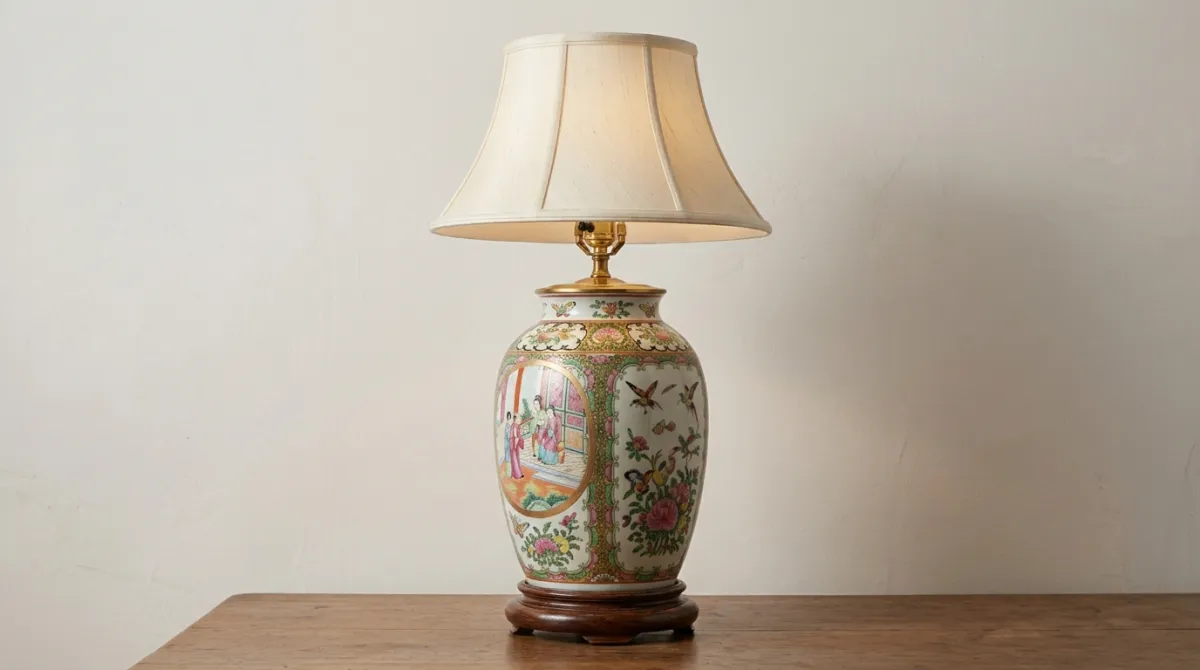
That doesn’t make a converted piece fake or dishonest. A lamp made from a genuine antique jar in the 1940s or 1950s is itself an antique conversion now, with its own age and story. It just means “antique Rose Medallion lamp” usually describes an antique porcelain body with a newer electrical history, and it’s worth asking a seller which claim applies to which part of the object.
We’d hedge here rather than promise a clean test: telling a 1940s conversion from a 1980s one is genuinely hard, even in hand, and it takes comparing hardware style, base material, and cord type against what’s typical for each era. If the conversion’s age matters to you, a dealer who can examine the actual fittings will tell you more than any description can.
Drilled or undrilled: does it matter for value?
Yes, and this is probably the single biggest value question in the whole category. A drilled jar or vase, one where a hole has been bored through the porcelain to run the electrical cord up through the base and out the top, is a permanent modification. It generally lowers the piece’s value as a stand-alone antique, sometimes substantially, because the porcelain can never go back to being unmodified.
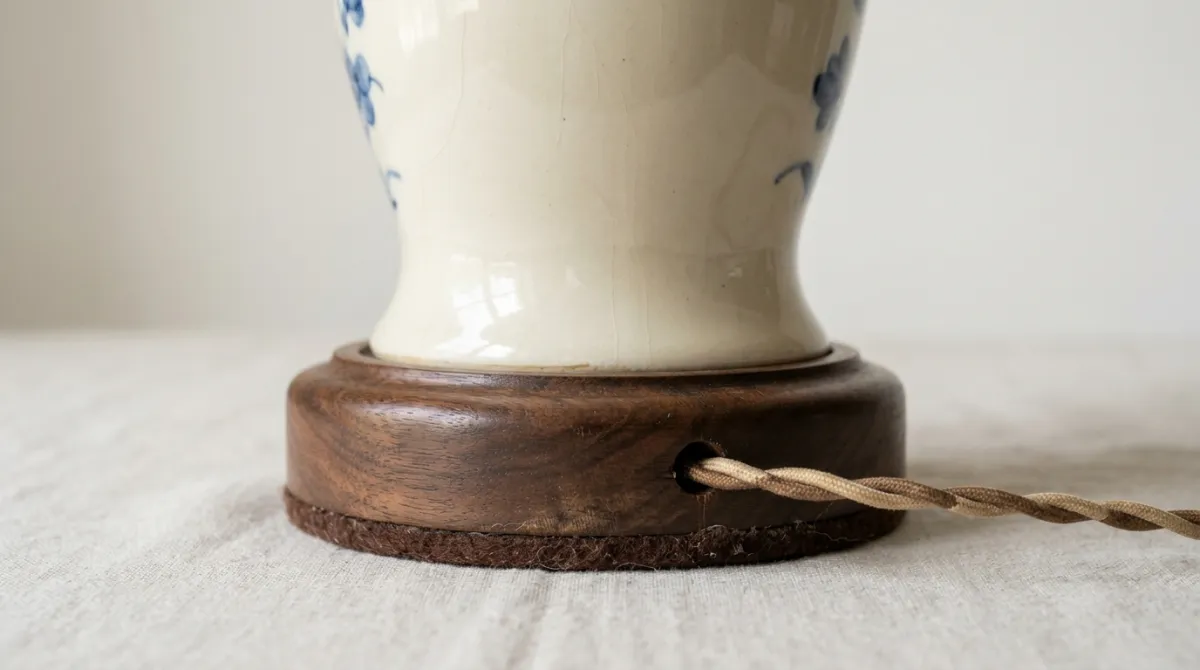
The alternative is a cord that runs up the outside of the piece, often disguised along the base and up behind the neck, or a mount that uses a cap or collar fitting at the top rather than a hole through the body. These are sometimes called reversible or non-invasive conversions, since the porcelain itself is left physically intact and the lamp hardware could, at least in theory, be removed without leaving a hole behind.
Here’s the trade-off, honestly: a drilled lamp is often more finished-looking and more stable, since the cord disappears cleanly through the base. An undrilled lamp can look slightly more improvised, with the cord visible along the outside, but it preserves the porcelain’s value should you ever want to un-convert it. Which one you’d pick depends on whether you’re buying a decorative lamp or preserving an antique.
In our experience, buyers shopping specifically for lamps rarely ask about drilling until after they’ve already fallen for a piece, and by then the emotional decision is mostly made. If drilling matters to you, ask before you fall in love with the lamp, not after.
How the mounting works, and whether it stresses the porcelain
A well-made mount cradles the jar or vase’s foot without gripping the body tightly enough to create pressure points, and that distinction is worth checking with your own hands before buying. Poorly designed mounts, especially older ones using metal clamps or tight-fitting collars, can put ongoing stress on a rim or shoulder that eventually shows up as a hairline crack.
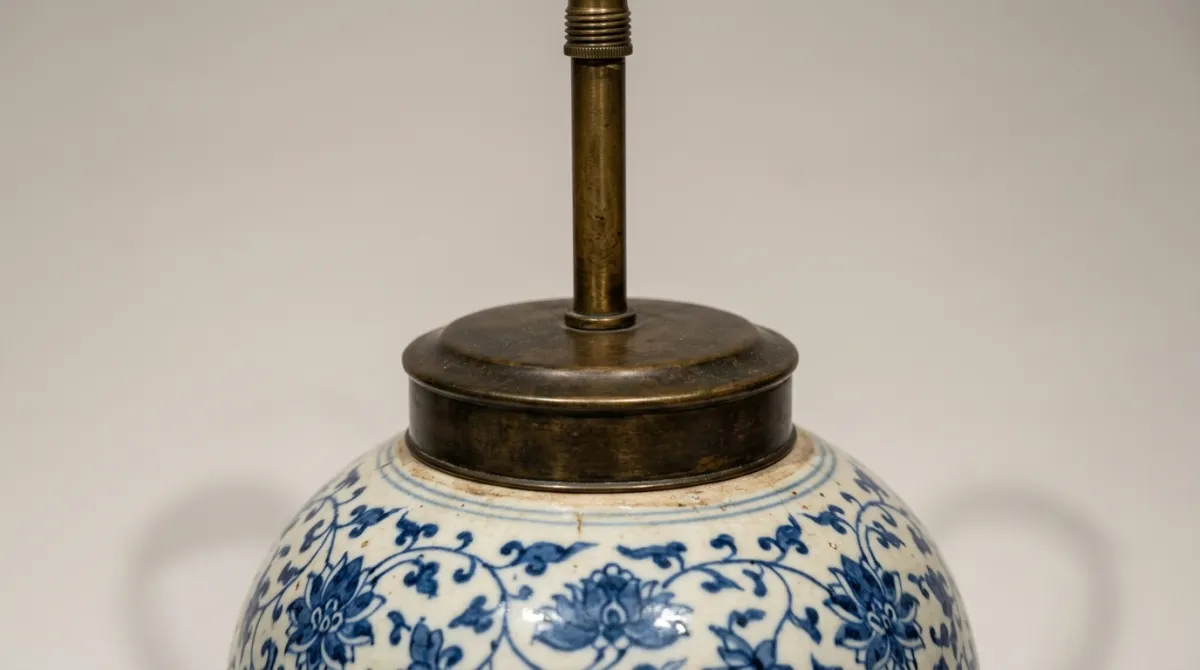
Look at where the mount actually touches the porcelain. A base that supports the jar from underneath, at the foot, distributes weight the way the piece was designed to sit in the first place. A mount that clamps around the body itself, particularly anywhere near the shoulder or neck, is worth examining closely for gaps, uneven pressure, or any sign the metal has already left a mark or a stress line in the glaze.
Kerry’s rule of thumb when she examines a converted piece is to check whether the mount would come off cleanly if you needed to remove it. A mount held on with a few points of contact and simple hardware is generally gentler on the porcelain than one that’s been glued, packed with filler, or force-fitted to a body it wasn’t really sized for. None of this is a hard pass or fail test on its own, but it’s worth five minutes of looking before you decide the lamp is sound.
Is the wiring on an old lamp safe to use?
Not necessarily, and this is the one place we won’t hedge much: old lamp wiring should be checked, and very likely rewired, by a qualified electrician before you plug it in and leave it running unattended. Cord insulation degrades over decades, sockets wear, and a lamp that’s sat unused in a cabinet or an estate for years is not something to trust on appearance alone.
We won’t walk through how to test or rewire a lamp yourself here, and honestly, we wouldn’t want to. That’s a job worth handing to someone qualified, both for your safety and for the porcelain itself; careless rewiring can crack a base or strain a mount just as easily as a poor original conversion did. If you’re buying a lamp to actually use, budget for a professional inspection as part of the purchase, not an afterthought.
A lamp that looks pristine can still have compromised wiring, and a lamp that looks a bit rough cosmetically can sometimes have been rewired safely and recently. Looks tell you very little here. That’s really the whole point: don’t guess.
What drives the value of a Rose Medallion lamp
Value on a converted lamp tracks the same painting-quality and condition factors as any Rose Medallion piece, plus two things unique to lamps: whether it’s drilled, and how well the conversion itself was done. A finely painted, undrilled jar with a clean, reversible mount will generally outvalue a similarly painted piece that’s been drilled and clamped, even if both started from comparable porcelain.
Painting quality still comes first, exactly as it does with any Rose Medallion piece. Confident brushwork, well-drawn figures, and rich color separate a fine lamp from a merely decorative one, regardless of what’s happened to the base. Condition, chips, hairlines, gilt wear, matters just as much as it would on an unconverted jar; a mount can hide a crack from casual view, so ask a seller whether the piece has been examined outside the hardware.
Beyond that, the conversion-specific factors stack on top: drilled versus undrilled, and whether the mounting hardware looks like quality work or a rushed job. Pairs matter here too, the same way they matter for jars generally; a matched pair of lamps, especially undrilled ones with consistent painting between the two, is genuinely harder to find than a single lamp and tends to be priced accordingly by dealers who know what they have.
Buying an antique lamp vs. converting a piece yourself
Buying an already-converted lamp is the faster route, and it puts the decision, drilled or undrilled, well-mounted or not, in someone else’s hands before you ever see the piece. What you’re buying is a finished object, for better or worse, and your main job is inspecting the porcelain and the wiring rather than commissioning any of the work yourself.
Converting a piece yourself, starting from a jar or vase you already own or bought for the purpose, gives you control over the questions raised here. You choose whether it’s drilled, you choose the mount, and you have the wiring done properly by a qualified professional from day one rather than inheriting someone else’s decisions. It’s slower and costs more up front, since you’re paying for the porcelain and the conversion separately, but you know exactly what you’re getting.
We’d lean toward converting a piece yourself, or having it done, whenever the porcelain is fine enough that you’d actually mind if it were drilled without your say. For a lamp you just want to look good on a side table and don’t especially care about as a stand-alone antique, buying an already-converted piece is perfectly reasonable, and often the better value.
Commissioning a lamp base pair
When a genuine antique pair, or a specific size, simply doesn’t exist on the antique market, commissioning a hand-painted jar or vase made specifically as a lamp base sidesteps the drilling question entirely. You decide the size up front to fit your lamp hardware and your space, and you decide from the outset whether it’s drilled cleanly during the piece’s construction or left for a non-invasive mount, rather than modifying an antique after the fact.
This is a request Kerry hears fairly often at GoodTime Studio Macau, usually from someone who wants a matched pair for a console table or mantel and can’t find two antique pieces that match closely enough. A piece made to order can be painted to echo a client’s existing porcelain, or designed fresh, and because it’s built for the purpose, there’s no antique jar sacrificed to make it happen.
If that’s closer to what you’re after, whether it’s a single base, a pair, or a piece sized to replace something broken, our commissions page is the place to start. We’ll talk through sizing, drilling versus a non-invasive mount, and timeline before anything gets painted.
Frequently asked questions
Are Rose Medallion lamps antique?
Usually the porcelain is: most Rose Medallion lamps started as an antique jar or vase that was mounted and wired later, sometimes decades after the piece was made. The lamp conversion itself, meaning the base, socket, and wiring, is typically newer than the porcelain, so it’s worth asking a seller which part of the “antique” claim applies to which component.
Does drilling a vase for a lamp ruin its value?
Drilling doesn’t ruin the piece, but it does generally lower its value as a stand-alone antique, since the modification is permanent. The trade-off is a cleaner-looking, more finished lamp with the cord hidden through the base, so it comes down to whether you value the porcelain’s future resale as an antique or the lamp’s finished appearance more.
Is the wiring on an old lamp safe?
Not necessarily, and old lamp wiring should be checked, and very likely rewired, by a qualified electrician before regular use. Insulation degrades over decades and a lamp that’s sat unused for years isn’t something to trust based on appearance alone; budget for a professional inspection as part of any purchase.
Can you make a Rose Medallion lamp base to order?
Yes. A hand-painted jar or vase made specifically as a lamp base lets you control size, palette, and whether it’s drilled, without modifying an existing antique. Our commissions page is where to start that conversation, particularly for matched pairs that are hard to find secondhand.
How do I tell if the porcelain is old but the fittings are new?
Compare the porcelain to the same clues used for identifying any Rose Medallion piece: body weight, foot-rim wear, and brushwork texture. Then look at the hardware separately; a fresh cord, a modern socket, or crisp unworn metal on the base usually points to a recent rewiring or a recent mount, even on genuinely old porcelain.
Whether you’ve inherited a lamp you’re not sure about, found one you’re tempted to buy, or you’re weighing an antique conversion against a piece made to order, we’re happy to talk through what’s actually in front of you. Reach out through our commissions page, and we’ll tell you honestly what we see, drilled or not.
Keep exploring
More from Rose Medallion
Identification, history, and care guides for Rose Medallion and Canton porcelain. New guides added regularly.
Explore all guides