patterns motifs
Rose Medallion Garden Stools: A Collector's Guide
Key Takeaways
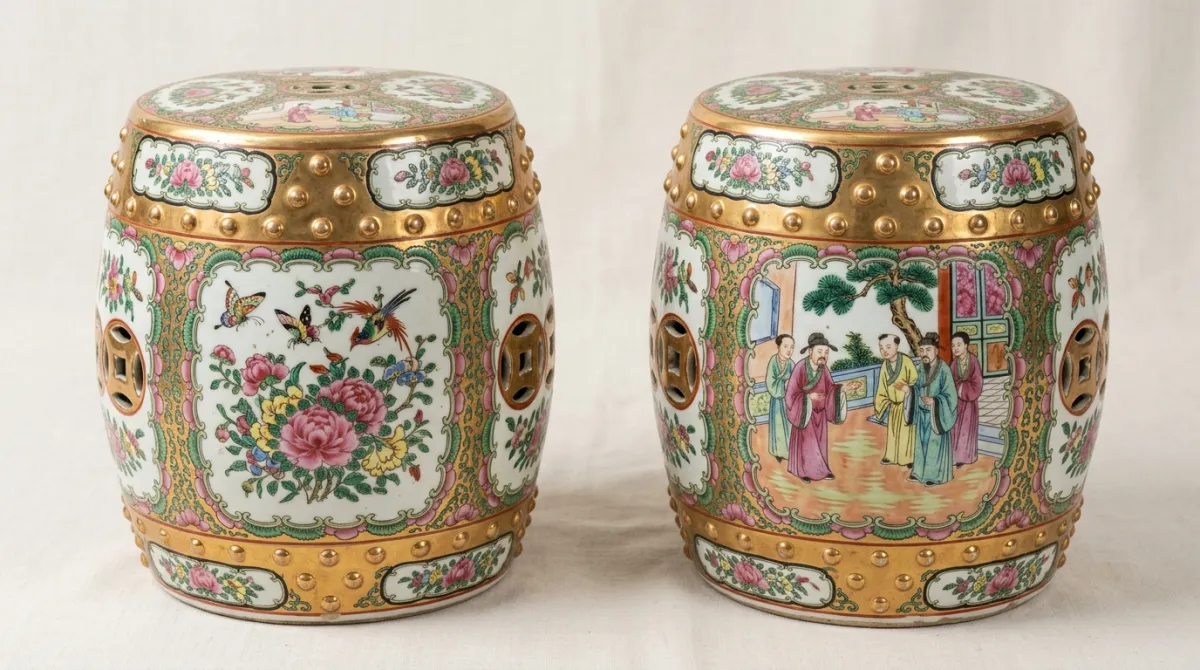
- A garden stool is a barrel-shaped ceramic seat, usually with a domed top, raised stud bands, and pierced cut-outs on the sides, often in a cash-coin or ruyi motif.
- These are heavy, functional forms, so cracks and chips matter more here than on almost any other Rose Medallion piece; a hairline near the seat can turn into a star crack under weight.
- Stools were commonly sold and displayed in pairs, and a genuine matched pair is scarcer, and usually worth more, than two similar singles.
- Even a sound antique is safest used as a plant stand or side table rather than everyday seating, and none of them belong outdoors through a freezing or wet winter.
- When a specific height, pair, or use case can’t be found secondhand, a custom hand-painted stool is often the more practical answer.
Garden stools are the Rose Medallion form people are most likely to walk past in a shop without realizing what they’re looking at. They read as furniture first, a plant stand or a low table, and only on a second look does the painting register. That’s part of the appeal, honestly. They’re one of the few forms in the pattern that were originally made to be used (as seating or a stand rather than pure display), and that history shapes almost everything worth knowing about buying one. Let’s work through the form, the condition checks that matter most on something this heavy, and what it means to actually live with one.
What is a Rose Medallion garden stool?
A garden stool is a barrel or drum-shaped ceramic seat, typically with a gently domed top and a slightly waisted or straight-sided body set on a narrow foot. Historically these sat in Chinese gardens and interiors as informal seating, and the Rose Medallion versions carry the pattern’s familiar alternating panels of figures, birds, and peonies across that curved surface. It’s a functional shape wearing a decorative pattern, and that combination is unusual in this porcelain family.
The form almost always includes raised “nailhead” or stud bands, rows of small round bosses running around the top and bottom, echoing the metal studs on old wooden and lacquer drum stools. Most also have pierced cut-outs on the sides, cash-coin shapes, ruyi scrolls, or simple geometric openings, which lighten the body, help the stool “breathe,” and read as decoration in their own right. Kerry keeps one by the studio door as a plant stand, and visitors almost always run a finger over the studs before they ask a single question about the painting.
Today these stools rarely get sat on by anyone who owns an antique one. Most function as occasional side tables, plant stands, or purely decorative accents next to a sofa or in a hallway, which suits the form well since the shape reads as furniture even when nobody’s using it that way.
Why do garden stools have holes in the sides?
The pierced openings are mostly decorative and traditional, echoing older wooden and bamboo drum-stool designs, though they also lighten a heavy form and let the piece “breathe” visually. On Rose Medallion stools the cut-outs usually take a cash-coin or ruyi shape, tying the piece to the same symbolic vocabulary found elsewhere in the pattern.
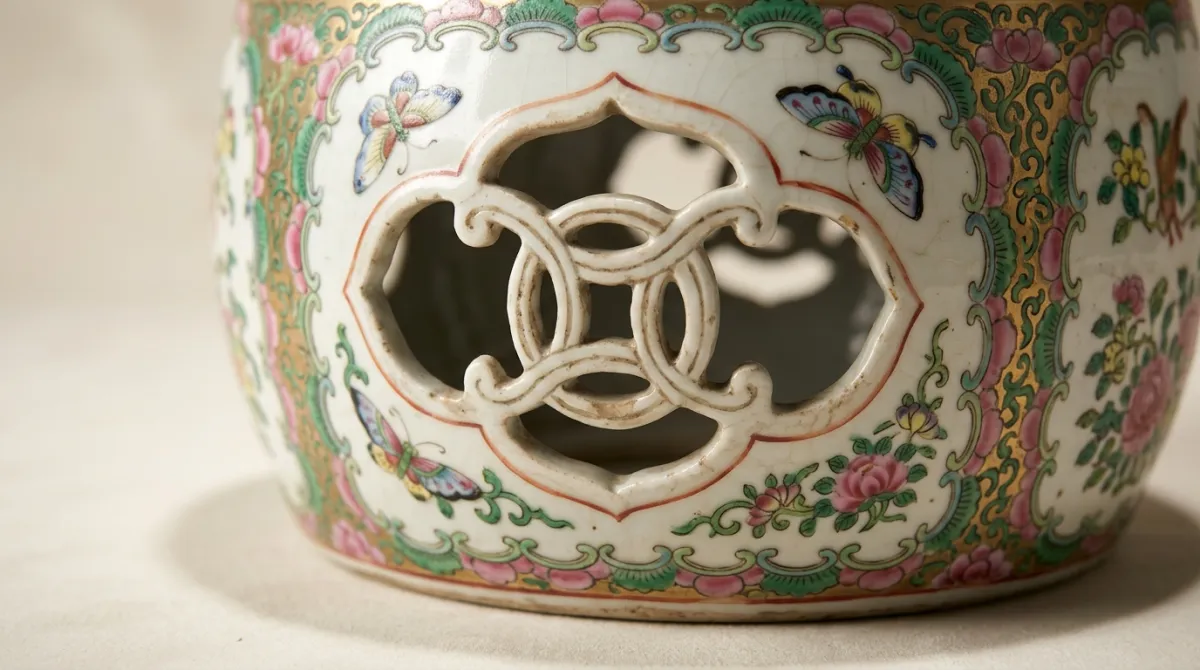
Cash-coin motifs, round with a square center, are an old symbol tied to prosperity and good fortune, and they show up across Chinese decorative arts well beyond porcelain. Ruyi shapes, that curling scepter-head silhouette, carry a wish for things going “as you desire.” Neither motif is unique to garden stools, but the piercing gives them a dimensional presence here that flat painting can’t quite match; light passes through, and the pattern shifts as you walk around the piece.
Practically, the piercing also serves the stool’s original function. A solid ceramic drum that size traps heat and feels dense and closed; the openings let air move and make the piece feel lighter, both visually and structurally, while generally sparing the more load-bearing rim and foot that actually carry weight.
Were garden stools made in pairs, and what sizes turn up?
Garden stools were very often produced and sold in pairs, meant to flank a fireplace, a console table, or a pair of doorways, and a genuine matched pair generally commands more than the same two stools bought separately. Sizes cluster around a fairly standard seat height, though smaller and larger versions both exist.
Most antique Rose Medallion garden stools sit somewhere in the range of a low occasional table, roughly knee height, give or take, since that height suited both seating and side-table use in the rooms they were made for. You’ll occasionally find shorter versions clearly meant as footstools or plant stands, and taller ones that lean more toward a proper side table. In our experience, buyers hunting a pair often fixate on matching height and diameter while skimming past the actual brushwork, and that’s backwards; two stools can measure identically and still have been painted years, or hands, apart. Compare the figures’ faces and the peony palette closely before calling anything a genuine pair.
Because they were functional furniture as much as decorative objects, singles are far more common on the secondhand market than intact pairs. If a true pair is the goal, expect the hunt to take patience, and expect to pay a real premium once you find one.
How do you check a heavy stool like this for cracks?
Hairline cracks, star cracks, rim chips, and foot damage are the main things to check on a garden stool, and they matter more here than on lighter forms because this piece was built to carry weight. A star crack radiating from the top is often the tell-tale sign of a knock or, sometimes, someone actually sitting on a piece that wasn’t sound enough for it.
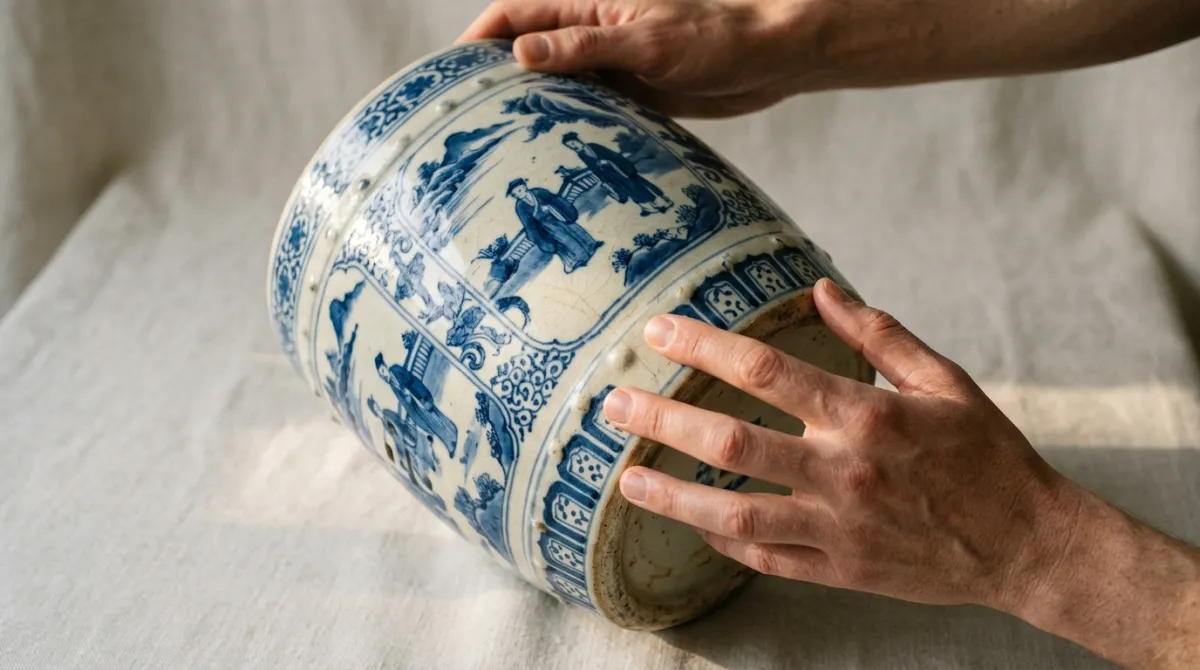
Start at the domed top and look across it under a raking light, since that’s the surface most likely to show a star crack or a fine hairline running out from a chip. Run a hand slowly around the rim and stud bands too; small chips can hide in the texture of the raised bosses in a way they wouldn’t on a flat surface. The pierced cut-outs deserve their own look, as thin ceramic walls around an opening are exactly where a hairline is most likely to start under stress.
Tap-testing is worth doing here, gently, with a knuckle rather than anything metal, listening for a clear, ringing note rather than a dull thud, which can suggest an internal crack you can’t see. It’s a clue, not proof, the same way it is on any other porcelain form, and it works best combined with a good look inside. Turn the stool over if you can and check the interior and the foot rim for cracks or old repairs that a seller’s photos conveniently left out of frame. Our guide on how to identify Rose Medallion covers brushwork and body checks that apply here too, though on a stool, structural soundness has to come first.
Given the weight and awkward shape of these pieces, condition assessment genuinely benefits from seeing one in person, or asking a seller for close, well-lit photos of the top, the rim, and the interior specifically, not just a flattering angle from across the room.
What actually drives the value of a garden stool?
Value tracks pairing, size, condition, and painting quality together, with condition weighing especially heavily because this is a form that was actually meant to bear weight. A stool with even a small crack near the seat is a meaningfully weaker piece, both structurally and in what a serious buyer will pay, compared with a chip on a purely decorative vase.
Painting quality still separates the fine pieces from the merely decorative ones, the same as everywhere else in the pattern: confident brushwork, well-drawn faces in the figural reserves, and rich, even enamel color over a densely worked ground. Kerry says she can usually gauge painting quality on a stool from across a room, before she’s even close enough to check the piercing or the foot.
Genuine matched pairs command a real premium over singles, sometimes substantially so, simply because intact pairs are harder to find than the individual demand would suggest. Rarity and age add to value on top of quality and condition, but they don’t override them. A plain, later stool in flawless condition with confident painting can outvalue a genuinely older piece dragged down by a cracked top or a chipped foot. Read all of it together, the way you would with any Rose Medallion piece, rather than leaning on a single clue.
Antique or later reproduction: what should you check?
The same core clues used across the pattern, body weight, foot-rim wear, brushwork texture, and gilding condition, apply to garden stools too, with a few form-specific tells worth adding. Wall thickness around the pierced openings is one worth feeling with a hand; older, hand-thrown stools often show a slight unevenness that mold-cast reproductions tend to lack.
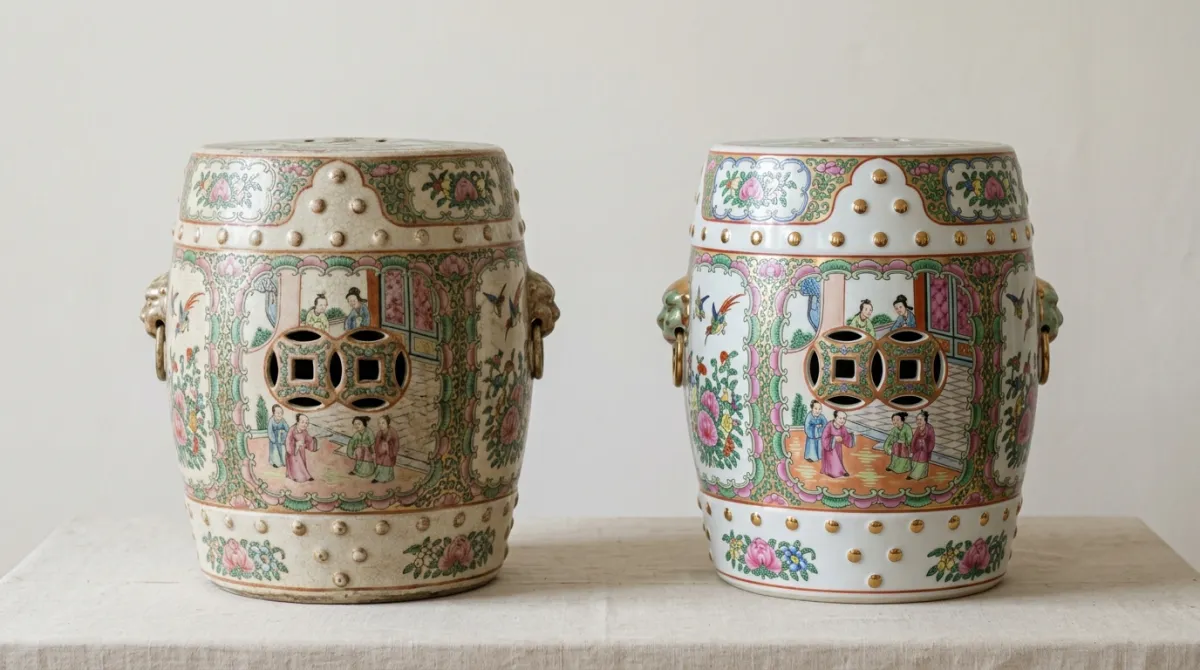
Turn the piece over and check the foot rim the way you would on any other form, feeling for soft, rounded wear from decades of actual use, as opposed to a suspiciously uniform sanded edge. Look at the stud bands closely too; hand-applied bosses on older pieces often show small variations in size and spacing, while some later reproductions cast the whole band as a single uniform mold pattern, and it reads as flatter and too regular once you know to look. Raking light across the painted reserves helps here as it does anywhere else in the pattern; hand-applied enamel has texture and slight variation that printed or transfer decoration simply doesn’t replicate.
Does age genuinely matter to you as much as soundness and painting quality? For a piece you’re planning to actually sit on or set outdoors part of the year, that’s worth asking honestly before you shop, since a well-made later stool in excellent structural condition may suit that use far better than a fragile antique. Our full identification guide walks through these clues in more depth with side-by-side comparisons.
Can you actually sit on one, or leave it outdoors?
A genuinely sound antique can technically be sat on, but we’d steer most people away from treating one as everyday seating; the safer, more common approach is to use it purely as a plant stand or side table. Weight, repeated use, and temperature swings all add stress that a decorative piece was never built to absorb indefinitely.
If a stool has passed a careful condition check with no cracks, chips, or old repairs, occasional light use isn’t unreasonable. But “occasional” is doing real work in that sentence: daily sitting, especially by anyone heavier than the piece was likely tested for a century or more ago, puts real ongoing stress on old ceramic. Most collectors we know treat their antique stools strictly as decor, seat height in name, table height in practice.
Outdoors is a firmer no for antiques. Despite the name, don’t leave an antique Rose Medallion garden stool outside through freezing or wet weather; moisture that gets into old glaze crazing and then freezes can crack a piece from the inside out, and sun exposure fades gilding and enamel over time. A covered porch in a mild, dry climate is about as far as we’d push it, and even then, bringing the piece in for winter is the safer habit. Our note on cleaning antique Rose Medallion covers safe handling more broadly, and most of that caution about moisture and temperature applies directly here.
Commissioning a matching pair or a specific size
Antique garden stools in a true matched pair, a specific height, or condition solid enough for actual outdoor or everyday use are genuinely hard to find, which is exactly where a custom hand-painted commission tends to make more sense. Rather than compromising on height, pairing, or soundness, a commission is built to the size and use you actually need from the start.
This is a request Kerry hears fairly often at GoodTime Studio Macau: someone with one surviving stool from a pair, or a couple wanting a matched set built to a specific seat height for either side of a fireplace they’re renovating. Matching an existing antique’s palette, panel layout, and stud spacing takes careful study before any brush touches the new piece, and building a stool sturdy enough for genuine outdoor or everyday use is its own separate conversation about body and glaze. If either situation sounds familiar, our commissions page is the place to start that conversation, and the broader Rose Medallion guide covers the pattern’s history for anyone wanting the fuller picture. Our pieces on ginger jars and planters cover other functional forms in the pattern worth a look too.
Frequently asked questions
Can you actually sit on an antique Rose Medallion garden stool?
Only if it’s genuinely sound, with no cracks, chips, or old repairs after a careful check. Even then, we’d treat it as decorative, a plant stand or side table, rather than everyday seating, since repeated use adds ongoing stress old porcelain was never really built to absorb.
Why do garden stools have holes in the sides?
The pierced cut-outs, usually cash-coin or ruyi shapes, are mostly decorative and traditional, echoing older wooden drum-stool designs. They also lighten the form and let it visually and structurally “breathe” while generally sparing the more load-bearing rim and foot.
Were Rose Medallion garden stools made in pairs?
Often, yes, meant to flank a fireplace, console, or doorway. A genuine matched pair, with brushwork that actually corresponds between the two pieces, is scarcer than singles and generally commands a real premium over two stools bought separately.
How do I check a heavy stool for cracks?
Look across the domed top under raking light for star cracks, run a hand around the rim and stud bands for hidden chips, and gently tap-test for a dull note rather than a clear ring. Check the interior and foot too; combine all these clues rather than relying on just one.
Can garden stools go outdoors?
We wouldn’t recommend it for antiques. Freezing or wet weather can drive moisture into old glaze crazing and crack a piece from the inside, and sun exposure fades gilding over time. A covered, dry spot is about as far as we’d push it, and bringing the piece indoors for winter is safer still.
Whether you’re weighing a single stool against a pair, trying to work out if a piece is sound enough to actually use, or thinking about a custom stool built to a specific height, we’re glad to talk it through honestly. Reach out through our commissions page, and we’ll tell you plainly what’s worth chasing secondhand versus what’s worth having made.
Keep exploring
More from Rose Medallion
Identification, history, and care guides for Rose Medallion and Canton porcelain. New guides added regularly.
Explore all guides