patterns motifs
Rose Medallion Bowls and Punch Bowls: A Collector's Guide
Key Takeaways
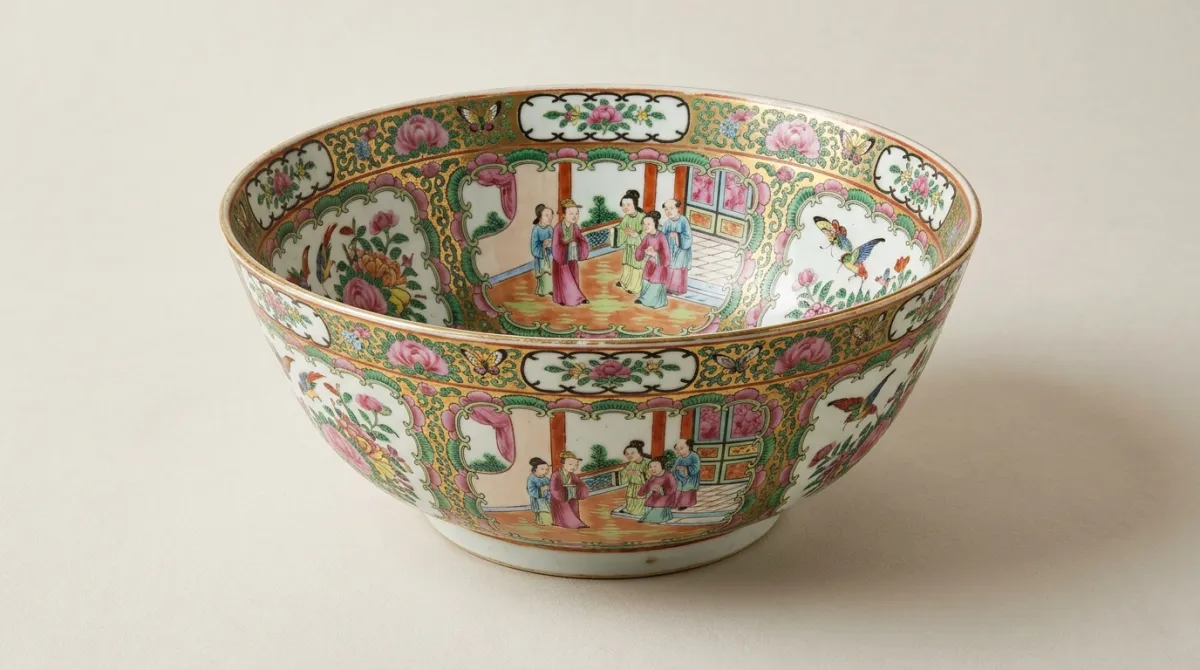
- Rose Medallion bowls run from small individual bowls up to large punch bowls, and a punch bowl is often the most sought-after form in a collection.
- Bowls saw real use at the table, so interior wear, scratches, and gilt loss on the inside are common and not automatically a red flag.
- Painting quality, size, condition, and rarity of form tend to drive value more than age alone, with large intact punch bowls typically commanding the strongest interest.
- Reproduction bowls exist in real numbers; body weight, gilding, and enamel texture are clues worth reading together, never proof on their own.
- If the antique market can’t supply the size, form, or matching piece you need, a hand-painted commission is often the more realistic route.
Bowls are where Rose Medallion collecting gets genuinely interesting, at least in Kerry Kwok’s opinion, and after years of watching people bring pieces into GoodTime Studio Macau, I’m inclined to agree with her. A bowl, especially a large punch bowl, carries a different kind of presence than a flat plate. It sat at the center of a table and did real work, which means it wears its history differently than a plate does. So what should you actually look for when you’re buying, judging, or trying to complete a set built around bowls? Let’s get into the forms first, because that’s where most of the confusion starts.
What bowl forms did Rose Medallion actually come in?
Rose Medallion bowls span a wide range, from small individual rice and tea bowls through medium serving bowls and footed bowls up to large punch bowls, plus occasional cut-corner or scalloped shapes. Canton export workshops produced these forms for both everyday dining and formal entertaining, not as a single fixed size. (Kerry Kwok, GoodTime Studio Macau)
At the small end, individual rice bowls and tea bowls turn up most often, usually a few inches across and meant to be handled and refilled repeatedly at a meal. These are the pieces most likely to show honest, heavy interior wear, simply because they were used the way they were designed to be used.
Medium serving bowls, sometimes with matching covers or a shallow well, sat somewhere between a plate and a true serving vessel, holding rice, soup, or a shared dish for the table. Footed bowls raise the form up on a separate pedestal base, which changes how the painting reads and, honestly, makes them a bit more vulnerable to a chipped or cracked foot ring over the decades.
Then there’s the punch bowl, which brings its own section below because it deserves one. Cut-corner bowls and other less common shapes exist too, generally in smaller numbers, and they tend to draw a certain kind of collector precisely because they’re not the shape everyone expects. For a broader look at how these forms fit into the pattern’s history, our Rose Medallion complete guide covers the full picture.
Punch bowls: the showpiece of the Rose Medallion table
A large Rose Medallion punch bowl is often the single most prized piece in a collection, and that’s not just sentiment. It’s simply harder to find one that survived a century and a half intact than it is to find a small rice bowl. (Kerry Kwok, GoodTime Studio Macau)
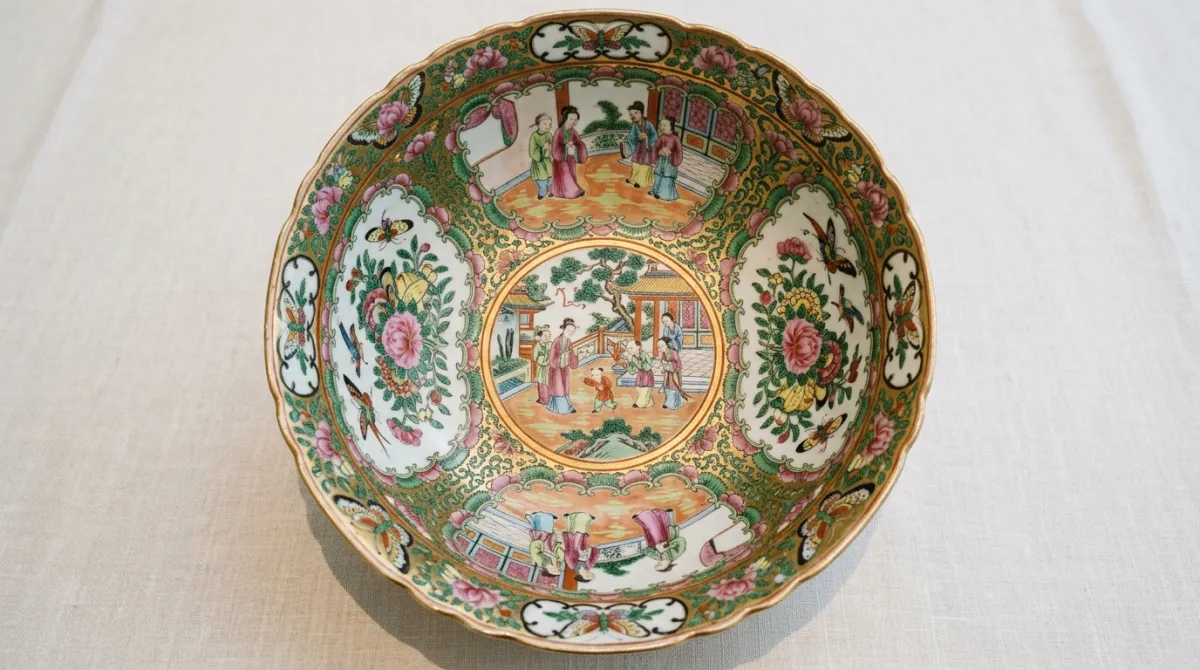
Think about the physics of it for a second. A punch bowl is big, heavy, and sat prominently on a sideboard or table, which meant it got handled, moved, and occasionally dropped far more than a stacked set of plates tucked in a cabinet. Every surviving large bowl, especially one without a rim chip or a repaired crack, represents a piece of genuine luck as much as good care.
Sizes vary, but a real punch bowl typically runs well beyond a serving bowl, sometimes a foot or more across, deep enough to hold a substantial volume of punch for a gathering. The painting on a punch bowl also had more surface to work with, so a well-painted example can show court figures, birds, and butterflies in a fuller, more ambitious composition than you’d see wrapped around a smaller form.
That combination, size, rarity of survival, and room for the painter to actually show off, is exactly why punch bowls tend to command the strongest interest among serious buyers. If you’re weighing a purchase and a punch bowl is on the table, it’s worth taking the extra time to look closely rather than rushing the decision.
What should you check before buying a Rose Medallion bowl?
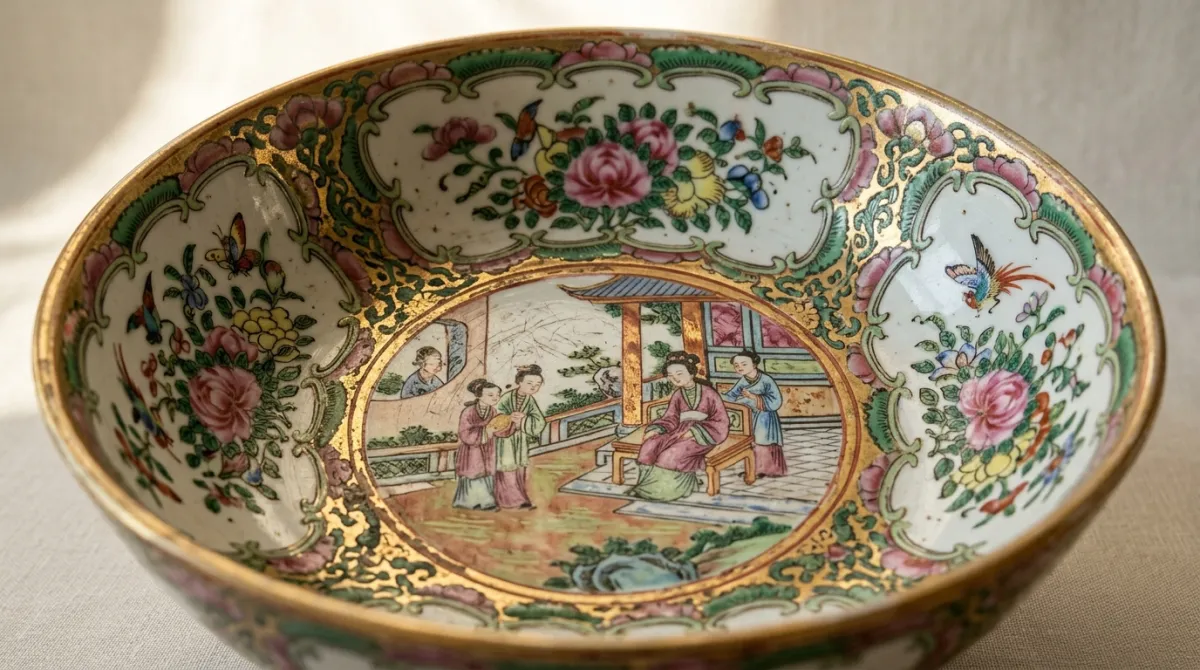
Check the interior wear pattern first, since bowls saw regular use and honest scratching or gilt loss on the inside is normal, not automatically a defect. Beyond that, rim condition, foot-rim wear, and painting quality inside and out matter more than any single detail taken alone. (How to identify Rose Medallion)
Interior wear and scratching
Run your eye, and then a finger, across the inside surface. Fine scratching from spoons and serving utensils, along with some gilt thinning near the rim where a ladle or hand repeatedly brushed the edge, is exactly what you’d expect on a bowl that actually got used. A pristine, unworn interior on a bowl claimed to be antique is, if anything, the more surprising find.
Rim chips and hairline cracks
Feel along the entire rim slowly, since a small chip is easy to miss by sight alone, especially if it’s been smoothed by a past repair. Hold the bowl up to strong light and look through the body near the rim and walls; a hairline crack often shows as a faint dark line when backlit, even when it’s nearly invisible in normal light.
Foot-rim wear
Turn the bowl over and look at the unglazed foot ring where it touched the table or shelf for generations. Genuine age tends to show as soft, uneven wear rather than a uniform, freshly sanded look, and a foot rim that’s suspiciously clean or sharp-edged is worth a second look. This is one clue among several, not proof by itself.
Painting quality, inside and out
Look at both surfaces, because a bowl’s interior sometimes carries its own painted medallion or border, not just a plain glazed well. Confident brushwork, individual expressions on the court figures, and even color saturation point to a stronger example; flattened, repetitive faces suggest a hastier or later production run. Our marks and dating reference is a useful next stop once you’ve formed an initial impression of a piece.
What actually drives a Rose Medallion bowl’s value?
Value tends to track form and size, painting quality, condition, age, and rarity, in roughly that order, though this is general market sense rather than a fixed formula. A large, finely painted, undamaged punch bowl will typically outvalue a small, average bowl even from an earlier period. (Kerry Kwok, GoodTime Studio Macau)
Form and size matter more than a lot of new collectors expect. A punch bowl or a large footed serving bowl is inherently scarcer than a small rice bowl simply because fewer were made and fewer survived whole. Painting quality is the next big factor, and it shows up the same way it does on plates: confident linework, well-drawn faces, and gilding that’s held up honestly over time.
Condition can make or break a bowl’s value in a way it doesn’t always for flatter forms. A rim chip on a punch bowl is more visually disruptive than the same chip on a plate’s edge, and buyers notice. Age adds a modest boost once quality and condition are already established, but it’s not the deciding factor on its own, and rarity of form, an unusual cut-corner shape or a size rarely seen, can push interest up regardless of exact date.
Spotting a later reproduction bowl
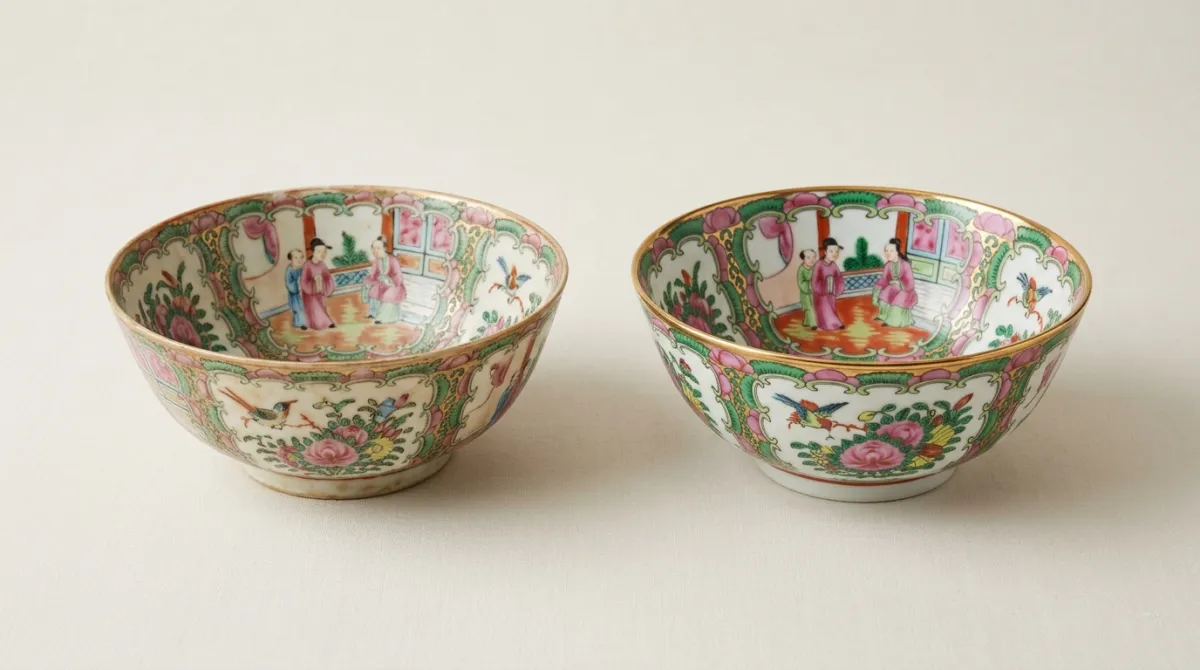
Later 20th-century reproduction bowls exist in real numbers, and some are convincing enough to fool a casual buyer at a glance. A whiter, more uniform body and brighter, more mechanically even gilding are worth weighing, though neither one is proof by itself. (How to identify Rose Medallion)
Documented Western reproduction houses produced Canton-style patterns for the mid-20th-century decorative trade, and those pieces typically carry a maker’s backstamp rather than a Chinese reign mark, which is a genuinely useful, honest clue once you know to look for it. Where it gets harder is when a backstamp has been ground away or a fake reign mark applied deliberately.
That’s exactly why body weight, foot-rim wear, and enamel texture matter more than any single tell on their own. A convincing fake mark is easy enough to produce; decades of honest handling wear is much harder to fake convincingly. Kerry keeps a couple of confirmed reproduction bowls in the studio purely for teaching, because comparing a genuine antique interior against a later one, side by side, trains the eye faster than any written description manages.
Can you actually use an antique Rose Medallion bowl?
Antique Rose Medallion is best treated as decorative, display-quality porcelain rather than everyday serving ware. The overglaze enamels and gilding sit on top of the fired glaze, and on older pieces those layers can contain lead, so serving food or punch from an antique bowl isn’t something we’d recommend without knowing the piece is genuinely sound. (How to clean antique Rose Medallion)
Wear, old repairs, and past restoration all affect how sound a piece actually is, and there’s no reliable way to judge lead content by eye alone. If a bowl shows visible gilt loss, a hairline crack, or an old rivet repair, it’s safest treated as display-only. Hand-wash gently if you do handle a piece, never in a dishwasher, and our full care guide walks through the rest of the routine. A new commission, by contrast, can be painted to modern food-safe standards, a genuinely different proposition from putting an antique back into service.
Why commission a custom bowl?
Because the antique market sells what survived, not what you actually need, and a specific size, a true punch bowl, or a piece to match an existing set is often exactly what’s missing from what’s out there. A hand-painted commission solves that gap directly. (Kerry Kwok, GoodTime Studio Macau)
I’ve watched this happen more than once at the studio. Someone owns four rice bowls from an inherited set and wants a matching punch bowl that, as far as anyone can find, was never part of the original run. Someone’s hosting a large gathering and wants a genuinely oversized punch bowl in a size the antique market simply doesn’t reliably supply. Isn’t it a little strange that the piece meant to be the centerpiece is often the hardest one to actually find?
None of that is a flaw in the antiques themselves. It’s just the nature of a fixed, finite supply from workshops that stopped producing generations ago. A custom hand-painted bowl, made to your size and reserve count, and even matched to an existing set’s palette, sidesteps that limitation entirely. It won’t be antique, and a good studio should tell you that plainly, but it can be exactly what the secondary market couldn’t produce. If a specific bowl is what you’re after, GoodTime Studio Macau’s commission page is a reasonable place to start that conversation.
Frequently asked questions
Are Rose Medallion punch bowls valuable?
Often, yes, and a large, well-painted, intact punch bowl is typically among the most sought-after forms in the whole pattern. Value still depends on painting quality, condition, and rarity rather than size alone, so a damaged punch bowl can still be worth less than a small, flawless piece.
How do I tell if a bowl is antique?
Look at the body weight, glaze tone, and foot-rim wear together with the enamel texture and gilding wear. No single clue proves it by itself; read them as a set, and our identification guide walks through the details more fully.
Why is the inside of my bowl so worn?
Because bowls got used, and interior scratching or gilt thinning near the rim is a normal sign of honest handling over decades, not a defect. A completely pristine interior on a supposedly old bowl is, if anything, the more unusual find.
Can I eat or serve from an antique Rose Medallion bowl?
We’d treat it as display-only unless you know the piece is genuinely sound, since overglaze enamels and gilding on older pieces can contain lead. Hand-wash gently if you handle it at all, and see our care guide for the full routine.
Were Rose Medallion bowls made in matched sets?
Sometimes, but not as consistently as buyers assume. Rice bowls were often ordered in small groups, while a punch bowl was frequently a standalone piece rather than part of a boxed set, so a “matched” grouping today was often assembled later from separate pieces of similar age and style.
A last word on collecting bowls
Bowls, and punch bowls especially, reward patience more than almost any other Rose Medallion form. They’re harder to find intact, they show their use more honestly, and a genuinely large, well-painted example is worth taking your time over. Whether you’re trying to complete an inherited set of rice bowls or chasing the punch bowl that pulls a whole table together, start from what the piece actually shows you, not what a listing claims, and let that guide the decision. For plates and platters, our companion piece on Rose Medallion plates covers similar ground for the flatter forms.
Simon Iong writes about Rose Medallion history and value. Craft insight in this piece comes from Kerry Kwok of GoodTime Studio Macau, a working 廣彩 painter trained under master Lei Iat Po.
Keep exploring
More from Rose Medallion
Identification, history, and care guides for Rose Medallion and Canton porcelain. New guides added regularly.
Explore all guides