identify value
Rose Medallion Plates and Platters: A Collector's Guide
Key Takeaways
- Rose Medallion plates range from small bread plates to large chargers and platters, and many sets on the market today were assembled over time rather than bought as a single matched purchase.
- Complete, tightly matched antique sets of six or twelve are less common than buyers often expect; many “sets” for sale were pieced together over decades from separate pieces of similar size and palette.
- Painting quality and condition matter more to value than age alone, and honest wear, gilt loss, and crazing are clues to read together, not proof by themselves.
- Later 20th-century reproduction plates exist in real numbers, and some are good enough to fool a casual buyer at a glance.
- If you need a specific size, a full matched set, or a plate for a gift the antique market simply can’t supply, a hand-painted commission is often the more practical route.
I’ve lost count of the number of times someone has brought Kerry Kwok a single Rose Medallion plate at GoodTime Studio Macau and asked, almost apologetically, whether she can “just paint five more like it.” It’s a fair question. Plates are the piece of Rose Medallion most people actually own, whether it’s one inherited platter or a half-finished set from a grandmother’s cabinet. So what should you actually know before you buy, sell, or try to complete one?
What plate and platter forms did Rose Medallion actually come in?
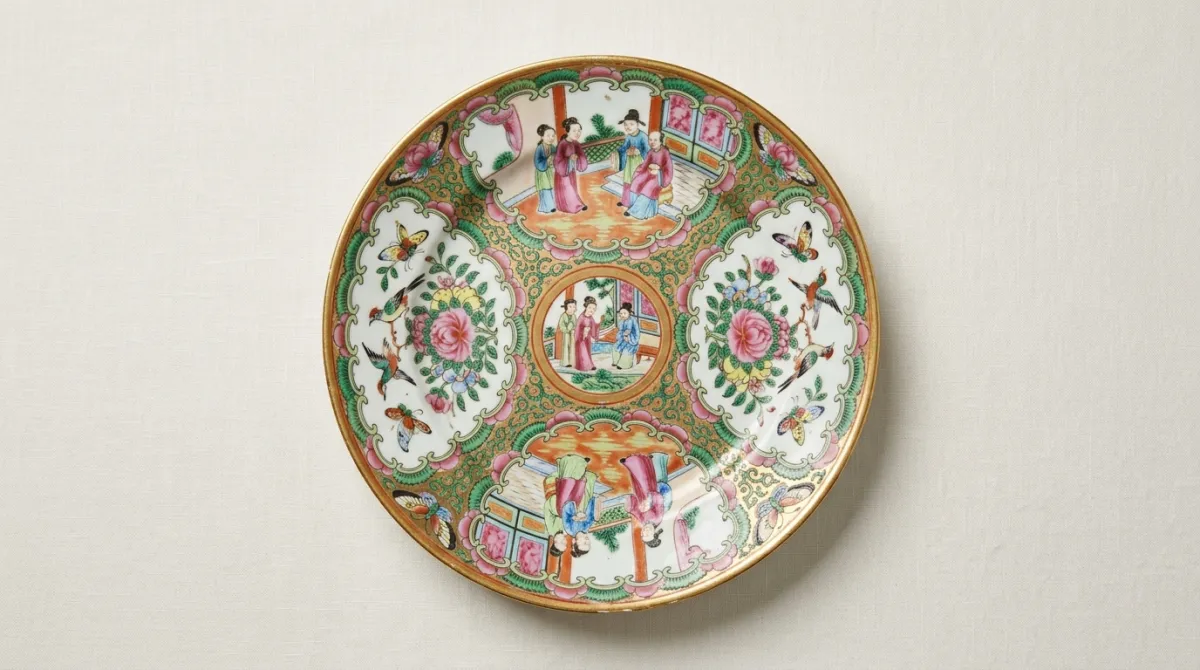
Rose Medallion plates were made in a wide range of forms and sizes for the export table, from small bread and butter plates through dinner plates up to large round or oval serving platters and chargers. Export porcelain workshops in Canton produced these forms in volume for Western dining customs, not as isolated decorative objects. (Rose Medallion complete guide)
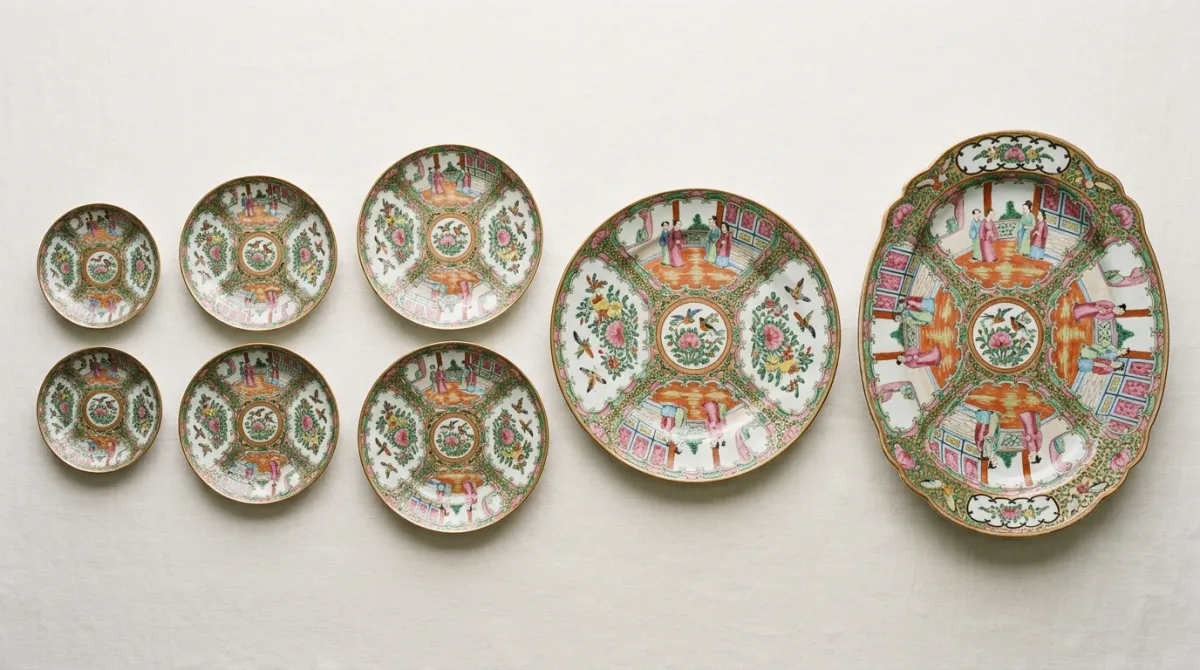
The smallest plates in a typical run were bread or side plates, often in the 6 to 7 inch range, meant to sit beside a dinner setting rather than anchor it. Dessert and salad plates came in a step up from there, usually somewhere around 7 to 8 inches, and dinner plates themselves typically ran from about 9 to 10 inches across, close to what a Western dinner service of the period expected.
Larger forms are where things get more interesting for collectors. Cake plates and chargers could stretch well past 10 inches, and platters, particularly oval serving platters meant for a whole fish or a joint of meat, sometimes ran 14 to 18 inches or more along the long axis. Round chop plates, meant for a centerpiece serving of rice or a whole dish, tend to sit in a similar large range.
It’s worth remembering these weren’t necessarily bought as a single boxed “set” the way a modern dinner service is. Export orders were placed by merchants and individual households, sometimes over more than one shipment, so a period dinner service might include plates painted years apart by different hands in the same workshop tradition.
What does a “matched set” of Rose Medallion actually mean?
Complete, tightly matched antique sets, meaning plates painted at the same time by the same hand with identical reserves and palette, are less common on today’s market than buyers often expect. Many “sets” for sale were assembled later from separate pieces of similar age and style, so “set of twelve” on a listing rarely means what it implies. (Kerry Kwok, GoodTime Studio Macau)
Think about it for a second: how many complete twelve-piece dinner services survive a century and a half of use, moves, and the occasional dropped tray, with every single plate intact? Not many. What survives, and what circulates on the antiques market, is usually a partial set, six plates here, four there, plus a platter that got separated from its original service generations ago.
Dealers and estate sales routinely combine plates from different original services to present something that looks like a complete set to a buyer. This isn’t necessarily dishonest, a careful dealer will tell you the pieces are “associated” rather than original to one service, but it does mean you should look closely rather than assume uniformity.
Compare painted reserves side by side if you’re buying more than one piece as a set. Look at the court figures, the peonies, the border patterns, and the gilt banding. Small differences, a slightly different shade of enamel, a border pattern that doesn’t quite line up, or gilding that reads brighter on some pieces than others, can indicate the plates weren’t painted together, though minor variation also occurs naturally within one honest workshop run.
How do you judge painting quality and condition on a plate?
Painting quality is usually the single biggest factor separating a desirable plate from an unremarkable one, and it shows up in confident brushwork, well-drawn faces, and even color saturation across the whole surface. Condition runs a close second, since even fine painting loses much of its appeal once chips, cracks, or enamel loss set in. For a deeper look at reading brushwork and gilding, see how to identify Rose Medallion.
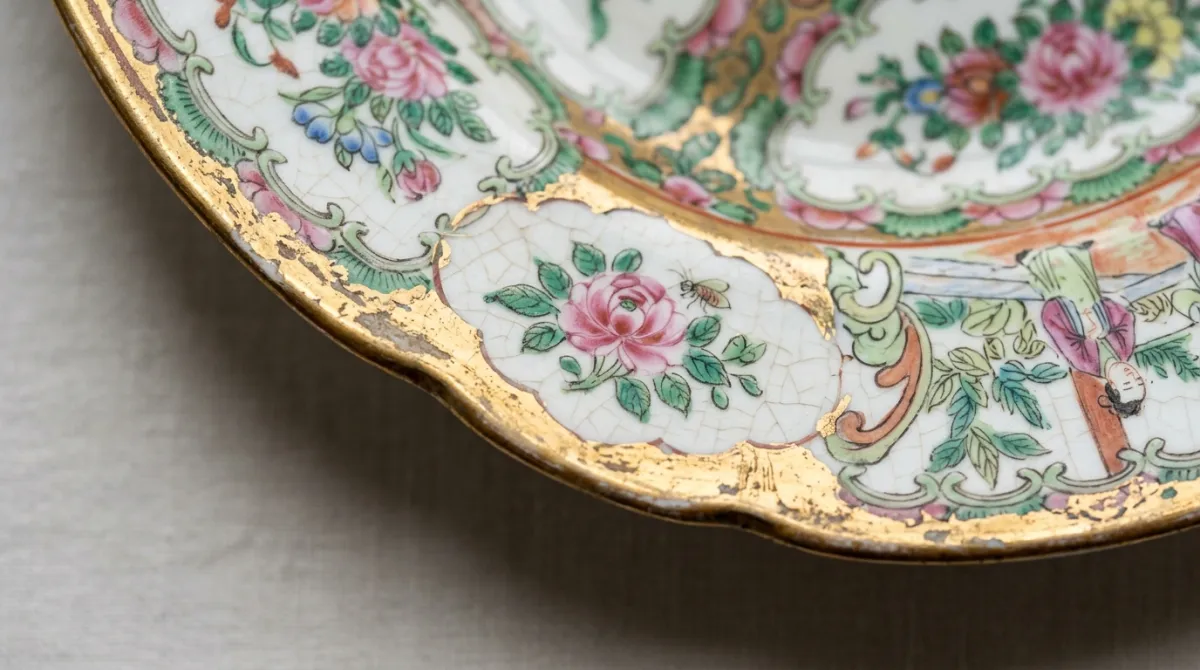
Hold a plate up at an angle in good light and look at the central medallion first. On finely painted examples, the court figures have individual expressions and the folds of clothing follow a natural, unforced line. Hastily painted pieces, often from later or lower-tier production runs, tend to flatten faces into near-identical, slightly stiff expressions repeated around the border.
Check the rim and border panels next, since that’s where a set’s overall consistency (or lack of it) usually shows first. Run your finger lightly around the edge, feeling for chips or a hairline crack you might not immediately see. Hold the plate to a bright light and look through it; a hairline often shows as a faint dark line when backlit, even when it’s nearly invisible from the front.
Look for crazing, the fine network of hairline cracks that can develop in old glaze over time. A little crazing is common and doesn’t automatically ruin a piece, but heavy crazing paired with staining inside the cracks tends to point to a harder life, possibly including past exposure to heat or moisture that wasn’t kind to the glaze. None of these signs work alone, they’re worth reading together, the same way you’d read the body and gilding when judging age. Our marks and dating reference covers how backstamps and reign marks fit into that same picture.
What actually drives the value of a Rose Medallion plate or platter?
Value tends to track painting quality, condition, size and rarity of form, and genuine age, in roughly that order, though dealers weigh these differently and this is general market sense rather than a fixed formula. A large, finely painted, undamaged platter will typically outvalue a small chipped plate even from an earlier period. (Kerry Kwok, GoodTime Studio Macau)
Size and form matter more than a lot of new collectors expect. Large platters and chargers survive in smaller numbers than dinner plates simply because there were fewer of them made per service to begin with, and their size made them more likely to be dropped or chipped over generations of use. An intact large platter is genuinely harder to find than an intact small plate of similar age.
Rarity of form works the same way. A plain round dinner plate is common; an unusual shape, a deep well platter, a scalloped rim, or a less typical border treatment, tends to draw more interest from serious collectors precisely because it’s less often seen. That rarity is worth something even when the painting quality is only average.
Genuine age adds a further, modest boost, but only once quality and condition are already established. An unremarkable, damaged 19th-century plate isn’t automatically worth more than a beautifully painted, sound early-20th-century one. It’s less a strict hierarchy and more a set of factors pulling in the same general direction, or not, and that’s exactly why two plates that look similar at a glance can be valued quite differently by someone who knows what they’re looking at.
How can you tell an antique plate from a later reproduction?
Later 20th-century reproduction plates exist in genuine numbers, some sold honestly as decorative reproductions and some later mistaken for antique when resold. A whiter, more uniform body can suggest a later piece, and brighter, more evenly applied gilding is another clue worth weighing, though neither is proof on its own, just one clue among several. Enamel work, while often competent, reads as more mechanical than freehand antique painting. (How to identify Rose Medallion)
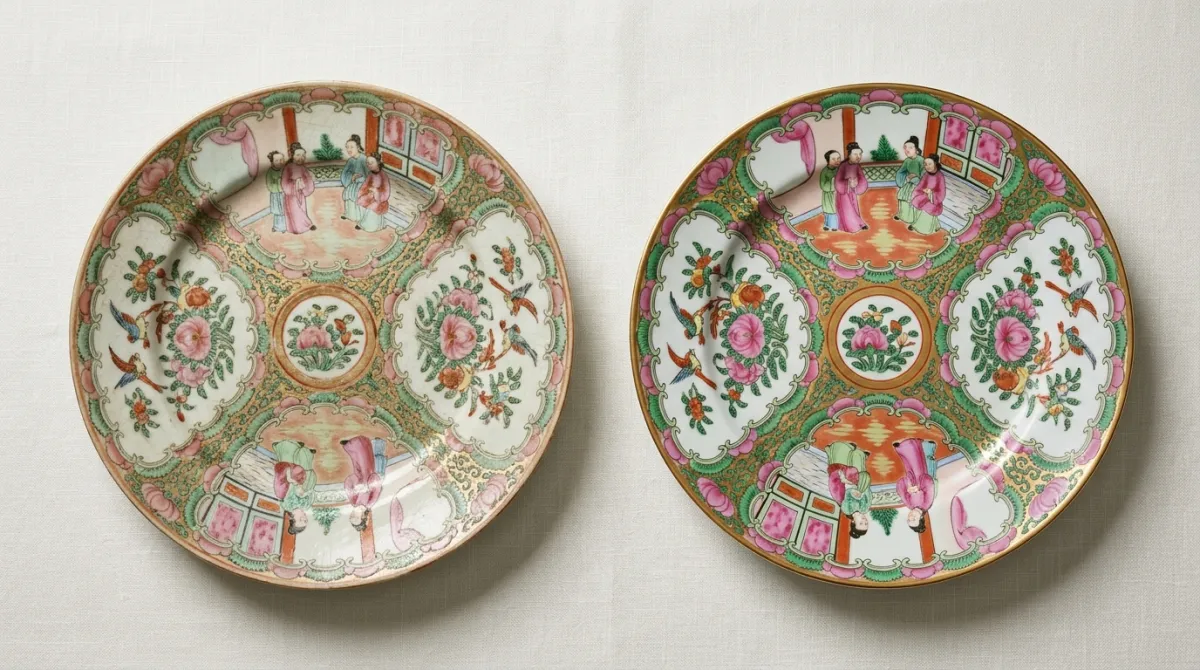
Documented Western reproduction houses, Mottahedeh is the name that comes up most often, produced Rose Medallion and related Canton-style patterns for the mid-20th-century American decorative trade. Pieces from these runs typically carry a maker’s backstamp rather than a Chinese reign mark, which is actually a useful, honest signal once you know to look for it.
Where it gets trickier is with pieces where a backstamp has been ground off, or plates made specifically to mimic an antique look more closely, sometimes with an applied fake reign mark. This is exactly why body weight, foot-rim wear, and enamel texture matter more than any single tell on their own. A convincing fake mark is easy to produce; decades of honest handling wear is much harder to fake well.
Kerry keeps a small shelf of confirmed reproduction plates in the studio purely for teaching, because comparing a genuine antique reserve against a later or printed one, side by side under the same light, trains the eye faster than any description can. If you’re weighing a purchase, ask the seller directly whether a piece is being sold as antique or as a later reproduction, and factor the answer into the price you’re willing to pay.
Are Rose Medallion plates safe to display and use?
Antique Rose Medallion is best treated as decorative, display-quality porcelain rather than everyday tableware. The overglaze enamels and gilding sit on top of the fired glaze rather than fused into it, and on older pieces those decorative layers can contain lead, so eating or drinking off an antique plate isn’t something we’d recommend without knowing the piece is genuinely sound. (How to clean antique Rose Medallion)
Wear, old repairs, and past restoration all affect how sound a piece really is, and there’s no reliable way to judge lead content by eye alone. If a piece has visible gilt wear, a hairline crack, or an old rivet repair, treat it as display-only and skip soaking it entirely. Even a piece that looks sound is better handled with care than used routinely at the table, and that’s ultimately a judgment call for the owner.
Hand-wash any piece you do handle, in lukewarm water only, never in a dishwasher. Our full care guide walks through handling and storage in more detail, including when it’s worth calling a conservator instead of attempting anything yourself. If you want a plate you can genuinely use at the table, a new commission can be painted to modern food-safe standards, a different proposition entirely from putting an antique back into daily service.
Why can’t the antique market reliably give you what you actually want?
Because the antique market sells what survived, not what you need, and buyers regularly want a specific size, a complete matched set, or a plate for a particular occasion that simply doesn’t exist among surviving pieces. This is where a hand-painted commission genuinely solves a problem the secondary market can’t. (Kerry Kwok, GoodTime Studio Macau)
I’ve watched this play out at the studio more times than I can count. Someone inherits four Rose Medallion dinner plates and wants eight to seat a full table. Someone’s getting married and wants a platter painted with a family crest worked into the border, alongside the traditional court figures. Someone simply loves the pattern and wants a large charger in a size that, as far as anyone can tell, was never made at all in the original export runs.
None of that is a flaw in the antiques themselves, it’s just the nature of buying something a workshop stopped making generations ago. Antique supply is fixed. It doesn’t grow to match a modern table setting or a specific wedding date, no matter how much a buyer might wish it did.
A custom hand-painted plate or platter, made to your size, your reserve count, and even a personalized detail worked into an otherwise traditional border, sidesteps that problem entirely. It won’t be antique, and a good studio will tell you that plainly, but it can be exactly the piece the antique market couldn’t produce for you. If that’s the gap you’re facing, GoodTime Studio Macau’s commission page is the place to start that conversation.
Frequently asked questions
How much are Rose Medallion plates worth?
Value varies widely and depends on painting quality, condition, size, and rarity of form rather than age alone. A small, chipped, average-quality plate is worth modestly little, while a large, finely painted, undamaged platter or unusual form can be significantly more sought after. There’s no fixed price formula, only general market sense built from comparing similar pieces.
How do I tell if my plates are antique or reproduction?
Check the body weight and glaze tone, look for hand-painted brushwork sitting slightly proud of the glaze, and examine gilding for honest, uneven wear rather than uniform brightness. No single clue proves it alone; read them together, and see our identification guide for a fuller walkthrough.
What sizes do Rose Medallion plates come in?
Sizes range from small 6 to 7 inch bread plates up through 9 to 10 inch dinner plates, cake plates and chargers past 10 inches, and platters that can run 14 to 18 inches or more along the long axis. Exact sizing varied by workshop and period, so treat these as general ranges.
Where can I buy Rose Medallion plates, or have one made?
Antique and reproduction plates turn up through estate sales, specialist dealers, and auction houses, though matched sets and specific sizes are hard to guarantee. For a specific size, a complete set, or a personalized piece, a hand-painted commission through GoodTime Studio Macau is often the more reliable route.
Are Rose Medallion plates safe to eat off?
Treat antique Rose Medallion as display ware rather than everyday tableware. Overglaze enamels and gilding can contain lead and sit unfused on top of the glaze, so we wouldn’t recommend eating or drinking off an antique piece without knowing it’s sound, and even then it’s a call for the owner to make. Hand-wash only if you do; see our care guide for the full routine.
A last word on collecting plates
Plates and platters are where most people start with Rose Medallion, and honestly, where most collections quietly stall too, once someone realizes a truly matched set is harder to find than expected. That’s not a reason to give up on it. It just means separating what the antique market can genuinely offer from what you’re hoping to complete at home, and being honest with yourself about which one you’re actually chasing. Whether you’re hunting a single platter to finish an inherited set or thinking about a custom piece built to fit your table exactly, it helps to start from a clear picture of what’s realistic, and go from there.
Simon Iong writes about Rose Medallion history and value. Craft insight in this piece comes from Kerry Kwok of GoodTime Studio Macau, a working 廣彩 painter trained under master Lei Iat Po.
Keep exploring
More from Rose Medallion
Identification, history, and care guides for Rose Medallion and Canton porcelain. New guides added regularly.
Explore all guides