patterns motifs
Mandarin Porcelain (Rose Mandarin): The Figure-Focused Canton Ware
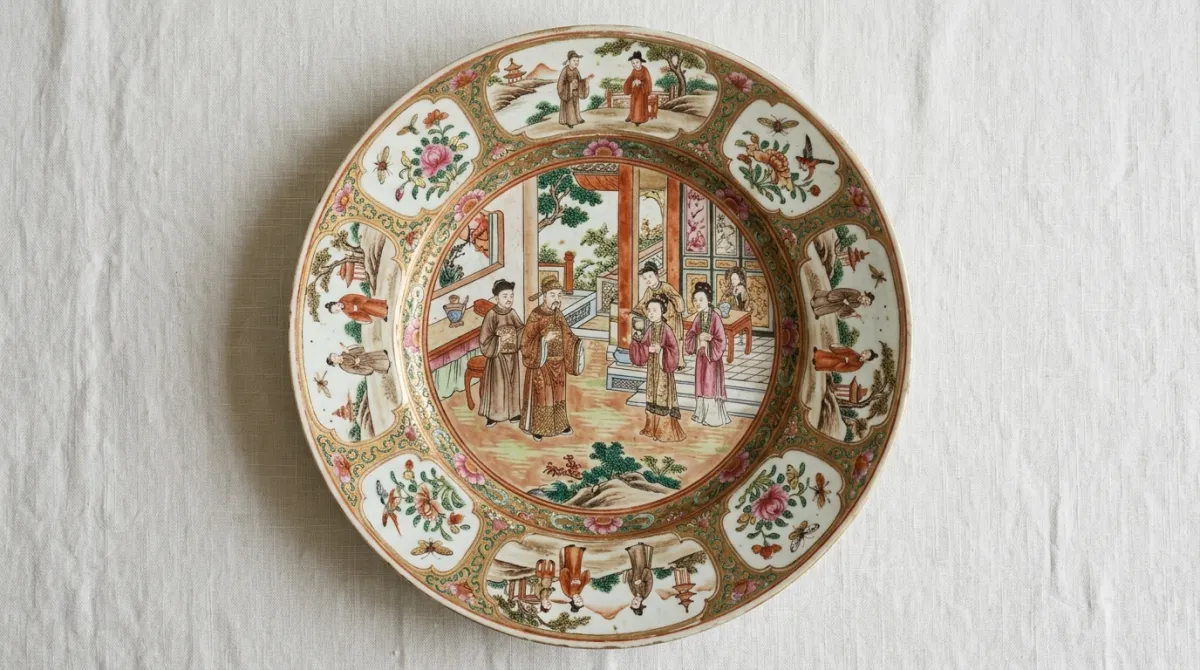
Key Takeaways
- Mandarin porcelain, or Rose Mandarin, is Canton famille-rose export ware where robed court figures dominate the reserves, rather than alternating with florals the way Rose Medallion does.
- Figure-heavy Mandarin-style Canton ware tends to trace earlier than Rose Medallion, into the late 18th century, though the two categories overlap and the dating is best treated as a general tendency, not a hard rule.
- The quick test: figures filling most of the panel means Mandarin, figures and flowers alternating evenly means Rose Medallion, and no figures at all means Rose Canton.
- Like its two relatives, “Mandarin” is a Western trade term applied after the fact, not a category Canton workshops used themselves, and dealers still apply it loosely today.
- See our full comparison of Rose Medallion, Rose Canton, and Mandarin for how all three patterns relate to one another.
What Is Mandarin Porcelain, or Rose Mandarin?
Mandarin porcelain is Canton famille-rose export ware whose panels are dominated by robed figures, usually officials or court attendants, rather than the alternating figures-and-flowers layout you’d see on Rose Medallion. The name comes from those officials, historically called “mandarins” in Western usage. Florals still show up, but they play a supporting role at most.
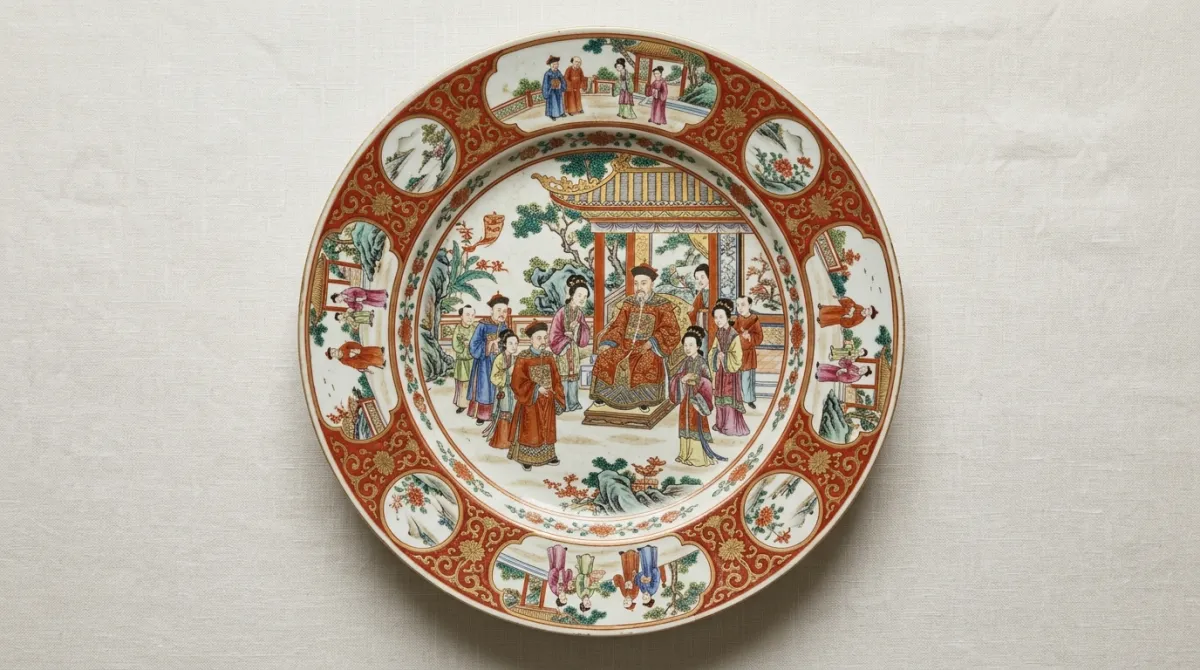
Picture a plate where one or two large scenes cover most of the surface: a group of robed figures in a courtyard or garden, maybe an attendant off to the side, with foliage sketched in behind them almost as scenery rather than as a subject in its own right. That’s the layout logic of Mandarin ware. Compare that to Rose Medallion, where the panels swap back and forth evenly between people and flowers around a central medallion, and the difference in emphasis is obvious once you know to look for it.
Mandarin pieces also tend to use sepia or grisaille detailing on the faces and fine linework, alongside strong orange and iron-red tones and plenty of gilt. That combination gives the palette a slightly different feel from the brighter, more uniformly pink Rose Medallion look, though the family resemblance, the gilt scrollwork, the dense reserves, is still very much there. Our beginner’s guide to Rose Medallion covers the trade-term history that applies to Mandarin just as much as it does to Medallion and Canton.
How Do You Tell Mandarin Apart From Rose Medallion and Rose Canton?
The fastest test is simple: count how much of each panel is figures versus flowers. Mandarin lets figures take over the whole scene, Rose Medallion splits the panels evenly between people and florals, and Rose Canton drops figures entirely in favor of birds and blossoms. That one question sorts most pieces correctly.
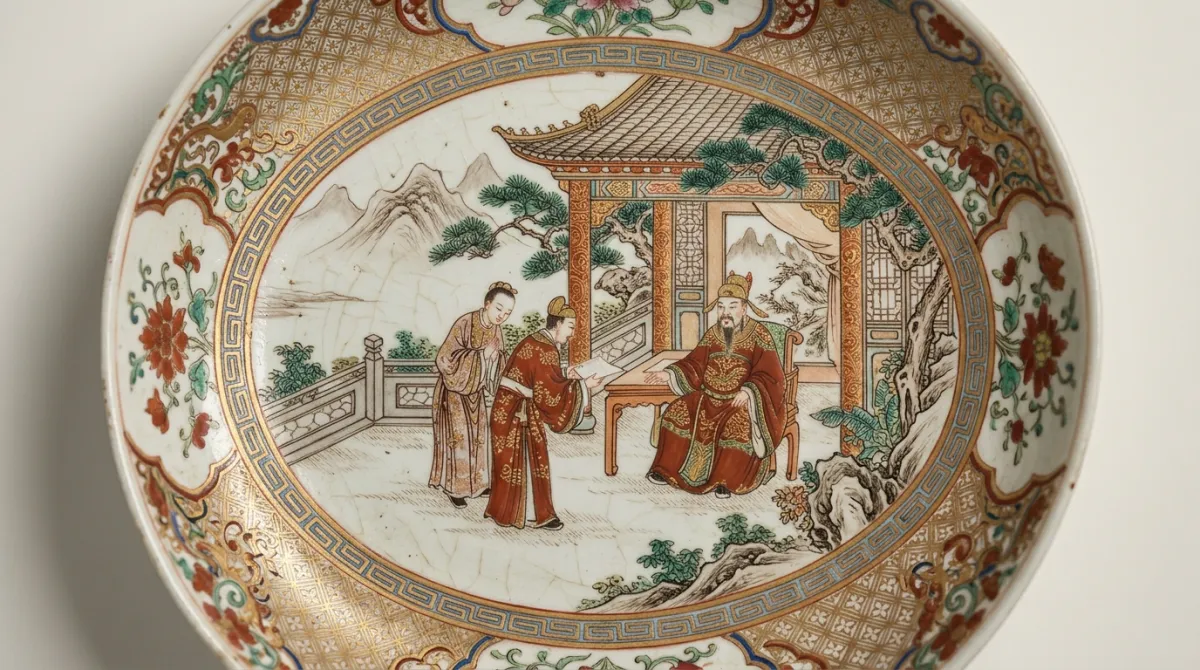
Walk the rim and look at panel size as well as content. Rose Medallion tends toward four to six modest reserves circling a central medallion, alternating in subject. Mandarin pieces often abandon that rhythm altogether, giving over one or two large panels almost entirely to a court scene, attendants included, with florals reduced to background filler if they appear at all. Our full identification guide walks through panel-by-panel checks that work well as a starting point here too, once you swap “count the alternation” for “check who’s winning the panel.”
Rose Canton sits at the opposite end from Mandarin on this same scale. It’s worth reading our dedicated piece on Rose Canton if you haven’t, since seeing the all-floral end of the spectrum makes the figure-heavy Mandarin end easier to recognize by contrast. Once you’ve looked at both extremes, Rose Medallion’s balanced middle ground stops feeling ambiguous.
Is this always a clean split? Not quite. Some pieces sit right on the border, where a “Medallion” plate has unusually large figural panels that start crowding out the florals and edging toward Mandarin territory. When that happens, dealers usually lean toward whichever term the piece more strongly resembles, and reasonable collectors can disagree without either side being wrong.
Is Mandarin Porcelain Older Than Rose Medallion?
Figure-dominant Mandarin-style Canton ware tends to trace earlier than Rose Medallion, with production reaching back into the late 18th century, while Rose Medallion is mostly a 19th century trade category. That’s a general tendency rather than a firm rule, and the two overlap for a good stretch of that history.
It helps to remember that none of these three names describe a strict, dated workshop tradition. Canton painters worked from shared pattern books across generations, and buyers in Europe and America kept ordering figure-heavy scenes well after Rose Medallion’s alternating layout became common too. So while an early, heavily figural piece is a reasonable candidate for an earlier date, that’s a tendency you weigh alongside other evidence, glaze, gilding, footrim wear, not a rule you apply on its own.
In our experience at the studio, buyers sometimes assume “more figures, older piece” is a hard formula, and it just isn’t reliable enough to lean on by itself. Kerry Kwok, the Canton-porcelain (廣彩) painter behind our studio’s work who trained under 廣彩 master Lei Iat Po and now runs GoodTime Studio Macau, has told me she’s seen plenty of later figural pieces that would fool a buyer using layout alone as a dating tool. Composition gives you a starting hypothesis, not a verdict.
Why Is It Called “Mandarin” Porcelain?
The name comes directly from the subject matter: robed officials, historically referred to as “mandarins” by Western traders and collectors describing Chinese court and civil officialdom. Since these figures dominate the panels on this particular style of Canton ware, the trade name attached itself to the pattern rather than to any specific workshop or region.
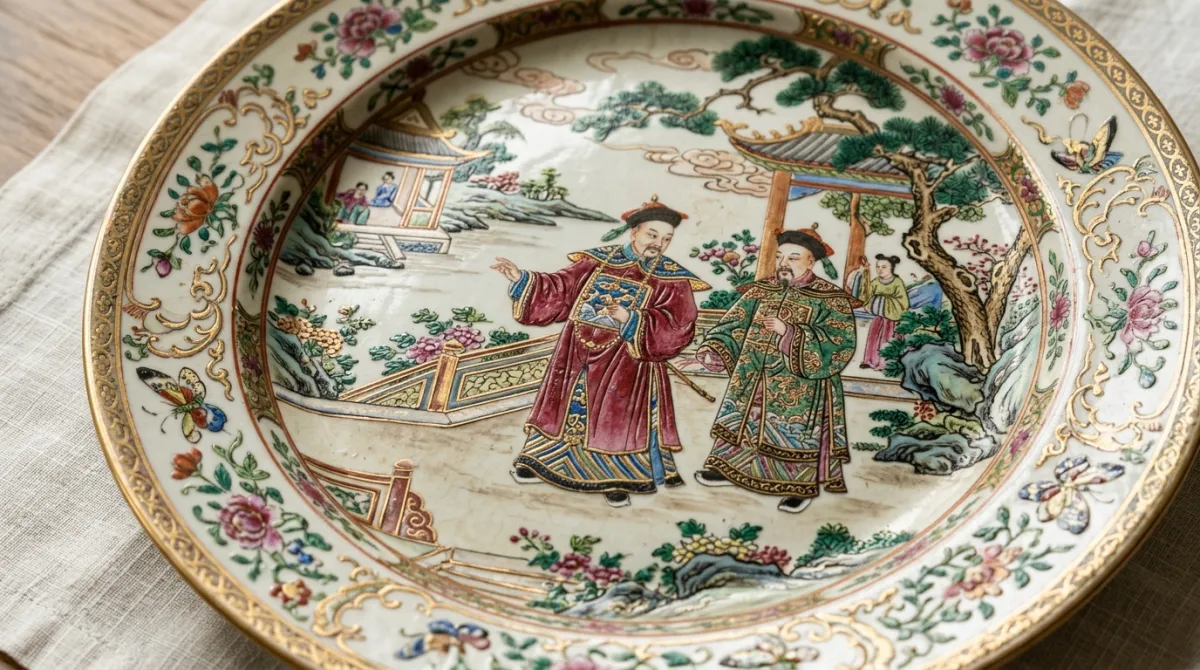
It’s the same naming logic that produced “Rose Medallion” and “Rose Canton,” honestly. Western dealers needed shorthand for what they were selling, decades after the porcelain left China, and they reached for whatever stood out visually. Robed officials stood out, so “Mandarin” stuck. None of these three names reflect how Canton workshops themselves organized or described their own output.
Isn’t it a little odd that a whole ceramic category gets named after what’s essentially a costume detail? Maybe, but it’s consistent with how most Chinese export porcelain terminology developed in the West: informally, visually, and well after the fact, with no single body enforcing a standard vocabulary across dealers and auction houses.
Is Mandarin Porcelain More Valuable?
Value depends on painting quality, condition, gilding wear, and rarity of shape far more than on which of the three pattern names applies to a piece. A well-painted, well-preserved Rose Medallion bowl can easily outvalue a mediocre Mandarin plate, and the reverse is just as true.
That said, finely executed figural work is genuinely harder to pull off than a repeated floral motif. Faces, posture, and robe folds all have to read correctly across a whole scene, and a weak hand shows up fast in figure painting in a way it doesn’t in a peony spray. So among pieces of otherwise similar age and condition, strong figural brushwork on a Mandarin piece often commands real respect from collectors, simply because it’s harder to do well.
We can’t point to firm market data breaking out “Mandarin” as its own consistent price tier separate from Rose Medallion or Rose Canton, and we’d be cautious of anyone who claims otherwise with too much confidence. What we can say from handling a lot of pieces over the years is that condition and craftsmanship still do most of the work in setting value, with the pattern name mostly along for the ride.
Caring for a Mandarin Porcelain Piece
Hand-washing with warm water and mild soap is the safest routine for antique or vintage Mandarin porcelain, the same as for Rose Medallion and Rose Canton. Dishwasher heat and detergent can dull gilding and stress old glaze faster than normal handling ever would.
Pieces with visible enamel wear, hairline crazing in the glaze, or fine gilt already thinning at the rim are best treated as decorative rather than functional. Display them on a stand, in a cabinet, or on a wall mount rather than rotating them through regular use. Sepia and grisaille figure work in particular can look flat or worn under harsh direct light over time, so a spot out of continuous sun exposure helps preserve the fine linework longer.
If a piece has real sentimental or monetary value and you’re unsure of its condition, it’s worth getting a specialist opinion before attempting anything beyond a light dusting. Some surface aging is part of an antique’s honest history, and overly aggressive cleaning can remove value along with dirt.
Frequently asked questions
What’s the difference between Mandarin and Rose Medallion?
Mandarin lets robed figures dominate the panels, often filling one or two large scenes, while Rose Medallion alternates figural and floral reserves evenly around a central medallion. Both share the same gilt-heavy, rose-pink family look, so layout and emphasis are what separate the two.
Is Rose Mandarin older than Rose Medallion?
Figure-dominant Mandarin-style ware tends to trace earlier, into the late 18th century, while Rose Medallion is mostly a 19th century trade term. The two overlap for decades, though, so treat this as a general tendency rather than a reliable dating rule on its own.
Why is it called “Mandarin” porcelain?
The name comes from the robed officials, historically called “mandarins” in Western usage, who dominate the decorated panels on this style. Like Rose Medallion and Rose Canton, it’s a trade term dealers applied after the fact, not a name Canton workshops used themselves.
Is Mandarin porcelain more valuable than Rose Medallion?
Not automatically. Condition, painting quality, gilding wear, and rarity of shape matter more than which pattern name applies. Strong figural brushwork is harder to execute well than repeated florals, so fine examples often earn respect, but a mediocre Mandarin piece won’t outvalue a superb Rose Medallion one.
Does Mandarin porcelain always have a lot of figures?
Figures are the dominant subject on most Mandarin pieces, but exact layouts vary. Some pieces devote nearly the whole surface to one large court scene, while others leave more room for background floral or garden detail. The consistent thread is that figures lead, and flowers, if present, play a supporting role.
The Short Version
Once you know to weigh figures against flowers, sorting Mandarin from Rose Medallion and Rose Canton gets a lot easier. Rose Canton sits at zero figures, Rose Medallion balances people and florals evenly, and Mandarin lets robed court figures take over the panel. The palette and gilding stay close across all three, so composition really is the test that matters.
Dealers will keep using these trade terms loosely, and that’s unlikely to change. Trust your own read of the panels over whatever the shelf tag says, and when in doubt, walk the rim and count what’s actually filling each reserve. If you’d like to see the whole family compared side by side, our full Rose Medallion, Rose Canton, and Mandarin comparison is a good next stop, and our pillar guide to Rose Medallion covers the broader pattern history in more depth. If you’ve fallen for the figure-heavy look and want a scene painted the traditional way, our commissions page covers hand-painted figural Canton work made using the same techniques Kerry learned from master Lei Iat Po.
Keep exploring
More from Rose Medallion
Identification, history, and care guides for Rose Medallion and Canton porcelain. New guides added regularly.
Explore all guides