patterns motifs
Rose Canton: The All-Floral Cousin of Rose Medallion
Key Takeaways
- Rose Canton is Canton famille-rose export porcelain decorated only with birds, butterflies, and flowers, no human figures anywhere on the piece.
- It shares the same rose-pink palette and gilt scrollwork as Rose Medallion; the presence or absence of people in the reserves is what separates the two.
- Dealers use “Rose Canton” and “Rose Medallion” loosely, so a piece labeled one way at a shop or estate sale can genuinely be the other.
- Rose Canton and Rose Medallion were produced alongside each other through the 19th century; neither name reliably tells you which came first.
- See our full comparison of Rose Medallion, Rose Canton, and Mandarin for how all three patterns relate.
What Exactly Is Rose Canton Porcelain?
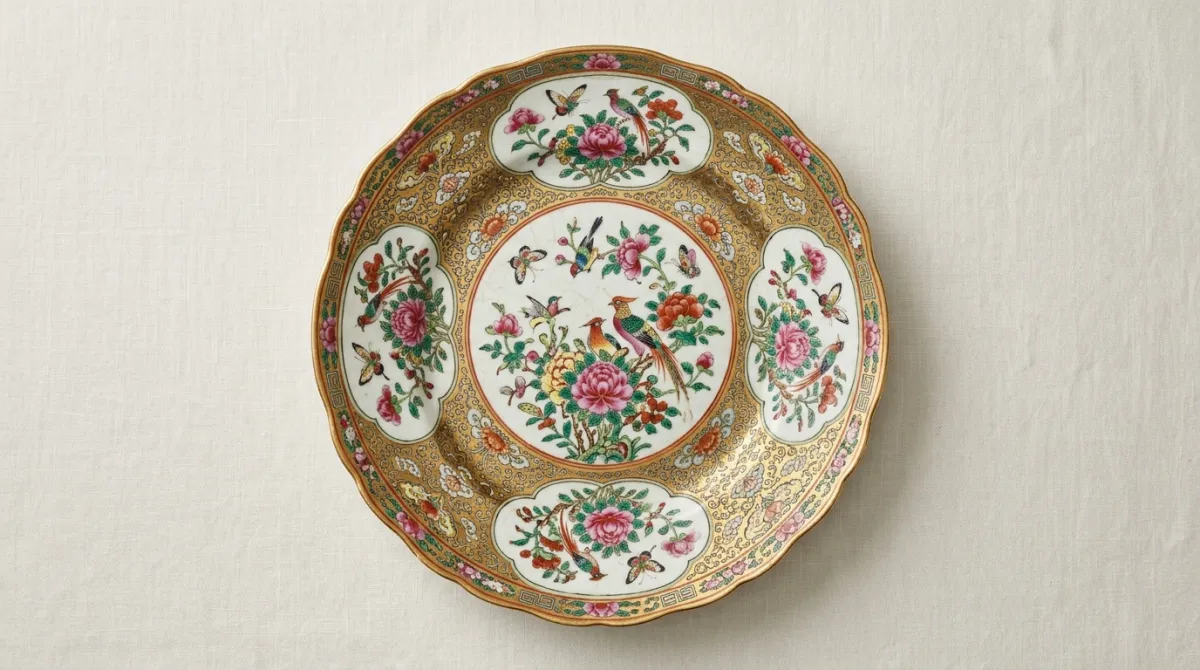
Rose Canton is Chinese export porcelain, painted in Canton (Guangzhou) in the famille-rose palette, whose panels contain only flowers and birds, never people. That single missing element, human figures, is the clearest thing separating it from its better-known cousin, Rose Medallion. The gilding, the pink enamels, and the general “busy” look stay the same.
Picture a plate ringed with gilt-framed reserves, the same alternating panel structure you’d see on a Rose Medallion piece. Now imagine every one of those panels holds a peony spray, a pair of songbirds, or a butterfly among chrysanthemums, and nothing else. No robed court figures, no garden scenes with people in them. That’s Rose Canton in a sentence.
It’s worth saying up front that “Rose Canton” is a Western collector’s trade term, not a name Chinese workshops used themselves. Painters in 19th century Canton studios weren’t sorting their own output into “Medallion” and “Canton” bins. They worked from shared pattern books, repeating florals and figures as orders demanded, and dealers back in Europe and America applied these labels afterward to describe what they were selling. Our beginner’s guide to Rose Medallion goes into that naming history in more depth, since the same trade-term logic applies to both patterns.
How Does Rose Canton Differ From Rose Medallion?
The difference comes down to one question: are there people anywhere on the piece? Rose Medallion alternates figural panels with floral ones around a central medallion (Rose Medallion vs Rose Canton vs Mandarin, which covers all three patterns side by side). Rose Canton drops the figures entirely and fills every reserve with birds and flowers instead.
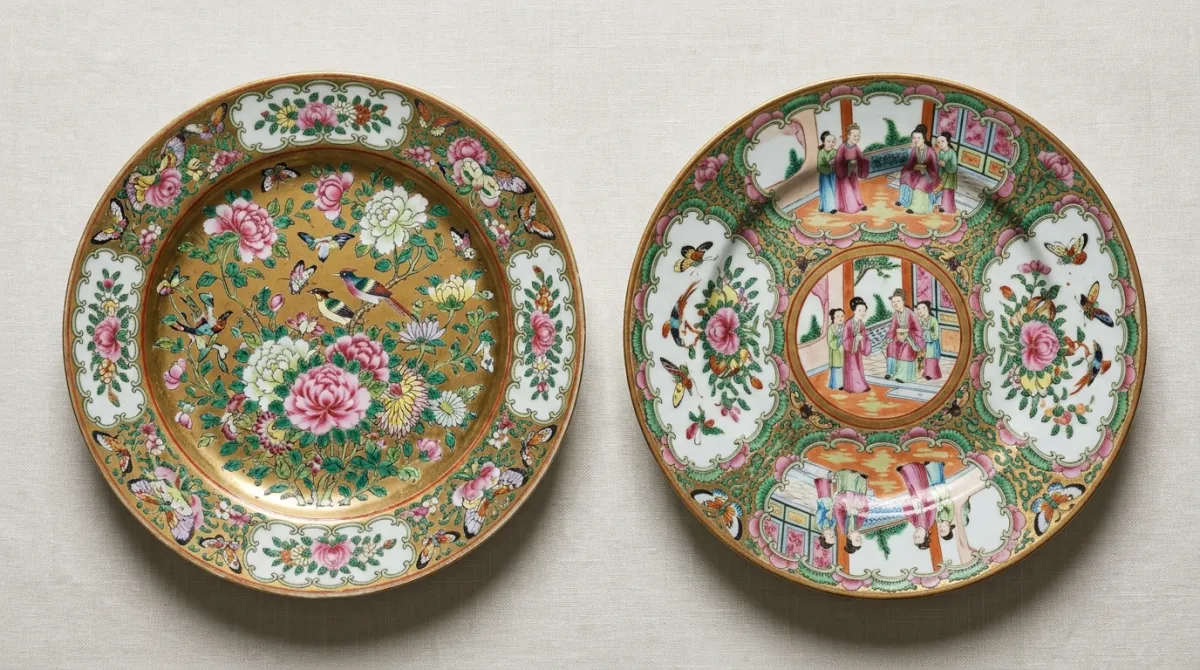
Everything else tends to carry over. The rose-pink enamel, the dense gilt scrollwork between reserves, the general shape range (plates, bowls, vases, tea sets), all of it looks nearly identical between the two patterns. If you set a Rose Medallion plate next to a Rose Canton plate, your eye would probably go straight to the palette and border first and assume they’re twins. They basically are, minus the people.
Why would a workshop choose one over the other? Figural scenes take longer to paint well. Faces, robes, and posture all have to read correctly, or the whole panel looks off. A peony or a perched bird is more forgiving. Kerry Kwok, the Canton-porcelain (廣彩) painter behind our studio’s work, has told me that in her own practice florals move noticeably faster than figures: “a face has to be right or the whole panel looks wrong; a peony just has to look like a peony.” That’s shop talk from her own bench rather than documented workshop history, but it lines up with why an all-floral order might have been cheaper or quicker to fill for buyers who didn’t care about court scenes.
We can’t point to surviving 19th century production records that spell out exact pricing or scheduling decisions piece by piece. What we can say, based on looking at hundreds of pieces over the years, is that the floral-only option existed as a real, common alternative, not a rare oddity within the broader Canton famille-rose family.
How Can You Recognize Rose Canton at a Glance?
Look for gilt-bordered reserves that hold only birds, butterflies, and flowers, with zero human figures on the entire piece. That’s the fastest, most reliable check. Everything else, the pink enamel, the busy gilt scrollwork, the panel layout, is shared with Rose Medallion and won’t help you sort the two apart on its own.
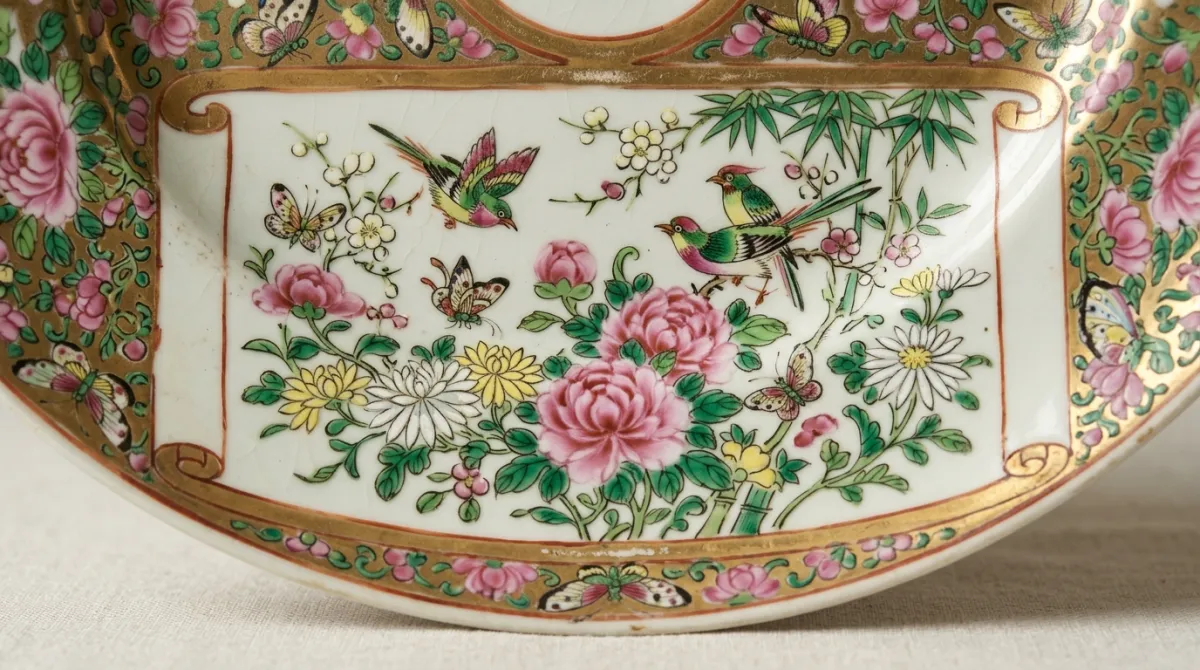
Walk the rim of the piece and count what’s in each reserve. Peonies, chrysanthemums, long-tailed birds, butterflies, maybe a rock or a bit of garden scenery sketched in behind the flowers, but never a robed figure standing in a courtyard or garden scene. If you spot even one small figure tucked into a corner panel, you’re probably looking at Rose Medallion instead, not Rose Canton.
Some pieces keep a distinct central medallion, often a peony spray or a rounder floral cluster, framed and set apart from the surrounding reserves. Others spread the floral decoration more evenly across the surface without any single obvious center. Both versions get called Rose Canton correctly, since the defining feature is the absence of figures, not the presence of a medallion.
Ground color matters less than layout here too. Most Rose Canton pieces use the same dense rose-pink or gilt lattice background that fills the gaps between reserves, the look that makes the whole family read as “busy” compared to plainer export wares. That shared aesthetic is exactly why the three related patterns get confused so often. Our full identification guide walks through the panel-by-panel checks in more detail, and most of it applies directly to Rose Canton once you swap “look for figures” for “confirm there aren’t any.”
Why Do Dealers Mix Up Rose Canton and Rose Medallion So Often?
Estate sale tags and shop labels frequently apply these names inconsistently, so a piece marked “Rose Canton” can turn out to be true Rose Medallion, and the reverse happens just as often. This isn’t sloppiness so much as a byproduct of how the trade terms developed: informally, decades after the porcelain left China, with no governing body standardizing usage.
In our experience running the studio, the mislabeling tends to cluster around one specific case: pieces where the figural panels are unusually small or tucked into a busy floral field. A dealer glancing quickly at the piece sees mostly flowers and birds and reaches for “Rose Canton,” missing a single small figure worked into one reserve. That piece is technically Rose Medallion, just a floral-heavy example of it.
The reverse mislabeling happens too, though less often in my observation. A genuinely all-floral piece occasionally gets called “Rose Medallion” simply because sellers reach for the more widely recognized name, since Rose Medallion tends to be the term casual buyers search for online. Neither error is malicious. It’s just imprecise cataloging built on decades of loose usage.
Isn’t it a little maddening to shop by name when the names themselves aren’t reliable? Sure, but it’s manageable once you know to check the actual panels rather than trusting the tag. Count what’s painted in each reserve yourself, and the label on the shelf stops mattering nearly as much.
How Do You Date and Value a Rose Canton Piece?
Age and value for Rose Canton depend on the same factors as any Canton famille-rose ware: enamel wear, gilding condition, glaze quality, and the porcelain body itself, not the pattern name. Rose Canton and Rose Medallion were produced concurrently through the 19th century, so neither term by itself tells you whether a piece is older or newer.
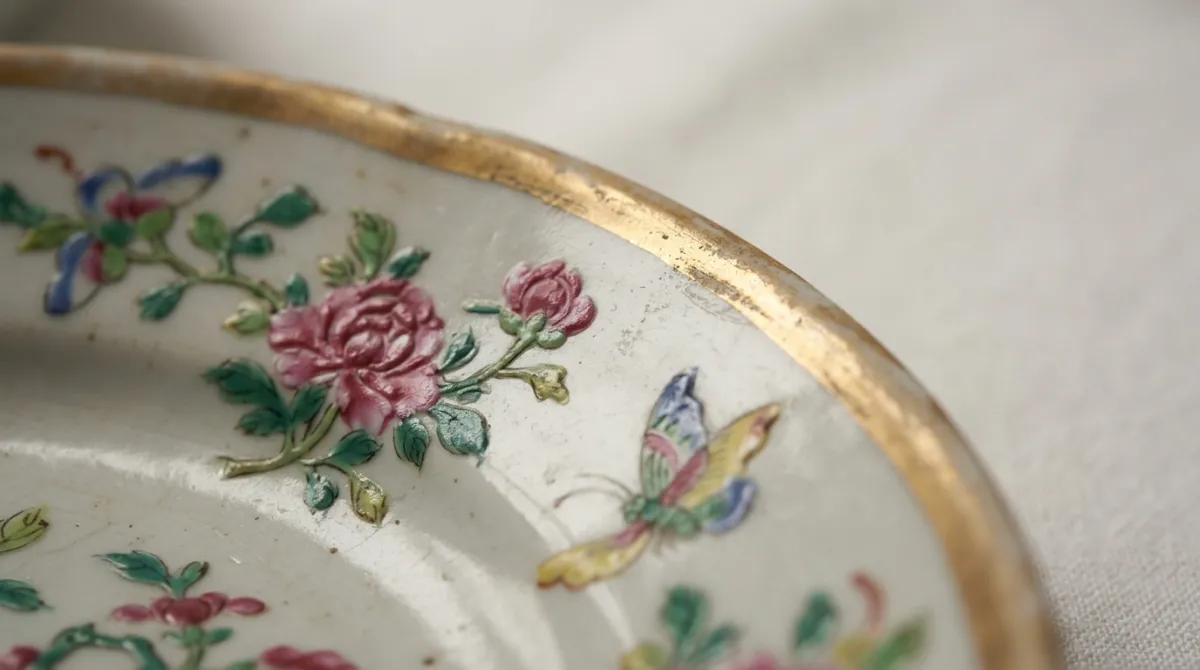
Genuine wear tends to show up in specific places: gilding thinned at the rim and any high point a hand or cloth would naturally touch, enamel that sits slightly proud of the glazed surface rather than flush with it, and a foot rim with honest scuffing from decades of stacking. None of that shows up in a photograph of the pattern alone. It shows up on the object itself, under decent light, ideally in hand.
Whether the absence of figures makes a piece worth less is a common question, and the honest answer is: not inherently. Painting quality, rarity of shape, condition, and overall craftsmanship tend to matter more to value than whether a panel happens to hold a person or a peony. A finely painted, well-preserved all-floral piece can outvalue a mediocre figural one without much trouble. Rose Canton isn’t automatically the “lesser” pattern just because it skips the harder figural brushwork.
Reproductions exist for Rose Canton just as they do for Rose Medallion, and later pieces can be entirely legitimate, hand-painted, and worth owning, provided they’re described honestly as newer rather than passed off as antique. Our identification guide covers the specific wear and body checks that apply across the whole Canton famille-rose family, Rose Canton included.
How Should You Care for and Display Rose Canton Pieces?
Hand-washing is the safest routine for antique or vintage Rose Canton porcelain, since dishwasher heat and detergent can dull gilding and stress old glaze over time. Warm water, a soft cloth, and mild soap are enough for most everyday cleaning needs on decorative pieces.
Older pieces, especially anything with visible enamel wear or hairline crazing in the glaze, are best treated as decorative rather than functional. That means display over daily use: a plate stand, a cabinet shelf, or a wall mount rather than a rotation through weekly meals. It’s a small precaution that meaningfully extends the life of gilding that’s already decades old.
If a piece has sentimental or monetary value you’re unsure about, it’s worth getting a specialist opinion before cleaning anything beyond a light dusting. Some stains and discoloration are part of an antique’s honest history, and aggressive cleaning can remove value along with dirt. When in doubt, do less rather than more.
Frequently Asked Questions
What’s the difference between Rose Canton and Rose Medallion?
Rose Canton’s reserves contain only flowers and birds, with no human figures anywhere on the piece. Rose Medallion alternates figural panels with floral ones. Both share the same rose-pink palette and gilt scrollwork, which is exactly why the two get confused so often.
Is Rose Canton older or newer than Rose Medallion?
Neither term reliably indicates age. Both patterns were produced side by side in 19th century Canton workshops, and the choice between all-floral and figural decoration varied by order rather than following a strict timeline.
Is Rose Canton less valuable because it has no figures?
Not inherently. Value depends more on painting quality, condition, rarity of shape, and glaze and gilding wear than on whether a piece happens to include figures. A well-painted, well-preserved Rose Canton piece can outvalue a lesser figural one.
Why do dealers mix up the names so often?
The trade terms developed informally among Western dealers decades after the porcelain was made, with no standard body enforcing consistent usage. Pieces with small, easy-to-miss figural panels tucked into a mostly floral field are the most common source of mislabeling.
Does Rose Canton always have a central medallion?
No. Some pieces keep a distinct central floral medallion, often a peony spray, framed and set apart from the surrounding reserves. Others spread floral decoration evenly across the surface with no obvious center, and both versions are correctly called Rose Canton.
The Short Version
Rose Canton is easy to spot once you know the one thing to check: are there any people painted on the piece? If the answer is no, and every reserve holds flowers, birds, or butterflies instead, you’re looking at Rose Canton rather than Rose Medallion. The palette, the gilding, and the general busy layout will look nearly identical between the two, so the figures (or their absence) really are the whole test.
Dealers will keep applying these names loosely, and that’s not likely to change soon. Trust your own read of the panels over whatever the shelf tag says. If you’ve fallen for the all-floral look and want a piece painted the traditional way, our commissions page covers hand-painted Rose Canton designs made using the same techniques Kerry learned from master Lei Iat Po.
Keep exploring
More from Rose Medallion
Identification, history, and care guides for Rose Medallion and Canton porcelain. New guides added regularly.
Explore all guides