history origin
The Canton Trade: How Chinese Export Porcelain Reached the West
Key Takeaways
- Export porcelain bodies were usually made and glazed at Jingdezhen, then shipped to Canton (Guangzhou) for overglaze enamel painting, the Canton decorating tradition known as 廣彩 (Guangcai).
- From roughly 1757 until the 1842 Treaty of Nanking, foreign maritime trade with China was largely confined to the single port of Canton, an arrangement historians call the Canton System.
- Licensed Chinese merchant houses, the “hongs,” handled that trade on behalf of the Qing government; foreigners worked out of the riverside trading posts known as the Thirteen Factories.
- American traders joined the Canton trade in 1784, when the Empress of China sailed from New York and opened a long US appetite for Chinese export porcelain.
- Rose Medallion is best understood as a 19th-century Western trade name for one Canton export style within this much longer story; see what is Rose Medallion porcelain for the pattern itself.
The Two-City Supply Chain: Jingdezhen’s Bodies, Canton’s Brushes
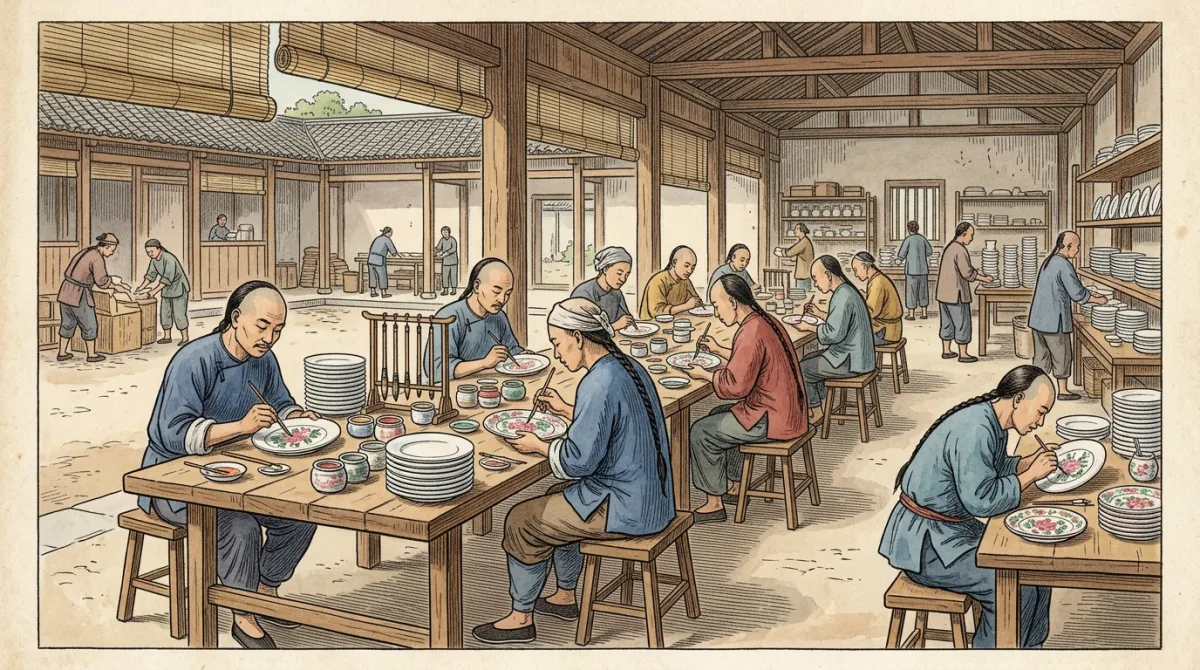
Most Canton export porcelain wasn’t actually made in Canton at all. The white body and its underglaze work generally came from Jingdezhen (景德鎮) in Jiangxi province, a kiln town that had supplied the imperial court for centuries, before finished blanks travelled hundreds of miles downriver to Canton for painting and export.
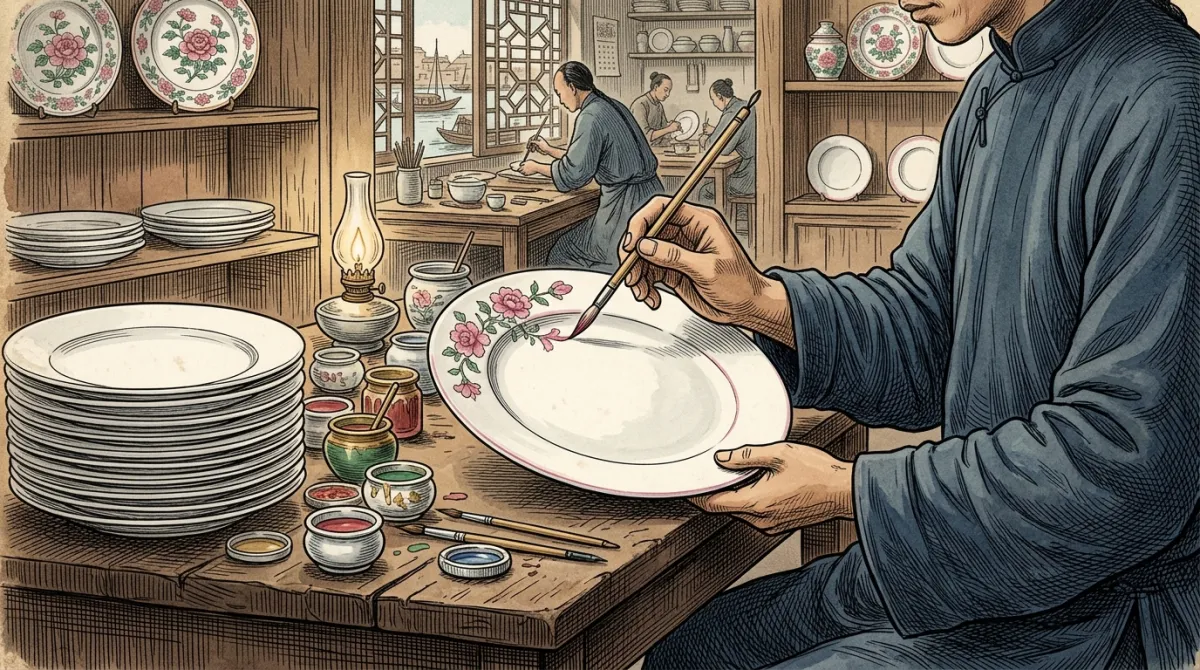
That’s the detail that trips up a lot of people the first time they hear it. A plate stamped in the mind as “Canton porcelain” often has more Jingdezhen in it than Canton, at least in terms of clay, glaze, and the first firing. Canton’s real specialty was what happened next: overglaze enamel decoration painted onto an already-finished, already-glazed piece, then fixed with a second, gentler firing.
This is the tradition called 廣彩 (Guangcai), Canton-colour painting, and it’s genuinely different work from what happens at Jingdezhen. Underglaze cobalt goes onto raw clay before the glaze and firing that seal everything together. Overglaze enamel goes onto glass that’s already hard and slippery, a far less forgiving surface for a brush. I’ve watched Kerry load a kiln for that second firing more times than I can count; a few degrees too hot and the enamel dulls or the gold goes flat.
Why split the work across two cities instead of doing it all in one place? Partly geography, and partly plain economics. Jingdezhen sat inland near the clay and kiln fuel it needed, while Canton sat on the coast, close to the foreign ships, merchants, and buyer preferences that decorating for export actually depended on. Painting close to port let workshops adjust patterns to what Western buyers wanted without an extra leg of inland shipping for every finished piece. Our antique Chinese porcelain guide covers this same division across the wider export tradition, not just the famille-rose patterns Kerry paints.
Did every export piece follow this same route?
Not universally, but it was the dominant pattern for enamelled export ware for a long stretch of the trade. Some porcelain was decorated closer to Jingdezhen itself, and blue-and-white export ware, painted entirely underglaze before it ever left the kiln town, didn’t need this second stop at all. The two-city model applies most cleanly to overglaze enamel wares like famille rose and, later, Rose Medallion.
What Was the Canton System?
The Canton System was a set of trade restrictions, generally dated from 1757, that confined Western maritime trade with China to the single port of Canton, under supervision of licensed Chinese merchants. It lasted until the Treaty of Nanking in 1842 opened additional ports and ended the arrangement.
Before 1757, foreign ships had, at various points, called at other Chinese ports along the coast. The Qing court then narrowed that access to Canton alone, a decision usually tied to the Qianlong Emperor’s concerns about managing foreign contact in one controllable location. Whatever the exact mix of motives, the practical effect is well documented: for the better part of a century, a European or American ship trading legally for Chinese goods by sea had one port to call at.
That single-port arrangement shaped the export porcelain trade directly. Foreign buyers couldn’t simply sail up the coast and deal with Jingdezhen or another production center on their own terms. Everything, tea, silk, and porcelain alike, funnelled through Canton’s docks, its licensed merchants, and its painting workshops. It’s part of why “Canton export porcelain” became such a durable, meaningful label rather than a vague geographic description.
How strict was this restriction in practice?
Fairly strict for the maritime side of the trade, though it wasn’t the only channel between China and the outside world; overland routes and other arrangements existed alongside it. For Western sea trade specifically, though, Canton’s status as the sole authorized port held for decades, and it’s the backdrop against which nearly all Canton export porcelain, Rose Medallion included, was produced and sold.
The Thirteen Hongs: Who Controlled Trade at Canton
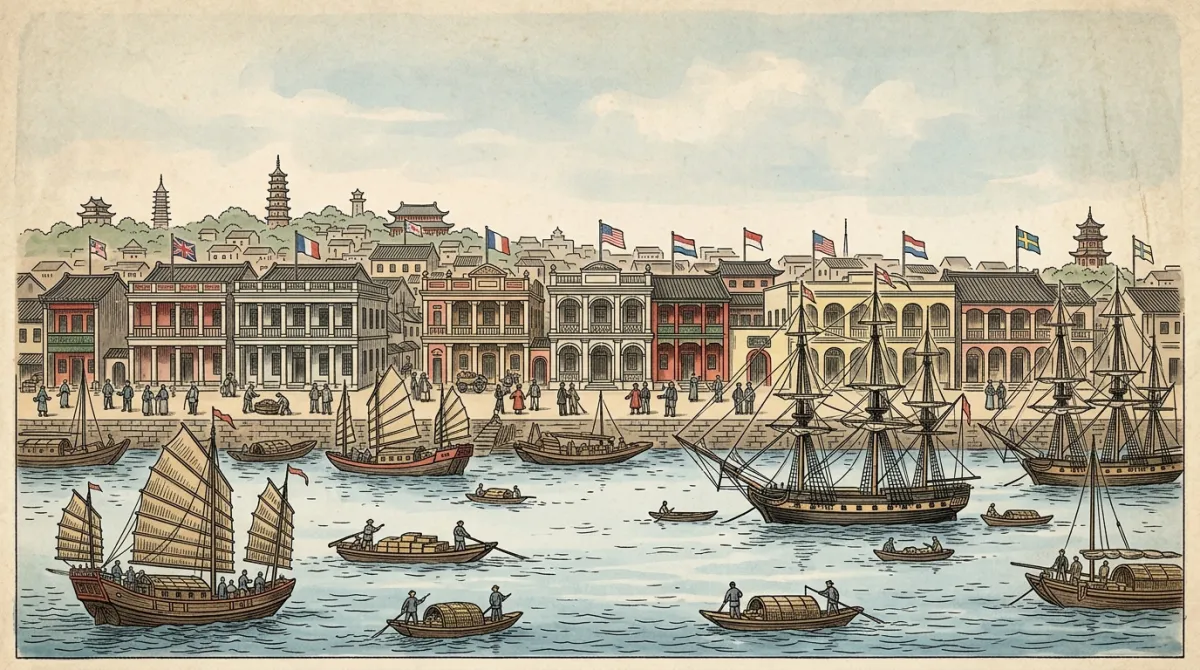
Chinese trade with Western merchants at Canton was handled by a small number of licensed merchant houses, commonly called the “hongs” or, in their most famous configuration, the Thirteen Hongs (or Thirteen Factories). These merchants held official sanction to deal with foreigners, a monopoly arrangement most historians refer to as the cohong system.
The hong merchants weren’t simply shopkeepers; they were the mandated intermediaries for essentially all legal foreign trade at Canton. They negotiated prices, guaranteed duties to the imperial government, and took on real financial and, at times, personal liability for the foreign traders under their sponsorship. It was a demanding, high-stakes role, and hong merchants could rise to considerable wealth or fall into ruinous debt depending on how a season’s trade went.
“Factories” in this context doesn’t mean a manufacturing plant. It refers to the row of riverside trading posts and warehouses along the Pearl River at Canton, leased to foreign companies, where the British, Dutch, and other national trading concerns kept their offices and stored goods during the trading season. Foreign merchants lived and worked there under real restrictions on movement and residence, since they generally weren’t permitted to travel freely beyond that riverside strip or to stay in Canton year-round.
It’s worth sitting with how much of the finished porcelain we now handle in the studio passed, unnoticed, through this narrow administrative bottleneck. A plate later called Rose Medallion by an American dealer had, at some earlier point, cleared a hong merchant’s books and sat inside one of those thirteen riverside factories, waiting on a ship. The romance collectors attach to the pattern sits on top of a genuinely bureaucratic, tightly licensed trading system.
Were the hongs Chinese-run or foreign-owned?
Chinese-run. The hong merchants were Chinese subjects operating under Qing government license, and the foreign East India companies and independent traders dealt with them as counterparties, not owners. The building called a “factory” housed the foreign trading company’s staff and goods, but the license to trade sat with the Chinese hong on the other side of the transaction.
How Did American Buyers Enter the Canton Trade?
American traders joined the Canton trade in 1784, when the ship Empress of China sailed from New York and became the first American vessel to trade directly with China. That voyage opened a strong, lasting American appetite for Chinese export goods, porcelain very much included.
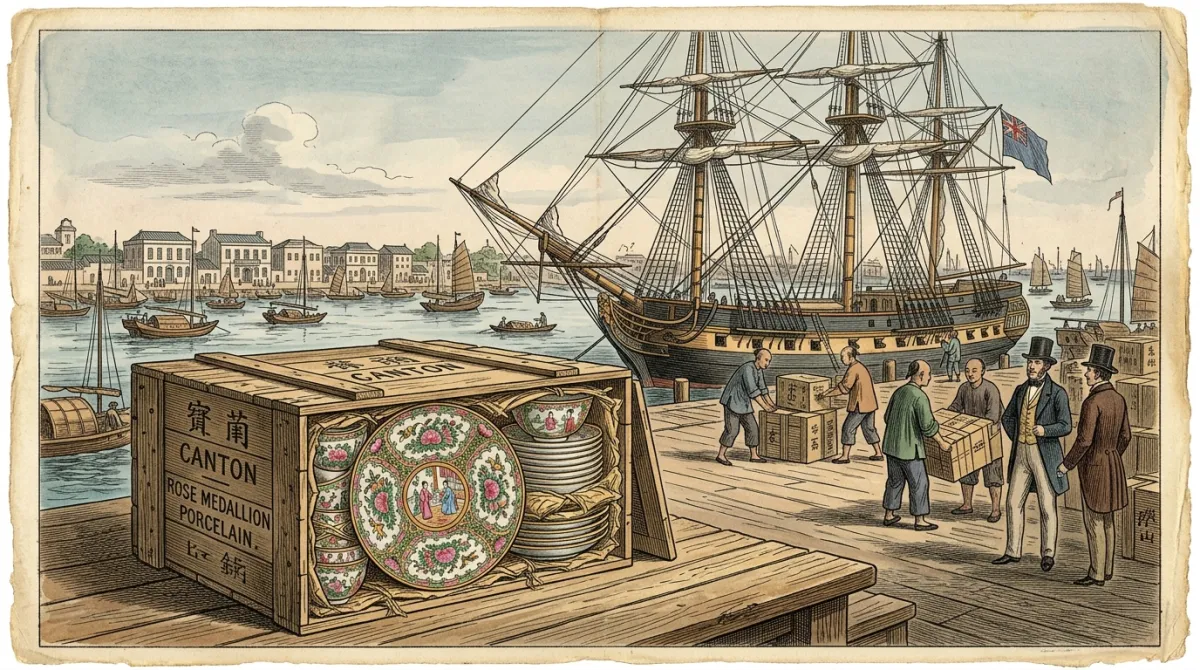
Before American independence, colonial buyers had gotten their Chinese porcelain secondhand, through British and other European East India companies rather than direct trade. Once the United States could trade on its own account, merchants in port cities like New York, Philadelphia, Salem, and Boston moved quickly to establish direct routes to Canton, following the same hong-merchant, single-port system that already governed European trade there.
This matters for anyone who collects Rose Medallion today. Why does so much of it turn up in American estates rather than European ones? American ship captains, merchants, and their families bought enormous quantities of Canton export porcelain across the 19th century, often commissioning services directly through hong contacts. That sustained demand is a large part of why Rose Medallion is so strongly associated with US collections, even though European companies had been buying Chinese porcelain for far longer.
Did other countries trade for porcelain at Canton too?
Yes, and earlier than the Americans. The British East India Company, the Dutch VOC, and smaller national companies from Sweden, Denmark, and France had all been trading through Canton, or through similar arrangements at other points, well before 1784. American entry added a new, eventually very large, buyer to a trade that Europeans had already been running for generations.
Where Rose Medallion Fits Into the Canton Trade
Rose Medallion is best understood as a 19th-century Western trade name for one specific decorating style produced within this much longer Canton export tradition, not a separate historical episode of its own. The pattern’s alternating panels of figures and florals emerged from the same Jingdezhen-to-Canton pipeline and the same hong-merchant trading system already well established by the time it became popular.
By the time Rose Medallion-style pieces were being painted in real volume, the Canton System had been running for decades, and American buyers were a well-established part of the customer base. So when a family passes down a Rose Medallion service with a story about a sea captain great-great-grandfather, that story usually has real historical footing. American ships genuinely did carry porcelain like this home from Canton, often as private trade goods alongside a ship’s official cargo.
It also explains why “Canton porcelain” and “Rose Medallion” get used almost interchangeably by casual sellers, even though they aren’t quite the same thing. Canton export porcelain is the broad category; Rose Medallion is one recognizable pattern within it, alongside close relatives covered in Rose Medallion vs Rose Canton vs Mandarin. Our full Rose Medallion guide goes deeper into the pattern itself, if the trade history is what brought you here and the design is what you actually want to understand next.
Was blue-and-white porcelain part of this same Canton trade?
Yes, though it followed a somewhat different production path. Blue-and-white export ware was typically painted and glazed entirely at Jingdezhen before shipment, without Canton’s overglaze enamel stage, but it still moved through the same Canton port and the same hong-merchant system during the Canton System years. Our Chinese blue and white porcelain guide covers that earlier, related tradition on its own terms.
What Happened When the Canton System Ended?
The Canton System ended with the Treaty of Nanking in 1842, signed after the First Opium War, which opened four additional treaty ports to foreign trade and ended Canton’s exclusive status. Foreign merchants no longer needed a hong-merchant intermediary or a Canton-only route to trade legally with China.
That change didn’t end Canton’s porcelain-painting tradition, though it did change the wider trading landscape around it. Shanghai in particular grew quickly as a trading center in the following decades, and porcelain export patterns kept evolving alongside shifting demand from American and European buyers through the second half of the 19th century. Rose Medallion’s strongest production period, by most accounts, falls within this later era, well after the strict single-port system had already loosened.
So the pattern most associated today with “old Canton china” actually flourished, in real volume, partly during and partly after the system that gave Canton its trading monopoly in the first place. History rarely lines up as neatly as the trade names suggest, and that’s part of what makes tracing a single plate’s path genuinely interesting rather than a dry timeline exercise.
Frequently Asked Questions
Where was Rose Medallion actually made?
The porcelain body was usually made and glazed at Jingdezhen, then shipped to Canton, where painters applied the famille-rose overglaze enamels and gilding that define the pattern. See what is Rose Medallion porcelain for a full look at the design itself.
What was the Canton System?
The Canton System, generally dated from 1757 to the 1842 Treaty of Nanking, restricted Western maritime trade with China to the single port of Canton, managed through licensed Chinese hong merchants. It shaped nearly every aspect of how export porcelain reached Western buyers during that period.
What were the Thirteen Hongs or Thirteen Factories?
The Thirteen Hongs were licensed Chinese merchant houses authorized to trade with foreigners at Canton, while the “factories” were the riverside trading posts where foreign companies kept offices and warehouses. Together they formed the administrative bottleneck through which nearly all legal Western trade, including porcelain, passed.
How did Rose Medallion porcelain get to America?
American traders entered the Canton trade directly in 1784, after the Empress of China sailed from New York, and American demand for Chinese export porcelain grew steadily across the 19th century. That sustained buying is a major reason Rose Medallion services are so often found in American family collections today.
What’s the difference between Canton porcelain and Jingdezhen porcelain?
“Canton porcelain” usually refers to where a piece was decorated, since Canton workshops specialized in overglaze enamel painting for export. “Jingdezhen porcelain” more often points to the body, glaze, and underglaze work, since that town supplied the raw white porcelain that Canton painters finished.
Where This Leaves Us
Canton export porcelain reads differently once you see the whole route: clay and glaze from Jingdezhen, painting and gilding at Canton, sale through licensed hong merchants, and, eventually, a long voyage to a buyer in London, Amsterdam, or New York. Rose Medallion sits near the later end of that story, a specific 19th-century pattern within a trading system that had already been running for generations.
Kerry still paints in that same Canton tradition at GoodTime Studio Macau, using techniques she learned from Lei Iat Po, and it’s a genuine privilege watching a centuries-old trade route compress down into a single brush on a single plate. If you’d like a piece made the traditional way, by hand, see our custom Rose Medallion commissions.
Keep exploring
More from Rose Medallion
Identification, history, and care guides for Rose Medallion and Canton porcelain. New guides added regularly.
Explore all guides