blue and white
Chinese Blue and White Porcelain: A Short Collector's Guide
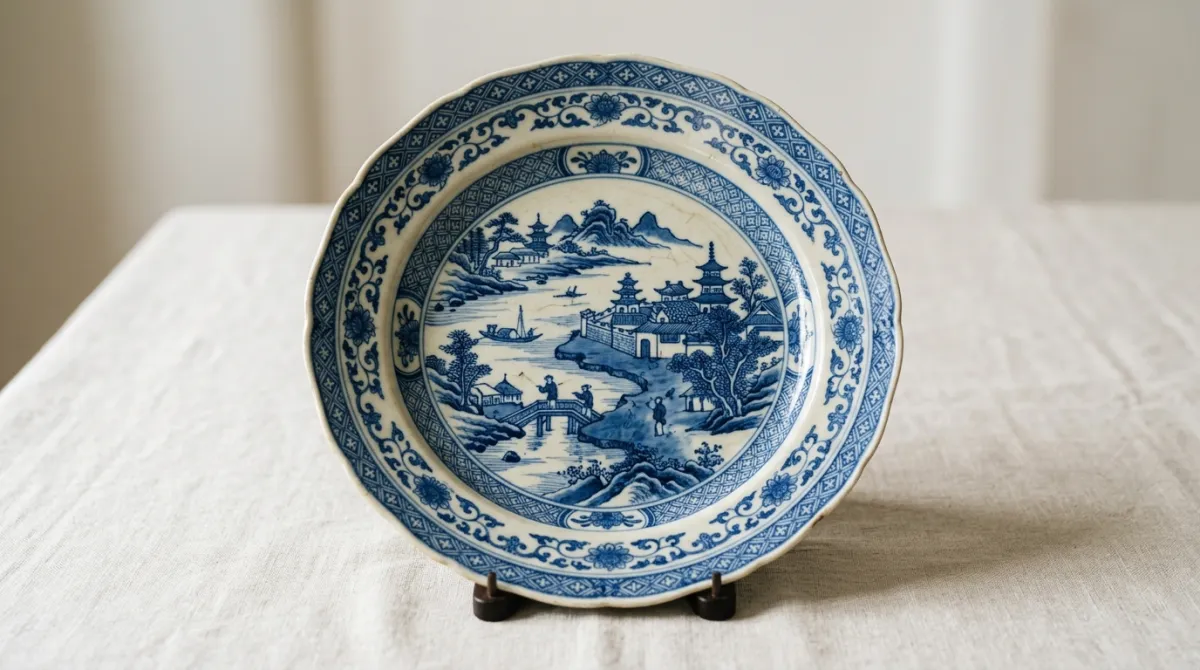
Key Takeaways
- Blue and white porcelain (青花) is painted with cobalt oxide directly on the unfired body, then sealed under a clear glaze and fired at high heat, so the pattern is fused into the piece rather than sitting on top of it.
- Jingdezhen, in Jiangxi province, has supplied both the imperial court and export markets with blue and white ware since the Yuan dynasty and remains the center of porcelain production today.
- The tradition matured under the Yuan dynasty, reached its most refined phase under early Ming emperors, and was already a major global export trade by the late Ming, before the Qing dynasty pushed that export volume even higher.
- Blue and white is underglaze work; Rose Medallion and other famille rose export wares are overglaze enamel, painted after the first firing. See what makes Rose Medallion porcelain distinctive for the comparison.
- Cobalt tone, brush quality, and glaze pooling tell you more about a piece’s age than a reign mark does. Our marks and dating guide explains why marks alone can mislead.
What Is Blue and White Porcelain, Exactly?
Blue and white porcelain is white porcelain decorated with cobalt oxide, painted onto the raw body, then covered with a clear glaze and fired at roughly 1,300°C. That single firing fuses the blue design under a glassy skin, which is why the pattern doesn’t wear off the way surface enamels sometimes do.
Cobalt is unusual among traditional Chinese pigments because it can survive that heat without burning out or changing color unpredictably. In its raw state, painted onto unfired clay, cobalt looks dull gray, almost black. It only turns into the vivid blue collectors recognize once it reacts with the glaze during the firing itself.
Kerry Kwok, the Macau porcelain painter who trained under 廣彩 master Lei Iat Po and now runs GoodTime Studio Macau, paints Jingdezhen-style blue and white alongside her famille rose work. She describes the two as almost opposite disciplines. “With cobalt you’re painting blind,” she told me. “The pigment looks flat and gray on the raw clay. You don’t see the real blue until it comes out of the kiln, so you’re trusting muscle memory, not your eyes.” Overglaze enamel lets her check color as she works; underglaze gives her one shot.
So why does that one-shot process matter? It’s part of why blue and white developed such disciplined, confident brushwork. There’s no painting over a mistake once a piece is glazed and headed for the kiln.
Jingdezhen: The Porcelain Capital Behind Blue and White
Jingdezhen, a city in Jiangxi province, has been the dominant center for China’s fine porcelain, including most of the country’s important blue and white ware, for roughly a thousand years, even though other regional kilns produced blue and white too. Imperial kilns operated there for centuries, and the city still produces everything from museum-grade reproductions to everyday ceramics.
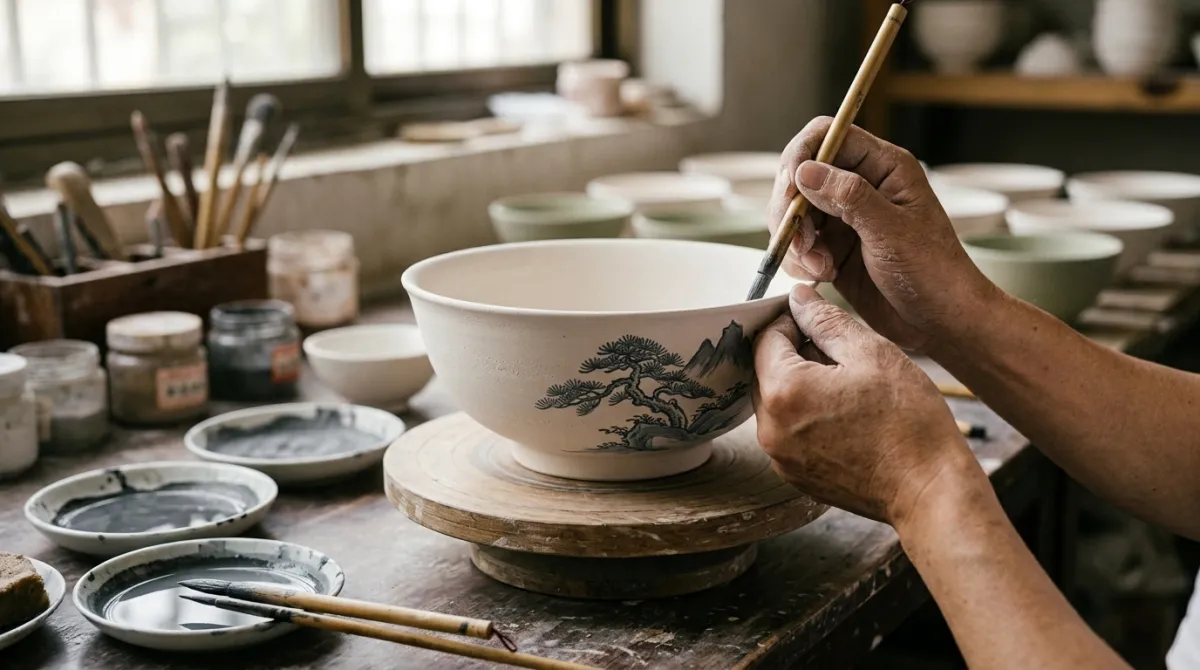
Two features made it the natural home for this technique. First, the local kaolin clay and petuntse (“china stone”) fire to a pure white, glassy body that shows cobalt blue at its most vivid, unlike the grayer stonewares used elsewhere in China. Second, imperial kilns were established there, drawing the best painters and steady court demand into one place.
Some of the richest early cobalt wasn’t even local. Yuan and early Ming potters alike prized imported cobalt sourced through Persian trade routes for the deep, slightly purplish tone it produced when mixed with domestic pigment. That imported cobalt is one reason the best Yuan and early Ming blue and white has a depth that’s genuinely hard to reproduce with lesser sources.
It’s worth sitting with that: a “purely Chinese” tradition that reached its early peak partly on pigment shipped in from the Middle East. Jingdezhen sat at the center of a trade network long before European ships ever went looking for porcelain.
From the Yuan Dynasty to the Qing: How Blue and White Grew Up
Blue and white porcelain moved from a minor, experimental ware in the early Yuan dynasty to the dominant style of Chinese ceramics within two centuries, driven by trade routes that supplied both cobalt and eager new export markets across Asia and the Islamic world. Collectors prize different peaks in this history for different reasons: Yuan wares for their scale and confident brushwork, Xuande and Chenghua reigns for painting refinement, and Kangxi-era export pieces for technical consistency at high volume.
Yuan Dynasty Foundations
Yuan potters worked out the core technique during the 14th century, favoring heavy, confident brushwork on large dishes and jars suited to both domestic use and export to the Middle East. Some of the finest surviving Yuan pieces, including a well-known pair of temple vases dated to the equivalent of 1351, show the style was already technically mature by the dynasty’s later decades.
Ming Dynasty Refinement
Blue and white became the signature ceramic of the Ming imperial court, especially during the early 15th century, when painters achieved a controlled, almost calligraphic line quality that later collectors treat as a benchmark. Cobalt sourcing, decoration density, and glaze tone shifted across the Ming dynasty’s roughly 270 years, giving specialists a rough timeline for dating a piece.
Late Ming Export Boom and the Qing Expansion
Large-scale export production was already well underway by the late Ming dynasty, particularly the Wanli reign in the late 16th and early 17th centuries, when Jingdezhen kilns supplied Portuguese and Dutch traders in real volume. This is the era most collectors mean by “kraak” ware: a style named after the Portuguese carracks that carried it to Europe, known for panelled borders and relatively thin, hard-fired bodies. The Qing dynasty then carried that export trade further still, supplying Dutch, English, and other European companies on an even larger scale through the 17th and 18th centuries.
What Patterns and Motifs Show Up Most Often?
Floral scrolls, especially peony and lotus vines wrapped around a vessel’s body, and layered landscape scenes are the two motif families you’ll see most on Chinese blue and white, alongside dragons and phoenixes on imperial-grade pieces and simpler genre scenes on later export ware made for Western buyers.
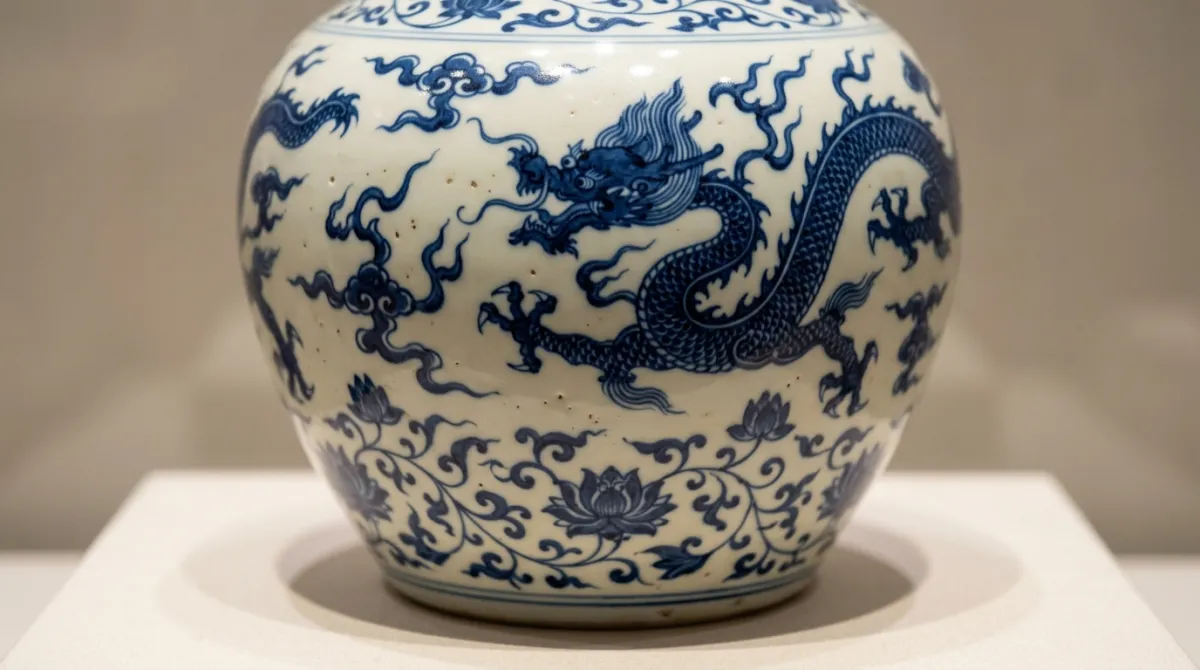
Dragons, phoenixes, and figures drawn from folklore mostly turn up on pieces made for the court or wealthy domestic buyers, where symbolism carried real weight. Export pieces bound for Europe and Southeast Asia leaned toward lighter imagery: pavilions, bridges, willow trees, and boating scenes that Western buyers found charming without needing to understand what any of it meant.
Here’s a detail that trips up new collectors. The famous “Willow Pattern,” with its bridge, willow tree, and pair of birds, is often assumed to be an ancient Chinese design. It’s actually an English composite pattern created by Staffordshire potters in the 1780s, stitched together from several genuine Chinese motifs. Isn’t it strange that the “traditional Chinese” pattern most people picture is a British invention? Chinese workshops later painted versions of the English pattern back onto export ware, so some “traditional-looking” blue and white is really copying an English copy of Chinese originals.
How Can You Start Identifying Antique Blue and White Porcelain?
Cobalt tone, the “heaping and piling” effect where pigment pools unevenly within a brushstroke, drawing confidence, and the finish of the foot rim tell you more about a piece’s age than the pattern or a reign mark ever will, since both patterns and marks were reproduced for centuries after their original periods.
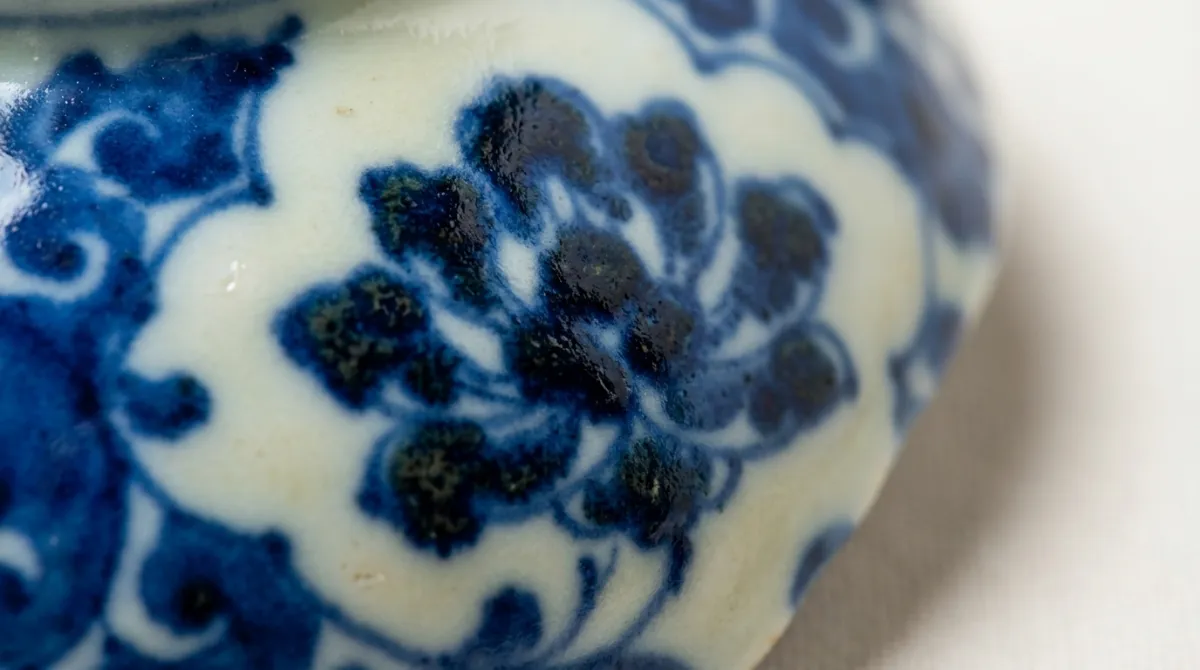
Cobalt Tone and Heaping and Piling
Iron-rich, unevenly refined cobalt tends to pool darker at the start and end of a brushstroke, an effect collectors call heaping and piling. Look for small black-blue flecks where pigment concentrated most heavily. This isn’t a strict early-versus-late rule, though: how much heaping and piling shows up depends on the ore mix, how finely it was refined, firing conditions, and how heavily the painter loaded the brush, so it’s a tendency worth weighing alongside other clues rather than a dating rule on its own.
Drawing Quality and Brushwork
Since cobalt can’t be corrected once it’s painted, the confidence of the linework says a lot about both the painter’s skill and, often, the period. Earlier pieces, especially fine Ming imperial ware, tend to show loose, energetic brushwork. Later export ware, produced faster for volume, often looks tighter and more mechanical, with stock motifs traced rather than freely drawn.
Foot, Glaze, and Base
Check the unglazed foot rim for the clay body’s color and texture. A slightly gritty, warm-toned foot shows up on many earlier pieces, but plenty of genuine early wares have smoother, paler feet, so treat this as a tendency with real exceptions rather than a fixed rule. Faint blue-green glaze pooling near the foot turns up often on older pieces, though skilled reproductions can mimic it too, so it’s one clue to weigh alongside the others, not proof by itself.
None of this replaces checking the base for a reign mark, but marks are the least reliable part of the puzzle. They were copied respectfully, and sometimes not so respectfully, for centuries after the reign they name, so a “Kangxi” mark on the base doesn’t guarantee a Kangxi-era pot. Our marks and dating guide walks through why marks mislead as often as they help, and what to check instead.
How Does Blue and White Relate to Rose Medallion and Famille Rose?
Blue and white and Rose Medallion are two branches of the same Chinese export porcelain story, but they use opposite decorating methods. Blue and white is underglaze cobalt fired once at high heat, while Rose Medallion’s famille rose enamels are painted over an already-glazed piece, then fired a second time at a much lower temperature to fix the colors without melting them into the glaze.
The two traditions were more connected in practice than their finished look suggests. Jingdezhen didn’t just make blue and white; it also fired the plain white porcelain blanks that were shipped downriver to Canton, where painters added the famille rose enamels that define Rose Medallion. A Rose Medallion plate on your shelf may well have started life as an undecorated Jingdezhen body before a Canton workshop ever touched it.
Kwok, who paints both traditions, says the switch changes her whole approach. “Underglaze is one chance, one firing, and you’re trusting how the color turns out,” she told me. “Overglaze lets me build up layers, fire, check the color, add more. It’s a different kind of patience.” That distinction is the cleanest way to understand why the two wares feel so different, despite growing out of the same porcelain tradition.
If you want the fuller picture of how those overglaze enamels work, our beginner’s guide to Rose Medallion porcelain covers the palette, panel layout, and history in more depth. For the full pattern family that grew out of Canton’s overglaze workshops, our complete Rose Medallion guide is the place to start.
Frequently asked questions
Is blue and white porcelain always Chinese?
No. Imitations exist worldwide, from Dutch Delftware to English Worcester porcelain, but the technique originated in China and reached its highest historical development at Jingdezhen. When people say “blue and white” without qualifying it further, they usually mean the Chinese tradition specifically.
Does a Kangxi or Ming mark on the base guarantee the piece is that old?
No. Reign marks were copied as a mark of respect for centuries after the named reign, so a “Kangxi” mark can appear on porcelain made decades or even a century later. Judge age from cobalt tone, brushwork, glaze, and foot construction first, and treat the mark as supporting evidence only.
Why does old blue and white sometimes look almost black in places?
That’s heaping and piling. Early, less-refined cobalt pooled unevenly during painting and darkened further under high heat, leaving small black-blue specks within a stroke. It can be a reassuring sign of hand-application and older, less-refined cobalt, though it’s one clue among several rather than proof of age on its own.
Is blue and white porcelain more valuable than famille rose pieces like Rose Medallion?
Not inherently. Value depends on age, painting quality, condition, and rarity within each tradition, not on which decorating method was used. A fine Kangxi-period blue and white vase and a well-painted antique Rose Medallion punch bowl can both command strong prices for very different reasons.
Can I still find blue and white porcelain made in Jingdezhen today?
Yes. Jingdezhen remains an active porcelain center, producing everything from tourist-grade souvenirs to museum-quality reproductions and skilled hand-painted work in the traditional style, so quality varies enormously and needs judging piece by piece.
The Short Version
Blue and white porcelain earns its reputation because cobalt sealed under a clear glaze survives handling, washing, and centuries of daily use in a way surface decoration rarely matches. Whether you’re drawn to a Yuan-style dish, a Kangxi export bowl, or a Rose Medallion plate that started life as a plain Jingdezhen body, understanding underglaze versus overglaze makes every other identification question easier.
And if you love the look of hand-painted blue and white but can’t track down the right antique, it’s worth knowing we take commissions for it too, painted using the same underglaze cobalt technique described above. See our commissions page for details.
Keep exploring
More from Rose Medallion
Identification, history, and care guides for Rose Medallion and Canton porcelain. New guides added regularly.
Explore all guides