patterns motifs
Rose Medallion Tea Sets and Teapots: A Collector's Guide
Key Takeaways
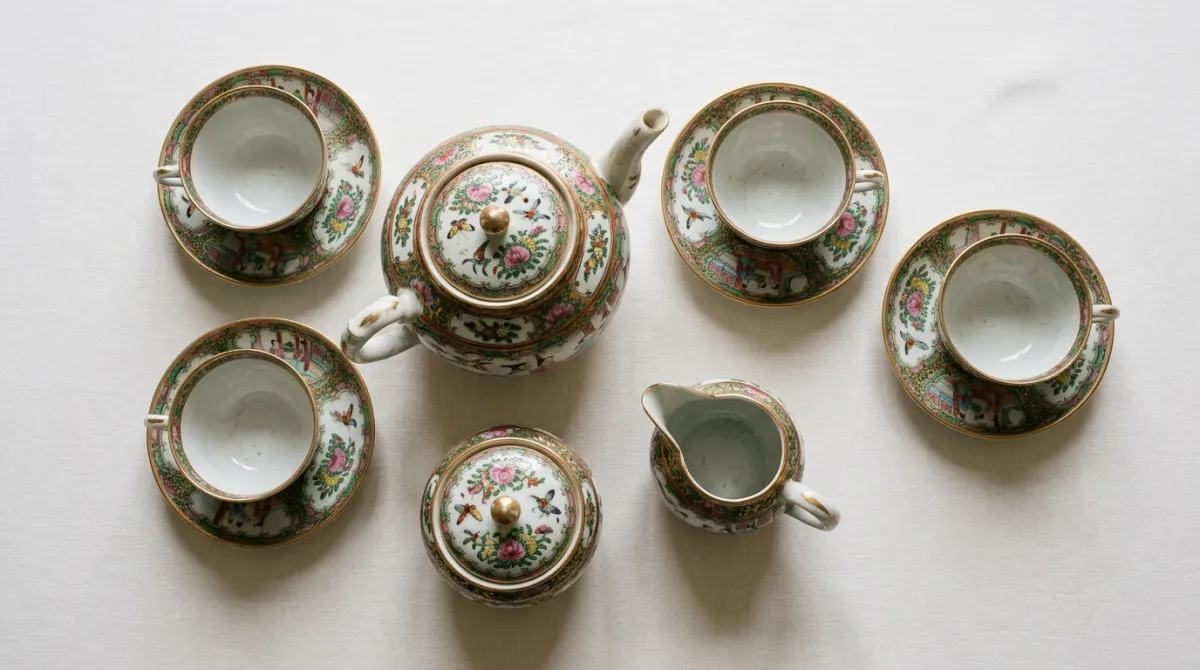
- A Rose Medallion tea set typically includes a teapot, matching teacups and saucers, a creamer, and a covered sugar, though piece counts vary a lot between sets.
- The teapot takes the most damage of any piece in a set, so its spout, handle, and lid deserve the closest inspection before you buy.
- Many “sets” on the market today were assembled over time from similar but not identical pieces; a truly matched antique set is less common than most buyers expect.
- Completeness, teapot condition, painting quality, and how well the pieces actually match each other tend to drive value more than age alone.
- Antique teapots are best treated as display pieces rather than daily brewing vessels, and a hand-painted commission can fill a gap the antique market can’t.
A tea set is where Rose Medallion collecting gets more involved, because you’re not judging one piece but a whole group of them at once. Kerry Kwok has seen this play out at GoodTime Studio Macau more times than she can count: someone arrives with a beautiful teapot and four cups that almost, but not quite, match. So where do you even start when you’re buying, evaluating, or trying to complete a Rose Medallion tea set? Let’s start with what a set is actually supposed to contain.
What’s included in a Rose Medallion tea set?
A typical Rose Medallion tea set includes a teapot, teacups and saucers, a creamer or milk jug, and a covered sugar bowl, and some tea services also turn up with a matching tray. Cup counts varied by workshop and original order, so don’t assume a “complete” set always meant a fixed number of pieces.
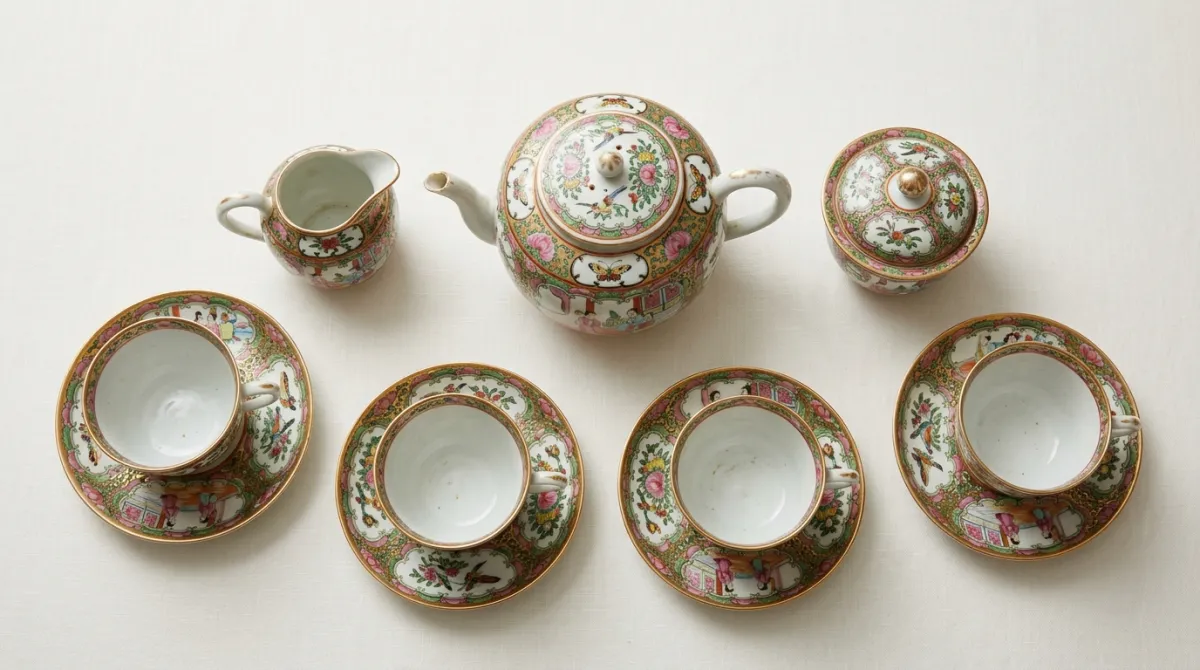
The teapot is the centerpiece, obviously, but it’s rarely the only piece that matters to a buyer. Teacups and saucers made up the bulk of a set by piece count, and they were ordered in varying quantities depending on the household or the original commission. Six-cup and twelve-cup groupings both turn up, and there’s no single “correct” number that defines a proper set.
Creamers and covered sugar bowls rounded things out, and both are small enough that they went missing or got separated from a set more easily than a large teapot or a stack of plates. Some sets also included a matching tray, and occasionally a larger coffee pot alongside the teapot, since Canton export workshops filled orders for Western tastes that didn’t always separate tea and coffee service the way you might expect. If you want the wider picture of how tea wares fit into the pattern’s full range of forms, our Rose Medallion dinnerware guide covers plates, bowls, and serving pieces alongside tea service.
Why is the teapot the piece to check most carefully?
Because a teapot has more vulnerable points than almost any other form in the pattern: a thin spout tip, a handle under constant stress, and a separate lid that’s easy to lose or break. Condition on teapots genuinely varies piece to piece, so treat any single clue as a starting point, not a verdict. (Kerry Kwok, GoodTime Studio Macau)
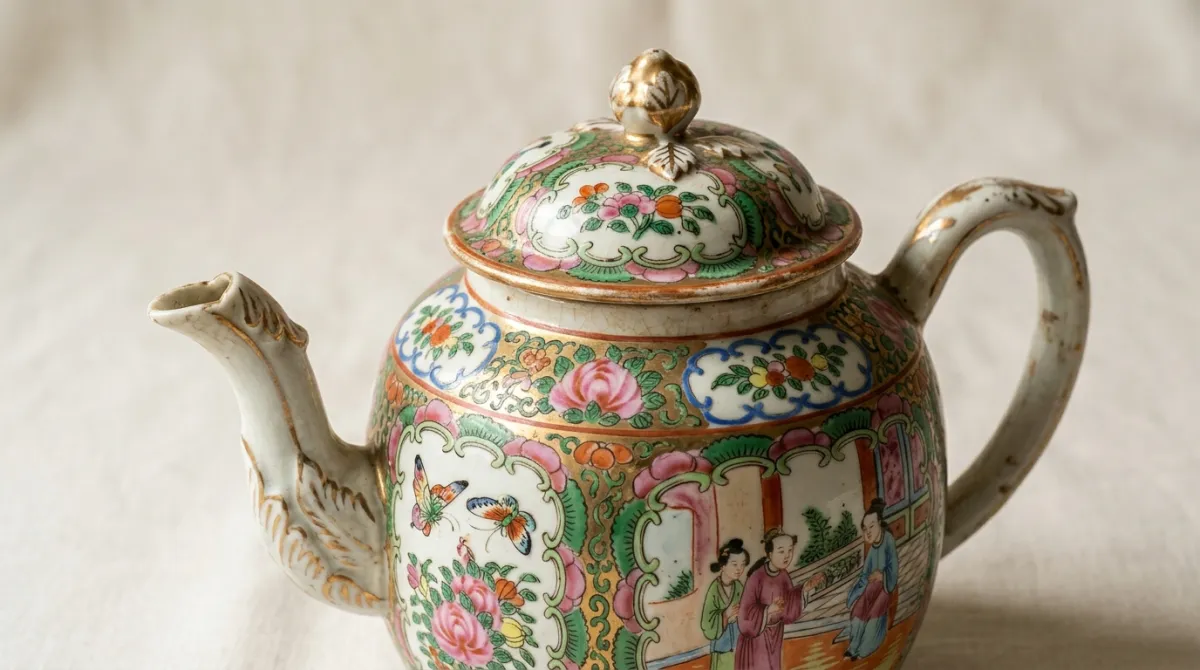
Think about what a teapot actually goes through compared to a plate sitting in a cabinet. It got picked up, poured from, set down, and occasionally knocked against a saucer or a table edge, over and over, for a century or more. That’s a lot more handling than most other pieces in a set ever experience, and it shows.
Spout tip and handle
Run a finger slowly along the spout tip, since a small chip here is one of the most common forms of damage on old teapots and easy to miss under a quick glance. The handle deserves the same attention: look closely at where it joins the body, top and bottom, for hairline cracks or a repair that’s been smoothed over. Handles bear real weight every time a pot is lifted full, so this is exactly where stress cracks tend to start.
The lid: often lost or married
Lids are the single most commonly missing or mismatched piece on an antique teapot, and a “married” lid, one that’s genuinely old but wasn’t originally paired with that pot, turns up often enough that it’s worth checking closely. Compare the lid’s painting style, palette, and gilding wear against the body rather than assuming a good visual match settles the question.
Check the finial too, that small knob or figure on top used to lift the lid. It’s delicate, sits proud of the surface, and chips or breaks off more easily than almost any other detail on the piece. A finial that looks slightly different in color or wear pattern from the rest of the lid is worth a second look.
Hairlines and interior staining
Hold the pot up to strong light and look through the body near the spout base and handle joints, the two spots under the most mechanical stress. A hairline crack often reads as a faint dark line when backlit, even when it’s close to invisible in ordinary room light. Interior staining from decades of tannin buildup is common and, on its own, isn’t a defect. For guidance on removing stains safely without stripping gilding, our antique Rose Medallion cleaning guide walks through the process.
Matched set or assembled over time? How to tell
Many Rose Medallion “sets” sold today were assembled gradually from similar but separately sourced pieces, not purchased as a single matched original order. A genuinely matched antique set, where every piece shares the same painting hand and palette, is real but less common than most buyers assume going in.
Compare the border width, the medallion spacing, and the exact shade of the famille rose pink across every piece in a set you’re considering. Small variations are normal even within a genuine original order, since hand-painted work was never perfectly uniform, but larger inconsistencies, a noticeably different face style on the court figures or a mismatched gilt tone, suggest pieces from different production runs.
Isn’t it a bit strange that “matched set” gets used so loosely in listings? In our experience, a seller’s description of “matching set” often means visually similar, not provably from the same original commission. That’s not necessarily a problem if the price reflects it and you’re buying for display rather than provenance, but it’s worth knowing which one you’re actually getting before you pay for it. Our guide to identifying Rose Medallion covers the painting and glaze details that help you compare pieces more confidently.
What actually drives a tea set’s value?
Completeness, teapot condition, painting quality, and how consistently the pieces match each other tend to matter more than age alone. A complete, well-matched set with an undamaged teapot will typically outvalue a larger but mismatched or incomplete grouping, even from a similar period.
Completeness carries real weight because a full set, teapot, cups and saucers, creamer, and covered sugar all present and undamaged, is genuinely harder to find intact than any single piece. The teapot’s condition specifically tends to anchor the whole set’s value, since it’s usually the most expensive and most vulnerable piece to replace or repair. Painting quality shows up the same way it does across the whole pattern: confident brushwork, individually expressive faces on the court figures, and gilding that’s aged honestly rather than looking mechanically flat.
Age adds some value once quality and condition are already solid, but a genuinely old set with a cracked teapot and three mismatched cups can still lag behind a smaller, cleaner grouping from a slightly later date. Rarity matters too, and a matched set with an unusually well-preserved teapot lid tends to draw stronger interest than the market average, simply because that combination doesn’t survive intact very often.
Is your tea set antique or a later reproduction?
Later reproduction tea sets exist in real numbers, and some pieces are convincing enough at a glance to fool a casual buyer. A whiter, more uniform porcelain body and brighter, more mechanically even gilding are both worth weighing, though neither one proves anything by itself.
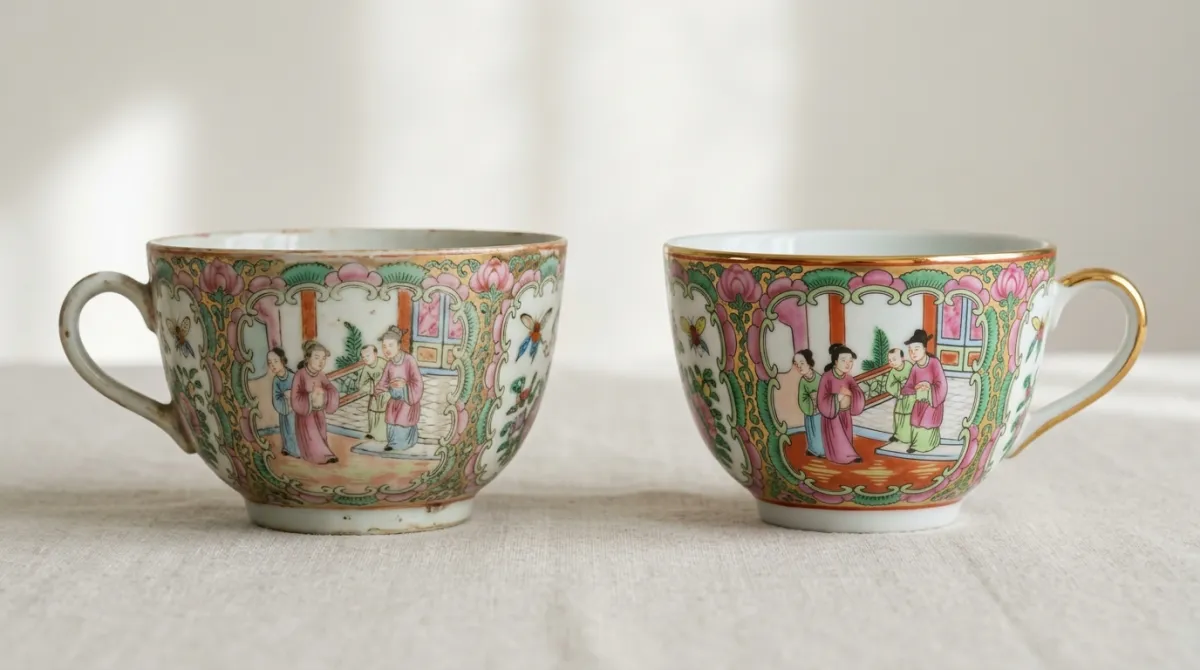
Reign marks and backstamps offer a useful clue but not a final answer, especially since fake marks are easy to apply and genuine marks are sometimes ground away. Weight, glaze tone, and the texture of the enamel under raking light tend to be more reliable read together than any single stamp on the base. Our Rose Medallion marks guide breaks down what genuine reign marks and later factory stamps typically look like, which is a good next stop once you’ve formed an initial impression.
Teapots specifically are worth extra scrutiny on this point, because a later reproduction lid sometimes gets paired with a genuinely antique body, or the reverse. If the lid and body read as different ages under the same checks, treat that as a real signal worth investigating further rather than something to explain away.
Can you actually brew tea in an antique Rose Medallion teapot?
Antique Rose Medallion is best treated as display porcelain rather than a daily brewing vessel. The overglaze enamels and gilding sit on top of the fired glaze, and on older pieces those layers can contain lead, so we wouldn’t recommend routine use without knowing the piece is genuinely sound.
There’s no reliable way to judge lead content by eye alone, and a teapot’s interior, where hot liquid sits directly against painted or glazed surfaces, is exactly the spot where that matters most. If a pot shows any hairline crack, old rivet repair, or heavy interior staining, it’s safest kept as a decorative piece rather than pressed back into service. If you do choose to handle or lightly use a sound piece, hand-wash only, gently, and never assume a piece is food-safe just because it looks intact. Our full cleaning and care guide covers the routine in more detail, including what to avoid entirely.
A newly commissioned teapot is a genuinely different proposition here, since it can be painted to modern food-safe standards from the start rather than inheriting a century of unknown handling history.
Can you complete or replace a piece?
Because the antique market only offers what happened to survive, not what your specific set actually needs, a matching replacement teapot, a missing lid, or an entirely new food-safe set is often better solved through a hand-painted commission than through years of hunting. (Kerry Kwok, GoodTime Studio Macau)
This comes up constantly at the studio. Someone inherits four cups and a creamer with no teapot at all, and the exact original piece simply isn’t findable at any price. Someone else owns a beautiful antique teapot with a lid that’s clearly married, and wants a properly matched replacement rather than a piece that will always look slightly off. A custom commission can match an existing palette and border style closely enough to sit comfortably alongside inherited pieces, painted for daily food-safe use rather than display-only caution.
It won’t be antique, and a straightforward studio will tell you that plainly rather than let you assume otherwise. But for completing a set, replacing a vulnerable teapot, or starting a new set meant to actually be used at the table, it’s often the more realistic path. GoodTime Studio Macau’s commission page is a reasonable place to start that conversation if a specific piece is what you’re after.
Frequently asked questions
What’s included in a Rose Medallion tea set?
Typically a teapot, teacups and saucers, a creamer, and a covered sugar bowl, sometimes with a matching tray. Cup counts varied by original order, so there’s no single fixed number that defines a “complete” set across every workshop and period.
Is a married or replaced teapot lid a problem?
It can be. A married lid, one that’s genuinely old but wasn’t originally paired with that specific pot, affects both authenticity and value, especially if the palette or gilding doesn’t quite match. It’s not automatically disqualifying, but it should affect the price you’re willing to pay.
How much is a Rose Medallion tea set worth?
It depends heavily on completeness, teapot condition, painting quality, and how well the pieces genuinely match. A full, undamaged, well-matched set will command more than a larger but incomplete or mismatched grouping, even from a similar period, so there’s no single number to quote here.
Can I actually make tea in an antique Rose Medallion teapot?
We’d treat it as display-only unless you know the piece is genuinely sound, since overglaze enamels and gilding on older pieces can contain lead. See our care guide for the full handling routine if you do choose to use a piece occasionally.
Can I complete or replace pieces in my set?
Yes, through a hand-painted commission matched to your existing palette and border style. This is often more realistic than hunting for an exact antique replacement, and a new piece can be painted to modern food-safe standards from the start.
A last word on collecting tea sets
A Rose Medallion tea set rewards the same patience bowls and platters do, maybe more, because you’re judging several pieces against each other, not just one. Check the teapot hardest, since it’s the piece most likely to carry damage or a mismatched lid, and don’t assume “matched set” in a listing means what it implies. Whether you’re completing an inherited grouping or starting fresh, start from what the pieces actually show you side by side. For the full picture of how tea wares fit into the pattern’s history, our Rose Medallion guide is a good place to keep exploring.
Simon Iong writes about Rose Medallion history and value. Craft insight in this piece comes from Kerry Kwok of GoodTime Studio Macau, a working 廣彩 painter trained under master Lei Iat Po.
Keep exploring
More from Rose Medallion
Identification, history, and care guides for Rose Medallion and Canton porcelain. New guides added regularly.
Explore all guides