patterns motifs
Peony Symbolism in Chinese Porcelain: Flowers, Birds and Figures
Key Takeaways
- The peony (牡丹) is often called the “king of flowers” and commonly reads as a wish for wealth, honor, and high rank, not just decoration.
- Butterflies, bats, pomegranates, and fish all carry their own conventional good-luck meanings, and painters combine them deliberately, not at random.
- Rose Medallion’s floral reserves draw heavily on this auspicious flower-and-bird vocabulary, which is part of why the pattern reads as celebratory rather than plain.
- Figures in the companion reserves usually depict court or garden life rather than a specific story, working as a visual counterpart to the florals.
- Symbolism is read by convention, not fixed rule, so context and the piece itself still matter more than any single motif in isolation.
What does the peony symbolize on Chinese porcelain?
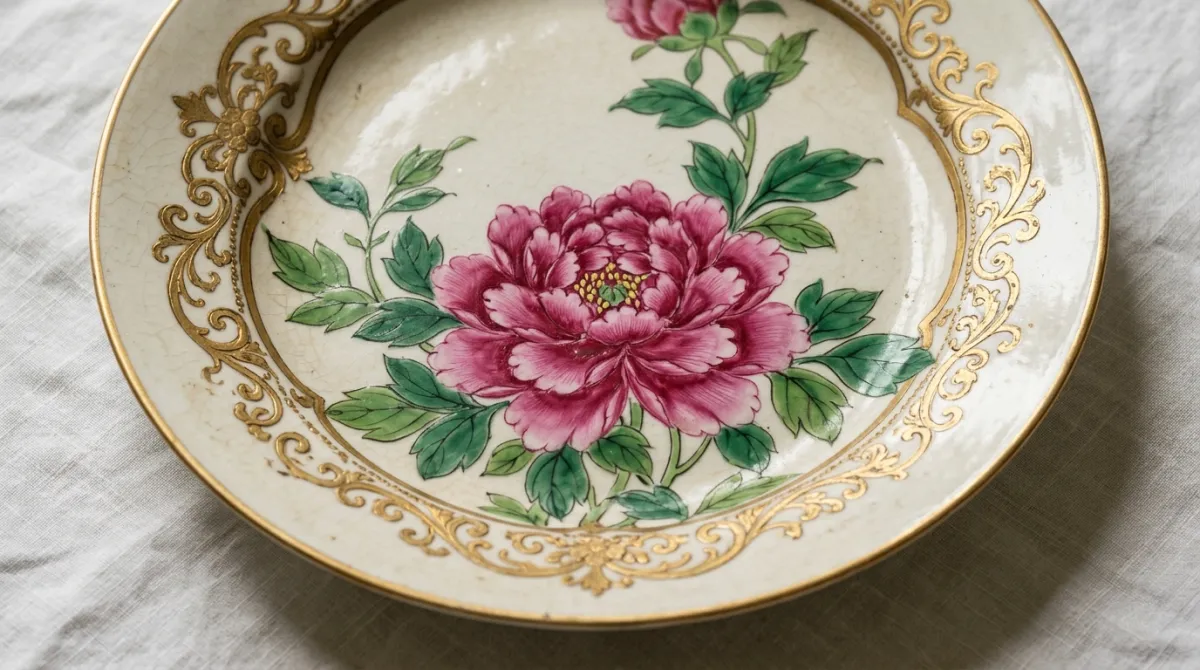
The peony commonly stands for wealth, honor, and high social rank in Chinese decorative art, a reading that goes back at least to its Tang-dynasty association with the imperial gardens of Luoyang. Painters lean on that shorthand constantly. A plate crowded with peonies isn’t just pretty, it’s making a wish for the person who receives it.
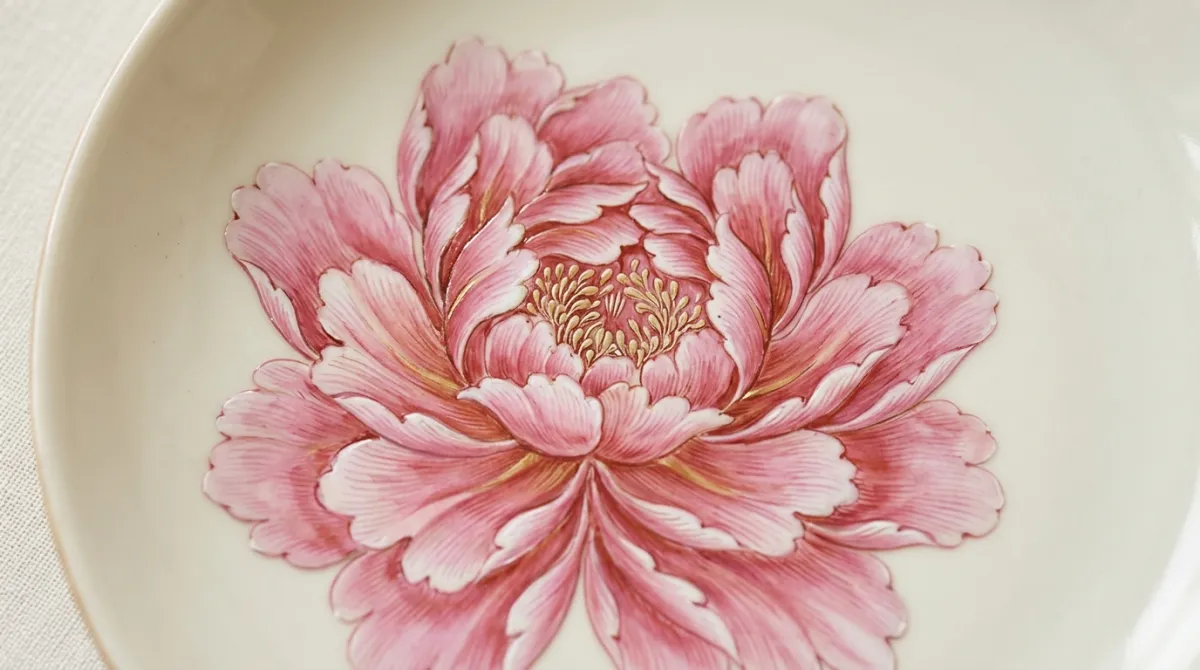
Chinese writers have called the peony the “king of flowers” (花王) for centuries, and the title isn’t casual flattery. Luoyang peony cultivation became famous enough during the Tang dynasty that the flower got tied to imperial favor and courtly prosperity, an association that stuck long after the dynasty itself ended. By the time export porcelain painters in Canton were filling reserves with peony sprays, the flower already carried centuries of that meaning behind it.
That’s also why the peony shows up so often on gift and wedding porcelain specifically. Sending someone a bowl or vase heavy with peonies was, in effect, sending a wish for a prosperous, well-ranked life. It’s a gentle way to say “may things go well for you,” painted rather than spoken.
Why is the peony called the “king of flowers”?
Its size, its full-bodied blooms, and its long cultural link to imperial Luoyang gardens earned the peony that nickname well before export porcelain existed. The title signals rank among flowers the way a peony signals rank among people, wealth and status expressed through scale and abundance rather than subtlety.
What do the other flowers and birds on the porcelain mean?
Beyond the peony, Chinese decorative painting draws on a fairly stable set of auspicious motifs, and each one commonly carries its own reading. Painters mix them deliberately, pairing flowers with birds or insects to build a fuller wish rather than repeating one symbol alone. Here’s how the recurring cast tends to be read.
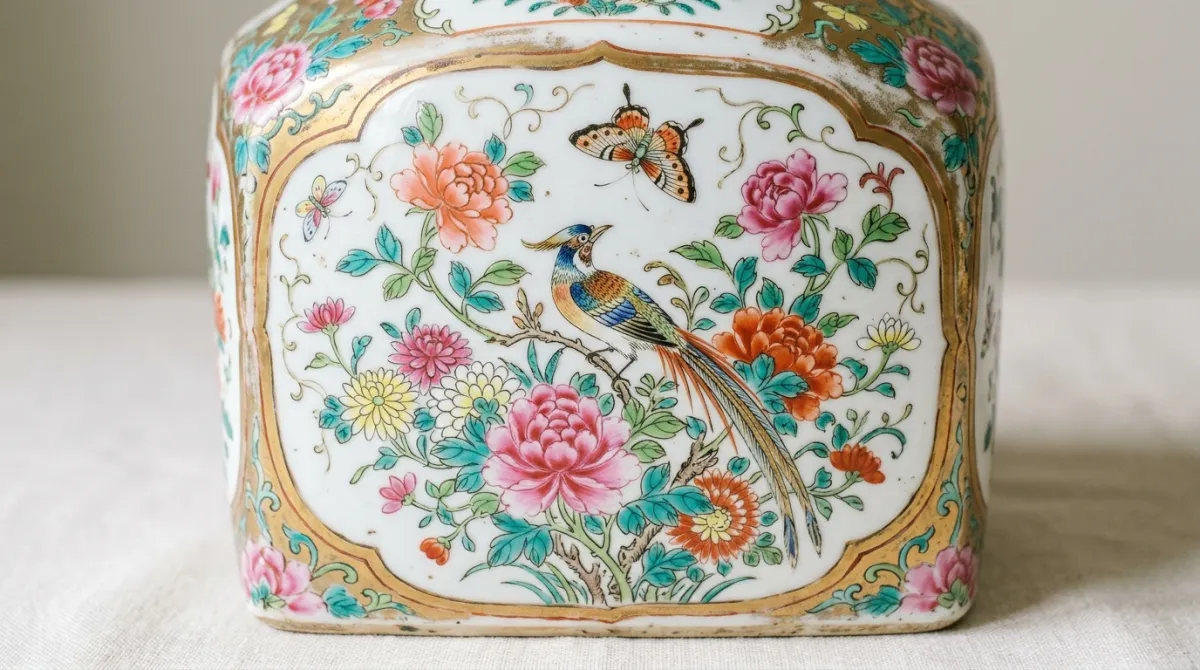
Butterflies are often associated with love and joy, and in some contexts with longevity too, through a wordplay: the Chinese word for butterfly (蝶, dié) sounds close to a term connected with old age (耋, dié, referring to someone in their seventies or eighties). Pair a butterfly with a peony and you’re often reading “prosperity plus a long, happy life” in a single reserve.
Bats work through the same kind of sound-play. The word for bat (蝠, fú) is a near-homophone of the word for fortune or good luck (福, fú), which is why bats appear so often in Chinese decorative art despite not being an obviously appealing creature to paint. Five bats together frequently stand for the “Five Blessings”: longevity, wealth, health, virtue, and a peaceful death.
Pomegranates, split open to show their seeds, commonly symbolize having many children, since the seed cluster reads visually as abundance and fertility. Lotus flowers usually point to purity, partly because the flower rises clean out of muddy water. Chrysanthemums are tied to autumn and, by extension, to longevity and the quiet dignity of the scholar-recluse who retreats from public life. Plum blossom, blooming while snow is still on the branch, often stands for perseverance through hardship. Magpies are a fairly direct symbol of happiness and good news. And fish (魚, yú) carry the same homophone trick as bats: yú also sounds like the word for surplus or abundance (餘), so a painted fish is quietly wishing the owner more than enough of something good.
If you’re still getting your eye in, our guide on how to identify Rose Medallion covers the distinguishing floral and figural features in more depth.
None of this is rigid. Meanings shift a little with context, region, and which combination of motifs a painter chooses to place together, so it’s worth treating these as common readings rather than a strict dictionary. Even so, a collector who knows the basic vocabulary starts noticing intent in pieces that used to look like generic “flowers and birds.”
Why did export porcelain painters use this particular repertoire?
Canton workshops leaned on auspicious flower-and-bird imagery because export porcelain was frequently bought as a gift, and a gift that quietly wishes wealth, longevity, or many children onto its recipient does more work than plain decoration. Weddings, birthdays, and business gifts all called for exactly that kind of message.
Western buyers in the 18th and 19th centuries weren’t necessarily reading the symbolism the way a Chinese buyer would, but Canton painters kept using the same repertoire regardless, partly because it was the visual language they’d trained in and partly because the motifs were genuinely decorative on their own terms. A peony spray looks good whether or not the viewer knows its cultural weight, which probably helped the imagery travel so easily into Western homes.
There’s a practical layer here too. A shared set of auspicious motifs meant a workshop could train painters on a repeatable vocabulary, peonies, chrysanthemums, butterflies, bats, rather than inventing new floral designs for every commission. That consistency kept output high without making pieces feel identical, since the arrangement, color balance, and brushwork still varied piece to piece.
How do the figure panels relate to the floral symbolism?
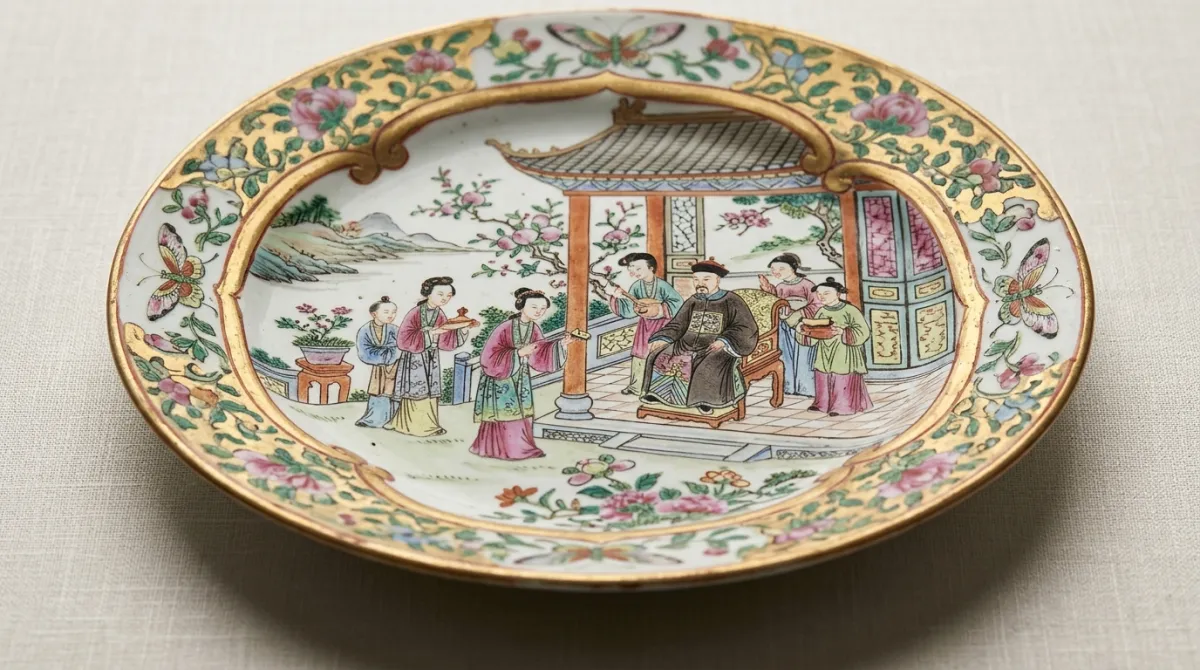
The figure reserves on patterns like Rose Medallion usually show court or garden scenes rather than a specific named legend, functioning as a human counterpart to the floral panels rather than a competing message. Robed figures in a pavilion or garden setting suggest the same prosperous, leisured life the flowers are wishing for, just rendered through people instead of plants.
For a fuller primer on how those figure and floral reserves are arranged, see what is Rose Medallion porcelain.
It’s easy to assume every figural scene on export porcelain tells a specific story, a folk tale or a historical episode, but that’s often not the case. Most figure panels on Rose Medallion and related patterns depict generic court or garden life: women in flowing robes, children at play, a scholar in a pavilion. The point isn’t narrative, it’s atmosphere, the same prosperous, unhurried world the peonies and pheasants are already suggesting.
Kerry Kwok, the Macau porcelain painter behind our studio’s work, trained under 廣彩 (Canton enamel) master Lei Iat Po and has painted these figure-and-floral reserves for years. When I asked her whether the court scenes carry hidden meaning the way the flowers do, she was fairly blunt about it: “Most of the time, no. The figures are showing you a good life, not telling you a story. The peonies are doing the symbolic work. The people are just living in that world.” It’s a useful distinction, and one that keeps collectors from hunting for a legend that usually isn’t there.
That said, some figural scenes do reference specific themes, immortals, scholars, or court officials, and those carry their own associations worth knowing separately. But on the export ware most collectors encounter day to day, the safer assumption is generic prosperity rather than coded narrative.
Why is Rose Medallion so densely covered in these auspicious flowers?
Rose Medallion’s floral reserves lean heavily on this same auspicious vocabulary, peonies, chrysanthemums, butterflies, and birds, which is a big part of why the pattern reads as celebratory rather than merely busy. The floral panels aren’t filler between the figure scenes; they’re doing real symbolic work of their own.
That figure-to-floral balance is exactly what separates the related patterns. See Rose Medallion vs Rose Canton vs Mandarin.
Look closely at a Rose Medallion floral reserve and you’ll usually find a peony as the anchor bloom, with a bird, often a long-tailed pheasant, perched among the petals, sometimes joined by a butterfly worked into the same panel. That’s not an accident of composition. It’s a compact, layered wish: rank and prosperity from the peony, happiness or longevity from the butterfly, an extra note of good fortune from the bird. Stack that across four or six alternating reserves circling a plate, and the whole object becomes a fairly dense bundle of good wishes, which is one reason these pieces made (and still make) such popular gifts.
We cover the wider decorative structure, the alternating panels, the gilt scrollwork, the central medallion, in our full illustrated guide to Rose Medallion, if you want the fuller picture beyond the symbolism alone.
Frequently asked questions
What does the peony symbolize in Chinese culture?
The peony commonly symbolizes wealth, honor, and high rank, a reading tied to its long historical association with imperial Luoyang gardens during the Tang dynasty. It’s often called the “king of flowers,” and that title signals status rather than casual beauty. Context can shift the emphasis slightly, but wealth and honor remain the core reading.
What do butterflies and peonies together mean?
A peony paired with a butterfly is often read as prosperity combined with love, joy, or long life, since the butterfly’s Chinese name (蝶) sounds close to a word linked with old age (耋). Painters use this pairing deliberately to layer more than one good wish into a single floral reserve.
Why are there so many flowers on Rose Medallion?
Rose Medallion’s floral reserves draw on a repeated auspicious vocabulary, peonies, chrysanthemums, birds, butterflies, so the density isn’t decoration for its own sake. Each floral panel is typically stacking two or three good wishes at once, which is part of why the pattern reads as celebratory rather than simply crowded.
Do the figures on Rose Medallion have a meaning?
Usually the figures depict generic court or garden life rather than a specific coded story, serving as a human counterpart to the floral symbolism rather than a separate message. Some figural scenes reference specific themes like immortals or scholars, but most export ware collectors encounter shows unnamed prosperous, leisured scenes.
Is peony symbolism the same in Japan?
Not entirely. Japanese art (where the peony is called botan, 牡丹) also treats the flower as a symbol of wealth and honor, but Japanese decorative traditions developed their own conventions and pairings around it, distinct from Chinese porcelain motifs. Treat the two traditions as related but separate rather than interchangeable.
The short version
Peony symbolism gives Chinese porcelain, and Rose Medallion especially, a layer of meaning that’s easy to miss until you know the vocabulary. The peony wishes wealth and honor. Bats and fish sneak in good fortune and abundance through wordplay. Butterflies and chrysanthemums add joy and long life. None of it is random, even when the exact reading shifts a little with context.
Once you can name what you’re looking at, a floral reserve stops being background pattern and starts reading like a small, deliberate message. If you’d like a piece painted around a specific auspicious motif, a wedding gift heavy with peonies and butterflies, or a milestone piece built around longevity symbols, see our custom Rose Medallion commissions for hand-painted work in the same traditional Canton technique.
Keep exploring
More from Rose Medallion
Identification, history, and care guides for Rose Medallion and Canton porcelain. New guides added regularly.
Explore all guides