patterns motifs
Famille Rose, Verte, Noire, and Jaune: The Chinese Enamel Families
Key Takeaways
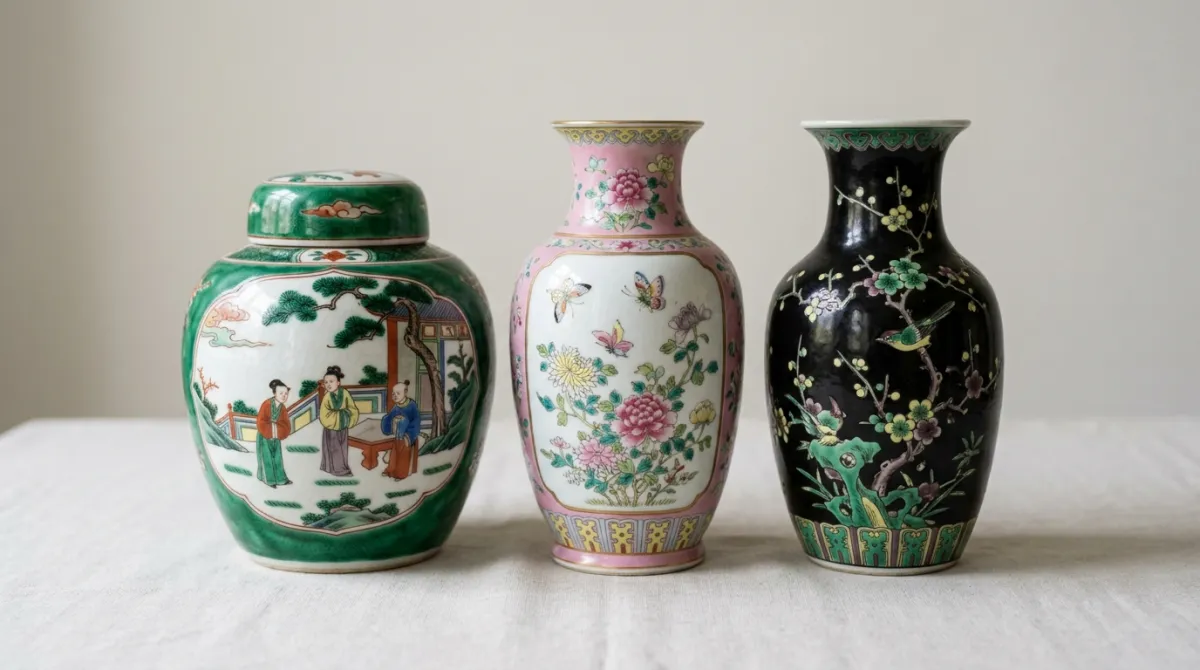
- “Famille” verte, rose, noire, and jaune are Western colour-family labels coined by 19th-century scholar Albert Jacquemart, not terms Chinese workshops used.
- Famille verte, green-dominant and glassy, came first, developing in the Kangxi period. Famille rose, opaque and pink-based, followed in the early 18th century.
- Famille noire and famille jaune are generally treated as ground-colour variants most often associated with the verte family: enamels over a black or yellow ground rather than separate palettes.
- Rose Medallion is painted in the famille-rose palette, so it belongs to the “rose” family, not verte, noire, or jaune.
- Some famille noire on the market has grounds added later, so this attribution deserves extra scrutiny.
What do “famille verte,” “rose,” “noire,” and “jaune” actually mean?
These four terms are a French classification system, coined by 19th-century scholar Albert Jacquemart to sort Chinese export porcelain by its dominant overglaze colour scheme. They don’t come from Chinese workshops at all. Jacquemart was grouping pieces by eye for European collectors who had no other consistent way to catalogue what was arriving from China in bulk.
We covered Jacquemart’s classification in more depth in our famille rose explained article, and it’s worth a read if you want the full backstory on where “famille” comes from. Here, the short version matters more: verte, rose, noire, and jaune aren’t four unrelated palettes. They’re really two underlying enamel traditions, green and pink, with noire and jaune describing ground colours applied under (or around) one of them.
That distinction trips a lot of people up when they’re staring at an auction listing. A piece labelled “famille noire” isn’t decorated in some fourth secret colour scheme. It’s a famille-verte-style piece on a black background. Once you see that, the four names stop feeling like a memorisation exercise and start feeling like a fairly logical system.
Who was Albert Jacquemart, and why did his labels stick?
Jacquemart was a French writer on decorative arts who published influential work on Chinese and Japanese ceramics in the mid-19th century. His colour-family system gave European dealers and museums a workable shorthand at a moment when almost no original Chinese workshop documentation had travelled west with the porcelain itself. The labels stuck because nothing better replaced them, and they’re still what you’ll hear at most auction houses today.
When did famille verte appear, and how do you spot it?
Famille verte is the earlier of the two main palettes, developing during the Kangxi reign, roughly the second half of the 17th century into the early 18th. It’s built around a bright, translucent green as the dominant colour, supported by iron-red, yellow, aubergine, and underglaze blue. There’s no true opaque pink in a famille-verte piece; if you think you’re seeing pink, look again, because rose enamel hadn’t been developed yet.
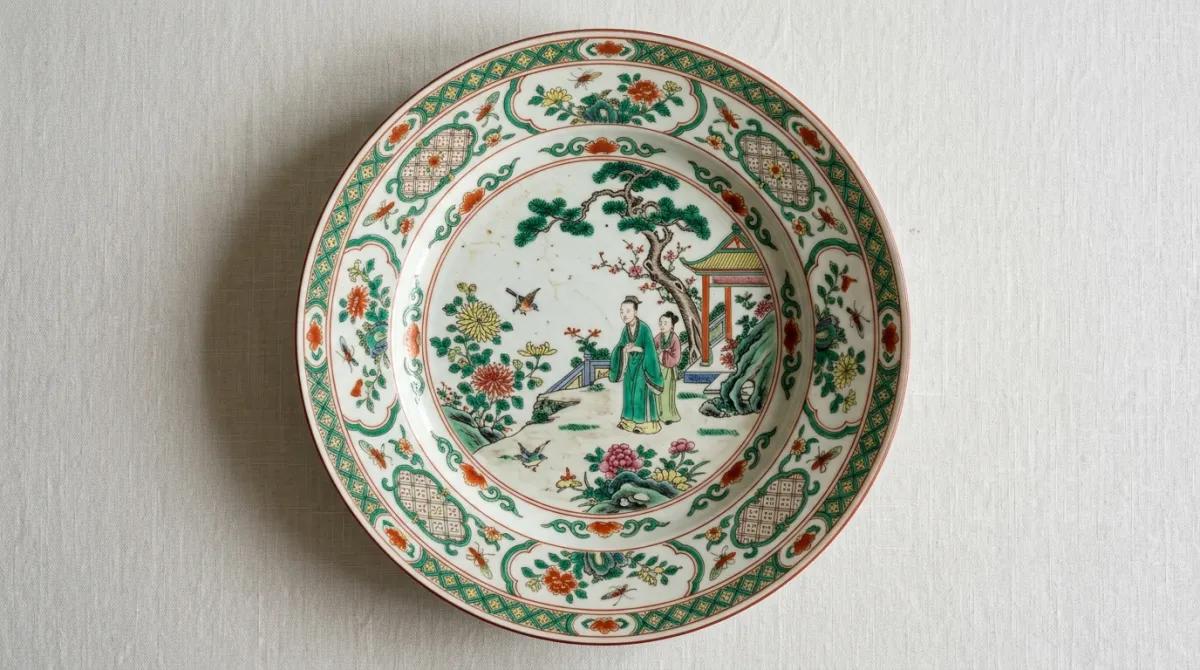
The word we’d reach for describing famille verte next to famille rose is “glassy.” The green enamel sits with a translucent, almost jewel-like quality, and the whole palette reads harder and more linear than what came after it. Shading tends to be done through hatching or layered translucent colour rather than the soft graduated blending famille rose made possible. It’s a different kind of skill, not a lesser one.
Kerry, who trained under 廣彩 master Lei Iat Po before opening GoodTime Studio Macau, still points out famille verte’s hatched shading to visitors as a benchmark for enamel control. She’s mentioned more than once that painting convincing gradation with a hard, transparent green is genuinely harder than it looks, since there’s no soft blending to hide an uneven hand.
How can you tell famille verte at a glance?
Look for a piece where green clearly dominates the palette, paired with iron-red, yellow, and aubergine, and no opaque pink anywhere. The colours will look glassy and slightly translucent rather than chalky or pastel. If you see a confident, soft pink used for shading faces or petals, you’re almost certainly looking at famille rose instead.
How does famille rose differ from famille verte?
Famille rose introduced an opaque, gold-based rose-pink enamel that simply didn’t exist in the famille-verte palette, and it appears in China in the early 18th century, overlapping with and gradually succeeding famille verte. The clearest visual tell is opacity: famille rose looks soft, matte, almost powdery, where famille verte looks glassy and translucent.
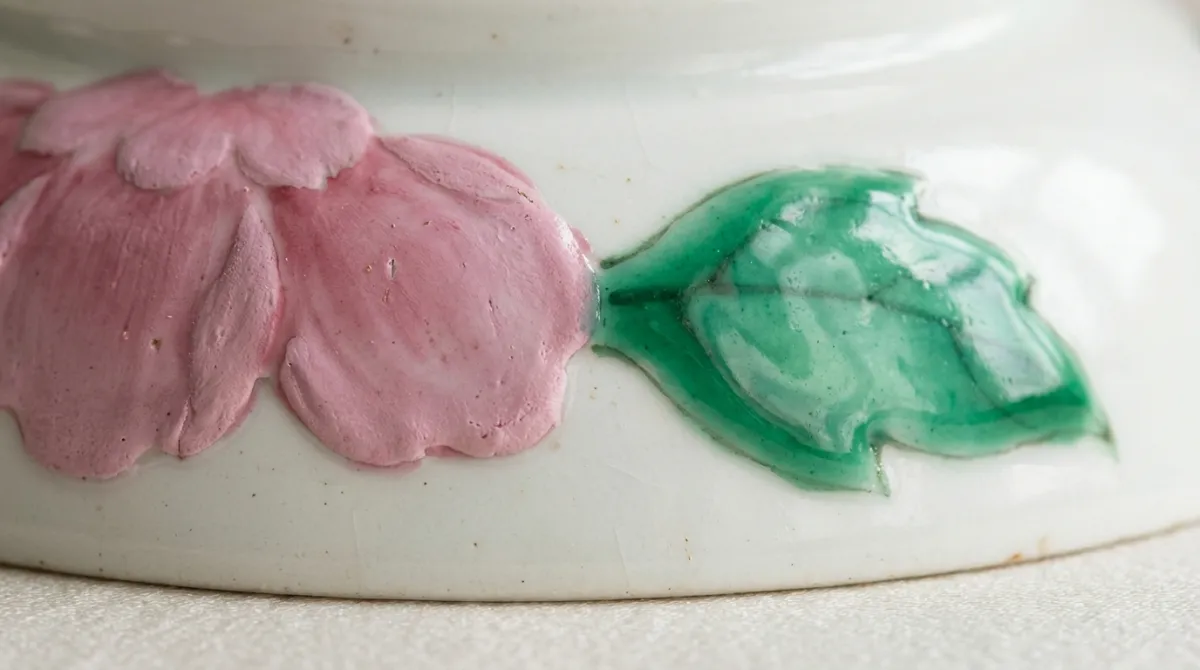
That pink didn’t just add a new colour option. It changed what painters could do with shading, letting them blend graduated tones across a petal or a face in a way the harder famille-verte enamels never really allowed. We’d argue this is the single most useful diagnostic for a beginner sorting the two families, more useful than trying to memorise reign dates: does the pink look opaque and soft, or is there no true pink at all? That question alone resolves most verte-versus-rose confusion faster than any date chart.
We go into famille rose’s full development, its likely gold-pigment origins, and its Chinese names (fencai and yangcai) in our dedicated famille rose article, so we won’t repeat all of that here. The short version: famille rose overlapped with famille verte for a while rather than replacing it overnight, and both palettes were produced side by side for decades before rose became the dominant export choice.
Which came first, verte or rose?
Famille verte came first, established well within the Kangxi period, decades before the rose-pink enamel technology reached Chinese workshops. Famille rose followed in the early 18th century and matured under Yongzheng and Qianlong, gradually overtaking verte as the preferred export palette without fully replacing it.
What are famille noire and famille jaune?
Famille noire and famille jaune are generally treated as ground-colour variants rather than separate palettes. They’re usually famille-verte-type decoration applied over a black ground or a yellow ground, respectively, rather than the more usual white porcelain body. Think of them as a background choice layered under the same green-dominant enamel family, not a fourth or fifth set of colours.
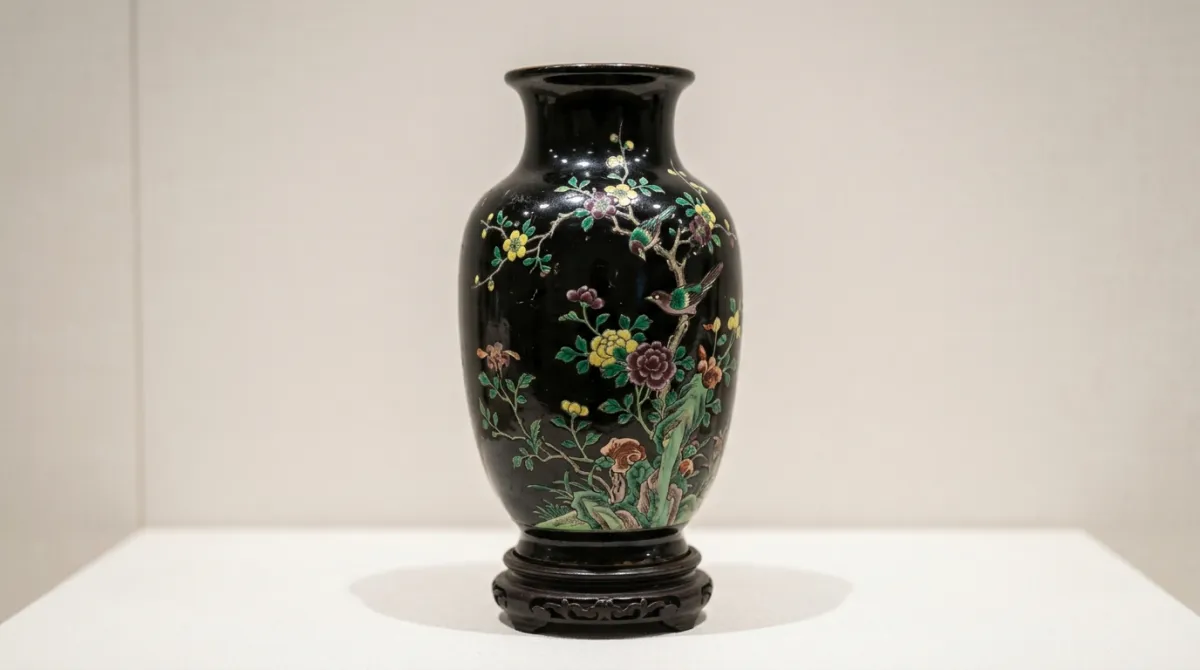
Famille jaune is fairly straightforward, a piece decorated in verte-style enamels where the field around the design is coloured yellow rather than left white. Famille noire is the more contested of the two. Genuinely early Kangxi-period black-ground pieces exist, but the category has a messy reputation because black grounds have sometimes been added or reworked on later or 19th-century pieces to imitate the rarer, more desirable early examples. Specialists disagree on how many surviving “famille noire” pieces have grounds that are original versus added later, and we’d rather flag that honestly than pretend the category is clean.
That’s the kind of hedge worth taking seriously if you’re buying rather than just admiring famille noire in a museum case. A black ground alone doesn’t guarantee an early or fully original piece, and it’s the sort of attribution question worth asking a specialist before paying a premium for the rarity.
Is famille noire always what it claims to be?
Not necessarily. Because black-ground pieces command higher prices, some later wares have had black grounds added or altered to resemble earlier famille noire examples. This doesn’t mean every black-ground piece is suspect, but it does mean the category deserves more scrutiny than famille verte or famille jaune, where the ground colour is less commonly disputed.
Where does Rose Medallion fit among these families?
Rose Medallion belongs to the famille-rose family, since it’s painted using the opaque rose-pink palette in its alternating panels of court figures and birds-and-flowers. It has nothing to do with famille verte, noire, or jaune beyond sharing the same general overglaze-enamel-on-fired-glaze technique that all four families use.
If you’re new to the pattern itself rather than the colour classification, our beginner’s guide to Rose Medallion walks through what actually defines the layout. And if you’re trying to place a piece against the wider field of Chinese export porcelain, verte, rose, blue-and-white, and everything in between, our antique Chinese porcelain guide and the illustrated Rose Medallion pillar guide both cover more ground than fits into one post.
It’s worth sitting with just how much confusion this causes in casual listings. We’ve seen pieces labelled “famille verte Rose Medallion,” which isn’t really possible given the two use different palettes entirely. If a listing mixes those terms, that’s usually a sign the seller is reaching for impressive-sounding vocabulary rather than describing the piece accurately.
Frequently asked questions
What’s the difference between famille rose and famille verte?
Famille verte is an earlier, green-dominant, glassy overglaze palette from the Kangxi period with no true pink. Famille rose introduced an opaque, gold-based pink in the early 18th century, enabling softer shading and gradually becoming the dominant export palette through the 18th and 19th centuries.
Which came first, verte or rose?
Famille verte came first, developing during the Kangxi reign in the late 17th and early 18th centuries. Famille rose followed once gold-based pink enamel technology reached China, maturing under the Yongzheng and Qianlong emperors and eventually overtaking verte as the more common export choice.
What is famille noire or famille jaune?
Famille noire and famille jaune are famille-verte-style enamels applied over a black ground or a yellow ground rather than plain white porcelain. They’re ground-colour variants of the green palette, not separate colour families, though some famille noire grounds are debated as later additions.
Is Rose Medallion famille rose?
Yes. Rose Medallion is a 19th-century Canton export pattern painted entirely in the famille-rose palette, defined by its layout of alternating figure and floral panels rather than by any unique enamel of its own.
Who named the famille colour families?
Albert Jacquemart, a 19th-century French writer on decorative arts, coined “famille verte,” “famille rose,” “famille noire,” and “famille jaune” to sort Chinese export porcelain by dominant colour for European collectors and museums cataloguing it at the time.
The short version
Four names, really two enamel traditions: green (verte) and pink (rose), with black and yellow grounds (noire and jaune) layered onto the verte side of that split. Verte came first, glassy and green-dominant; rose followed with its opaque pink and eventually became the more common export palette, which is the family Rose Medallion belongs to.
Next time a listing throws all four terms at you, you’ll at least know which questions to ask. Kerry still paints in the fencai tradition daily at GoodTime Studio Macau, and she’s always happy to talk through a piece if you’re trying to work out which family you’re actually looking at.
Keep exploring
More from Rose Medallion
Identification, history, and care guides for Rose Medallion and Canton porcelain. New guides added regularly.
Explore all guides