history origin
Famille Rose Explained: The Pink-Enamel Palette Behind Rose Medallion
Key Takeaways
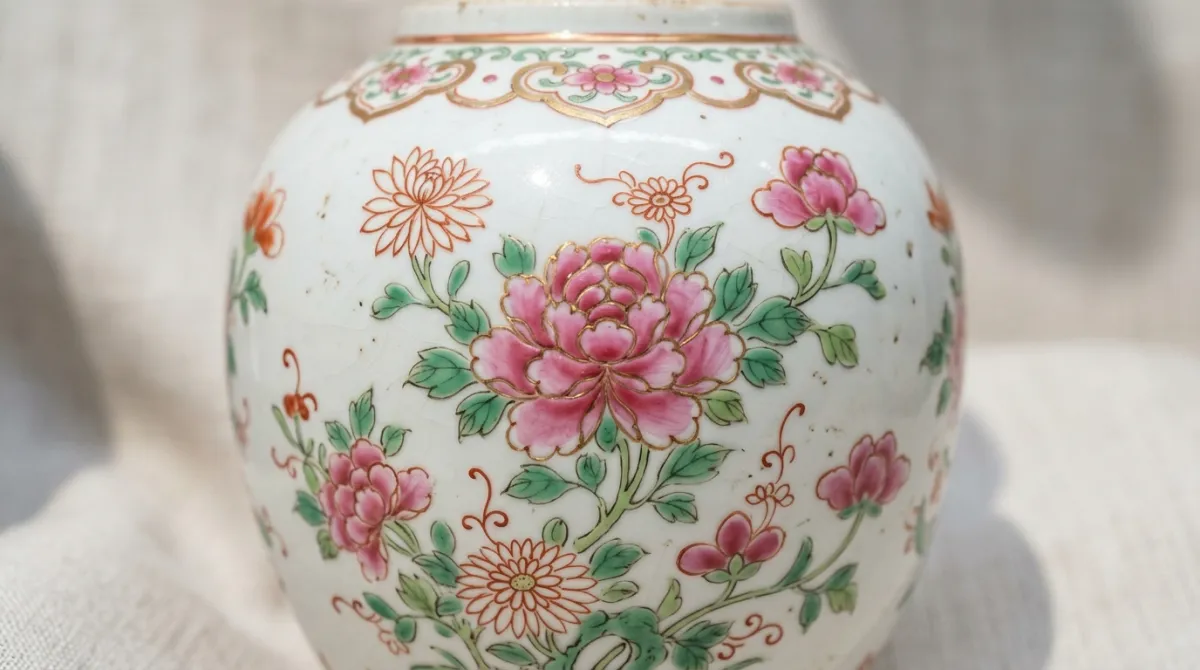
- Famille rose is a French classification, “pink family,” for a Chinese overglaze enamel palette defined by an opaque rose-pink.
- The name was coined by 19th-century scholar Albert Jacquemart; in Chinese the palette is usually called fencai or yangcai.
- The pink likely traces to gold-based enamel technology, though the exact route into China is debated among specialists.
- It appears in China in the early 18th century and matures under the Yongzheng and Qianlong emperors.
- Rose Medallion is one export style painted in the famille-rose palette, not a synonym for it. See our beginner’s guide to Rose Medallion for how the two connect.
What does “famille rose” actually mean?
Famille rose means “pink family” in French, and it names a Chinese overglaze enamel palette built around an opaque rose-pink that doesn’t occur in earlier Chinese ceramic colour schemes. It’s a Western art-history label, not a term Chinese potters or painters ever used themselves.
The phrase groups together porcelain decorated with that pink enamel alongside a wider range of soft, opaque colours, whites, yellows, and blues that sit differently on the glaze than the harder, more transparent enamels used before it. Once you’ve seen the pink in person, next to older green-dominant wares, the difference is hard to miss. It reads as softer, almost powdery, rather than glassy.
It’s worth saying plainly that “famille rose” describes a palette, a family of colours and a technique for applying them, rather than a single pattern, workshop, or dynasty. That’s the same distinction that trips people up with Rose Medallion, which is a specific export layout painted using this palette, not the palette itself.
Is famille rose a Chinese term?
No. Chinese sources don’t use “famille rose” at all; it’s a 19th-century French coinage that entered the English-language antiques trade through translation. The Chinese terms, fencai and yangcai, describe the same enamels from a different angle, and we’ll get to both below.
Where does the term “famille rose” come from?
The term comes from Albert Jacquemart, a French scholar who classified Chinese porcelain by dominant colour family in his 19th-century writing on ceramics. He also coined famille verte, famille jaune, and famille noire for other colour groups, and the naming system stuck in Western scholarship well beyond his own lifetime.
Jacquemart wasn’t cataloguing techniques so much as sorting pieces by eye, grouping wares that shared a dominant colour mood. It was a useful shorthand for European collectors trying to make sense of a huge and unfamiliar body of imported porcelain, and it’s still the vocabulary most auction houses and museums use today. Whether it’s the most useful way to think about the porcelain is a fair question, and we’ll come back to that.
That Western framing matters for collectors because it means the label tells you about colour, not about workshop, region, or maker. Two pieces from entirely different kilns and decades can both correctly be called famille rose, the same way two Rose Medallion pieces can be a century apart.
Why did European scholars need this classification at all?
European museums and dealers in the 19th century were absorbing enormous quantities of Chinese export porcelain with no consistent labelling system attached. Sorting by colour family gave them a workable taxonomy, rough as it was, for cataloguing collections and writing about pieces whose original workshop records rarely survived the trip west.
What are the Chinese names for this palette?
In Chinese, the famille-rose enamels are most often called fencai (粉彩), meaning “soft” or “pale colours,” or yangcai (洋彩), meaning “foreign colours,” a name that nods to the palette’s likely foreign-influenced origins. Neither term maps neatly onto “pink family,” which is exactly why the French and Chinese naming traditions can feel like they’re describing two different things.
Fencai emphasises the visual softness of the enamels, opaque and slightly matte compared to the glassier famille-verte colours that came before. Yangcai leans into the historical account that the pink pigment and some related enamelling techniques arrived in China through contact with European traders and Jesuit court painters active in the early Qing period. Both names are still used in Chinese scholarship, sometimes for overlapping but not identical groups of wares, and specialists don’t always agree on where one term stops and the other starts.
It’s worth pausing on that: even within Chinese ceramic scholarship, the boundaries between fencai and yangcai get argued over. We wouldn’t pretend that’s settled, and we’d be suspicious of anyone who tells you it is with total confidence.
Do fencai and yangcai mean exactly the same thing?
Not quite. Fencai tends to describe the general soft-enamel palette across a broad range of wares, while yangcai more often refers to a subset associated with imperial workshops experimenting with imported pigments and techniques. In practice, the two labels overlap heavily, and you’ll see both used for pieces that look identical to a non-specialist eye.
Where does the rose-pink colour actually come from?
The rose-pink enamel is generally linked to gold-based pink and purple pigment technology, sometimes associated with the “Purple of Cassius” process used in European glass and enamel work of the same era. Most specialists connect its arrival in China to contact with European enamelling know-how in the early 18th century, though the exact transmission route isn’t fully settled.
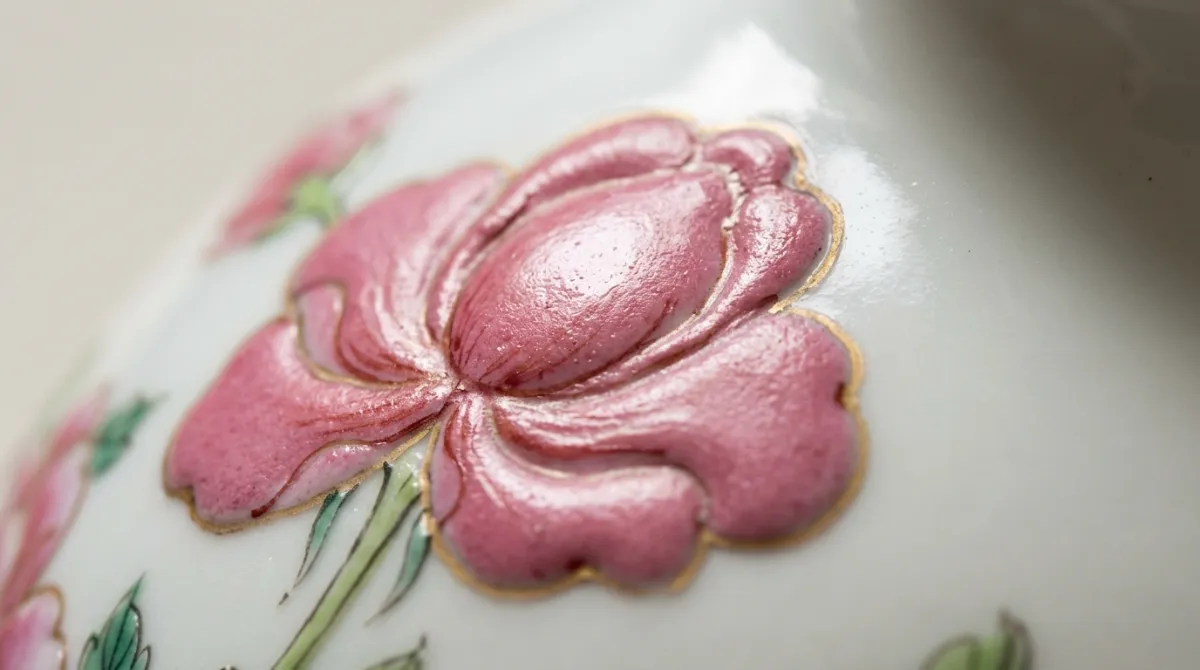
Purple of Cassius, broadly speaking, is a colloidal gold-tin compound that produces a pink to purple colour depending on concentration and firing conditions. European enamellers had been using gold-based pinks before the technique shows up on Chinese porcelain, and the timing lines up with increased contact between the Qing court and European Jesuit missionaries serving as painters and technicians.
That said, we’d hedge here rather than state it as settled fact. Some scholars point to court workshop records and Jesuit correspondence as fairly direct evidence of transmission; others note that pigment chemistry can arrive through trade goods and pattern books without any single documented “moment” of transfer. The honest answer is that the what (gold-based chemistry) is more secure than the exactly how (which hands carried it where, and when).
Was the pink pigment invented in China or imported?
Neither answer is fully clean. The underlying gold-based chemistry has European precedent, but Chinese court and provincial workshops adapted, refined, and scaled the enamel for porcelain in ways that went well beyond simple copying. Treating it as purely “borrowed” undersells the skill Chinese painters brought to making it work on a fired glaze surface.
When did famille rose first appear, and how did it develop?
Famille-rose enamels start showing up in China in the early 18th century, toward the end of the Kangxi reign, and the palette matures significantly under the Yongzheng and Qianlong emperors through the mid-1700s. Exact dating of individual early pieces is difficult, and scholars generally describe this as a window rather than a single fixed year.
Under Yongzheng, the palette tightens up considerably: the pink becomes more controlled, the range of accompanying pastel colours expands, and imperial workshops produce some genuinely refined pieces that collectors still hold up as high points of the style. Qianlong-era production continues that refinement while also scaling up, as demand grew both domestically and for export.
By the time Canton export workshops were producing porcelain for Western buyers in volume, later in the 18th and through the 19th century, famille rose was the dominant overglaze palette for decorative export wares. It’s easy to assume the palette stayed static once it “arrived,” but the pink itself, its hue, opacity, and the range of colours painted alongside it, kept shifting across the century as workshops adjusted formulas and firing conditions.
Did the palette look the same in 1730 as it did in 1830?
Not really. Early Yongzheng-period famille rose tends toward more restrained, carefully modelled pink with fine shading, while later export-era pieces, especially heavily decorated 19th-century Canton wares, often use a bolder, flatter application across a busier composition. Both are correctly called famille rose; they just represent different moments in a century-long evolution.
How does famille rose differ from famille verte?
Famille verte is the earlier of the two, a green-dominant overglaze enamel palette that developed in the Kangxi period, decades before the rose-pink enamel became available. The clearest difference is simple: famille verte has no true opaque pink, leaning on green, iron-red, yellow, and aubergine instead.
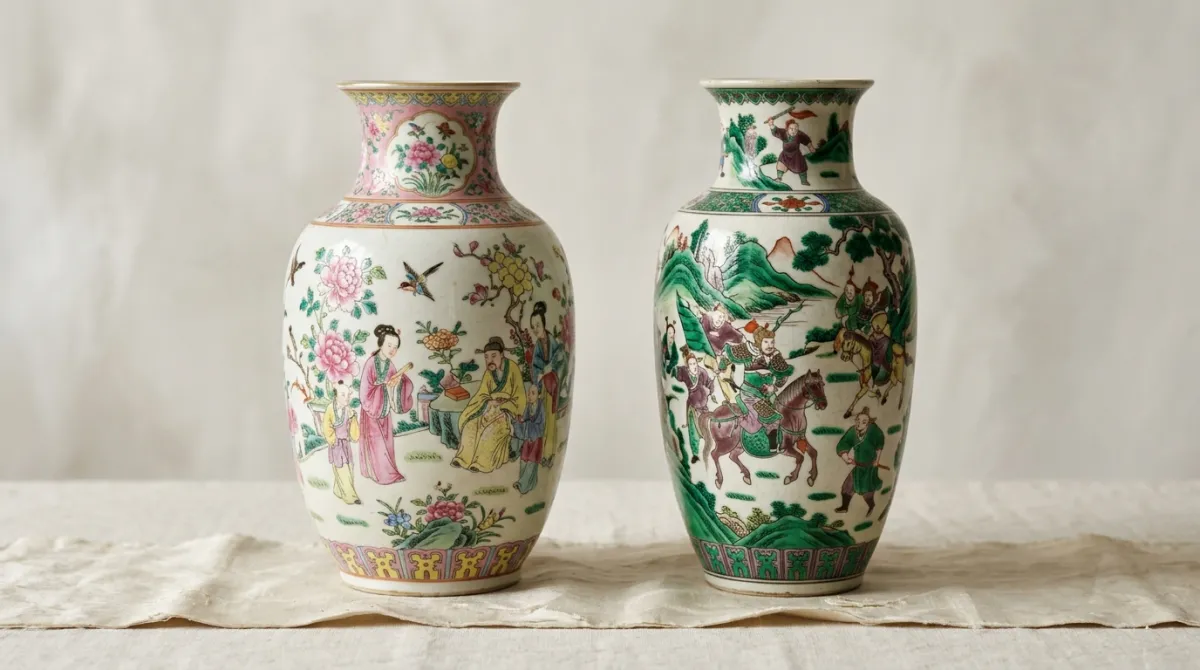
Once the rose-pink enamel became available, it didn’t just add a colour, it changed the whole feel of the decoration. Famille-rose wares tend to read as softer and more pastel overall, partly because the pink enabled subtler shading in figures and florals that famille verte’s harder colours couldn’t easily achieve. Painters could now blend pink into white for graduated tones on a face or a petal, something the earlier palette simply didn’t support.
Both palettes sit on top of an already-glazed and fired body, applied in a second, lower-temperature firing, so the underlying technique is shared. The visual result, though, is different enough that experienced eyes can usually sort the two families at a glance, even before checking any other feature of a piece.
Which came first, famille verte or famille rose?
Famille verte came first, developing during the Kangxi reign, roughly the second half of the 17th century into the early 18th. Famille rose followed once the rose-pink enamel technology became available, and it gradually became the more dominant export palette through the 18th and 19th centuries, without fully replacing green-toned wares.
How does famille rose compare to underglaze blue-and-white?
Famille rose and blue-and-white porcelain differ in where and how the colour sits on the piece, not just in which colours appear. Blue-and-white uses cobalt painted directly onto unfired clay, then sealed under a single glaze firing, while famille rose is painted on top of an already-fired glaze in a separate, later step.
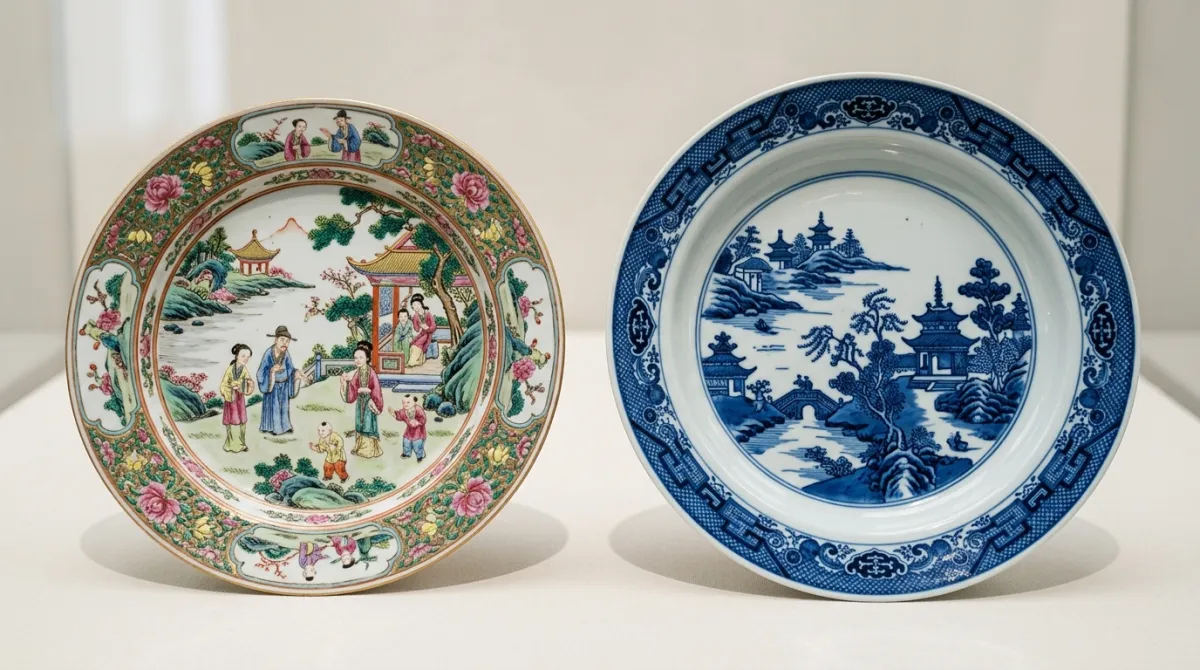
That difference in process shows up physically. Underglaze blue sits flush with the glaze surface, smooth to the touch, because it’s sealed beneath it. Famille-rose enamels sit slightly proud of the surface, since they were fired a second time at a lower temperature that fixes them without melting the glaze underneath. Run a fingertip carefully across an old famille-rose piece and you can often feel that faint texture.
The two traditions also overlap on the same object more often than people expect. Plenty of export porcelain combines underglaze blue borders or details with overglaze famille-rose enamel decoration on the main body, so it’s not always an either-or choice for a given piece. We go into that underglaze process on its own in our guide to Chinese blue-and-white porcelain, which is worth reading alongside this one if you’re trying to place a piece.
Can a single piece have both underglaze blue and famille-rose enamels?
Yes, and it’s fairly common on export wares. A plate might carry a blue underglaze border or diaper pattern, fired first with the glaze, and then famille-rose figures or florals painted on afterward in the second firing. Seeing both isn’t a contradiction; it just means the piece went through both decorating steps.
How does Rose Medallion fit into the famille-rose family?
Rose Medallion is a specific 19th-century Canton export style painted in the famille-rose palette, not a separate colour family of its own. It’s defined by its layout, alternating reserves of court figures and birds-and-flowers, rather than by any unique pigment or firing method beyond the shared famille-rose technique.
That’s a distinction worth sitting with, because a lot of casual listings use “famille rose” and “Rose Medallion” almost interchangeably, and they’re not. Famille rose is the palette; Rose Medallion is one pattern painted with it, among many others, including Rose Canton and Mandarin. Every piece of Rose Medallion is famille rose, but plenty of famille-rose porcelain has nothing to do with the Rose Medallion layout at all, imperial Yongzheng bowls, for instance, or simple export dishes with a single central floral spray.
If you’re trying to place a piece and you’re not sure whether you’re looking at Rose Medallion specifically or another famille-rose export pattern, our beginner’s guide to Rose Medallion and our broader antique Chinese porcelain guide both walk through the visual cues side by side. The illustrated Rose Medallion pillar guide covers the pattern in more depth than fits in one article.
Would a Yongzheng imperial bowl and a 19th-century Rose Medallion plate both count as “famille rose”?
Yes, technically, both use the same rose-pink overglaze palette. But they represent very different production contexts, an imperial workshop piece from the early 18th century versus a Canton export pattern from more than a century later, so lumping them together as “the same thing” misses most of what actually distinguishes them as objects.
Frequently asked questions
What does “famille rose” mean?
Famille rose is French for “pink family,” a classification coined by 19th-century scholar Albert Jacquemart for Chinese porcelain decorated with an opaque rose-pink overglaze enamel. It’s a Western art-history label, not a term used by Chinese potters themselves.
Is famille rose the same as Rose Medallion?
No. Famille rose is the enamel palette itself, while Rose Medallion is one specific 19th-century Canton export pattern painted using that palette. All Rose Medallion is famille rose, but plenty of famille-rose porcelain isn’t Rose Medallion at all.
What’s the difference between famille rose and famille verte?
Famille verte is an earlier, green-dominant overglaze palette from the Kangxi period, without a true opaque pink. Famille rose introduced the rose-pink enamel in the early 18th century, enabling softer shading and becoming the dominant export palette through the 18th and 19th centuries.
What is fencai or yangcai?
Fencai (粉彩, “soft colours”) and yangcai (洋彩, “foreign colours”) are the Chinese terms most often used for the famille-rose enamels. They don’t map perfectly onto the French classification, and even specialists debate exactly where the two Chinese terms overlap or diverge.
When was famille rose first made?
Famille-rose enamels appear in China in the early 18th century, toward the end of the Kangxi reign, and the palette matures under the Yongzheng and Qianlong emperors through the mid-1700s. Specialists generally treat this as a developmental window rather than a single fixed date.
The short version
Famille rose is a French label for a Chinese overglaze pink-enamel palette, named by Albert Jacquemart, known in China as fencai or yangcai, and rooted in gold-based pigment technology that arrived in the early 18th century. Rose Medallion is one export pattern painted with it, not a synonym for the palette itself.
Once you’ve got that distinction, the rest of the vocabulary, famille verte, fencai, Canton export, starts fitting together instead of feeling like scattered trivia. If you’d like to see the palette applied by hand in the traditional way, Kerry Kwok paints daily in this technique at GoodTime Studio Macau, working from the training she received under 廣彩 master Lei Iat Po.
Keep exploring
More from Rose Medallion
Identification, history, and care guides for Rose Medallion and Canton porcelain. New guides added regularly.
Explore all guides