commission
Custom Wedding and Anniversary China: Hand-Painted to Order
Key Takeaways
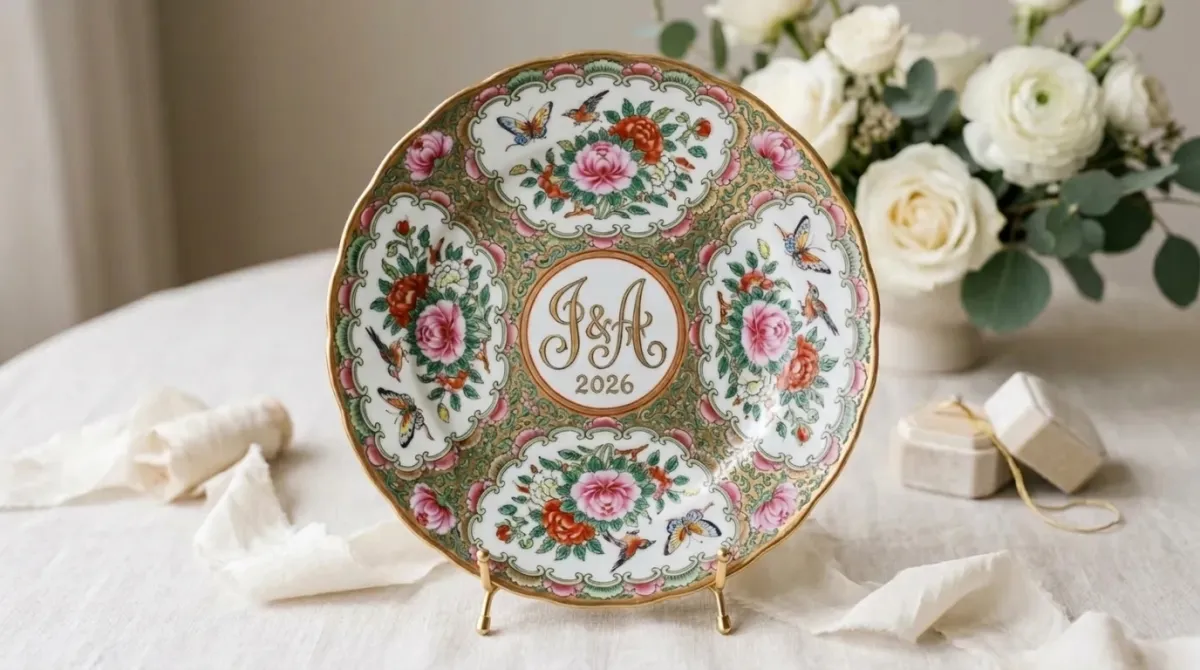
- A hand-painted commission can give you an heirloom-quality wedding or anniversary piece, something a standard registry set doesn’t offer in the same way.
- You can personalize a plate or set with a monogram, names, a wedding date, or a chosen motif, and the size and colour palette are yours to decide.
- Auspicious symbols like peonies, mandarin ducks, and double happiness (囍) carry real meaning for a couple, not just decoration.
- Kerry Kwok hand-paints every commission at GoodTime Studio Macau, so plan several weeks ahead, especially for a wedding date that isn’t moving.
- New commissions can be made to modern food-safe standards, unlike antique Rose Medallion, which we treat as display-only.
Why choose hand-painted china for a wedding or anniversary?
A hand-painted piece works as wedding or anniversary china because it’s made once, for one couple, rather than pulled off a shelf. That’s really the whole appeal. Registry china is chosen from a catalog; a commissioned piece is built around a specific date, a specific pair of initials, a specific story.
I get asked fairly often why anyone would commission a plate instead of just buying a nice set from a department store. Fair question. The honest answer is that a commissioned piece isn’t competing with a registry brand on price or convenience, it’s doing something different entirely. It’s closer to a piece of jewelry than a dinnerware pattern: made for this couple, this date, this occasion, and unlikely to be duplicated by anyone else at the wedding.
There’s also the symbolism, which registry china rarely bothers with. Traditional Chinese porcelain motifs, peonies for prosperity, butterflies for joy, mandarin ducks for a devoted pair, aren’t decorative filler. They’re a language, and putting that language on a couple’s plate is a way of wishing them well without saying a word. Our peony symbolism guide covers what these motifs actually mean if you want the full picture before choosing one.
None of this is meant to talk anyone out of a registry. Most couples still want everyday plates for everyday dinners. A commissioned piece tends to sit alongside that, as a showpiece plate for the mantel or a special set brought out on anniversaries, not a replacement for the china you actually eat off every night.
What can you personalize on a custom wedding plate?
Nearly everything on a custom piece can be adjusted, because Kerry paints each order individually rather than working from a fixed template. Monogram, names, a wedding date, the motif itself, the colour palette, and the size all sit on the table for discussion before a brush ever touches porcelain.
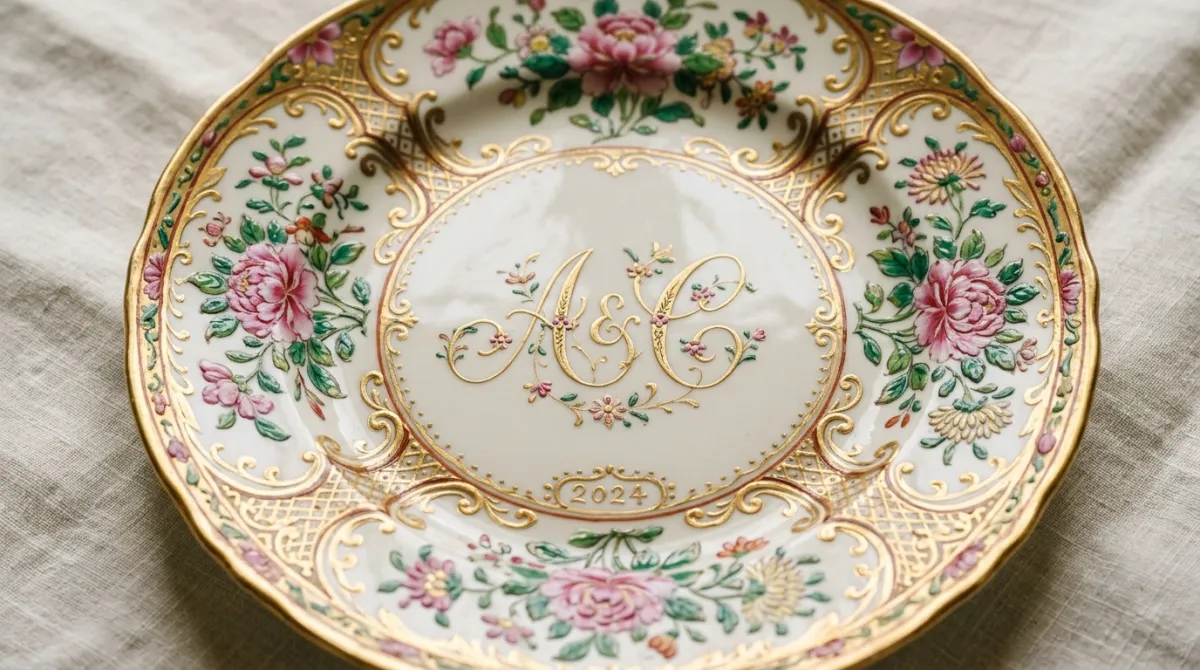
The monogram or names are usually the first thing people ask about. A couple’s initials, worked discreetly into a border panel or centered under the medallion, is one of the most common requests we get. Some couples want the wedding date instead, tucked into a cartouche the way a mark or inscription would sit on an antique piece. Both read as intentional rather than tacked-on when they’re planned into the design from the start instead of added as an afterthought.
Colour palette is the next big lever. A bride might want the gilt banding heavier, or the ground colour shifted to match a bridesmaid’s dress or a wedding’s overall palette. None of that breaks the traditional Rose Medallion look, it just tailors it. Kerry’s told me that the trickiest requests aren’t usually the ambitious ones, they’re the subtle colour-matching jobs, getting a specific shade of blush or blue right in fired enamel takes more trial than people expect.
Then there’s scale. A single showpiece plate reads very differently from a small matching set of four or six, and both are common orders. A showpiece plate tends to go to a couple who wants one meaningful object rather than tableware; a small set usually goes to a couple who plans to actually use the pieces on anniversaries. Neither is the “right” choice, it depends on what the piece is for.
If you want the fuller rundown of how sizing, borders, and patterns work on a commission generally, our guide to how commissioning works walks through it step by step.
How does commissioning custom wedding china actually work?
The process runs through a few clear stages: you describe the occasion and what you have in mind, we confirm feasibility and price, Kerry paints the piece by hand at GoodTime Studio Macau, and then it’s fired, finished, and shipped. Nobody’s guessing at any point along the way.
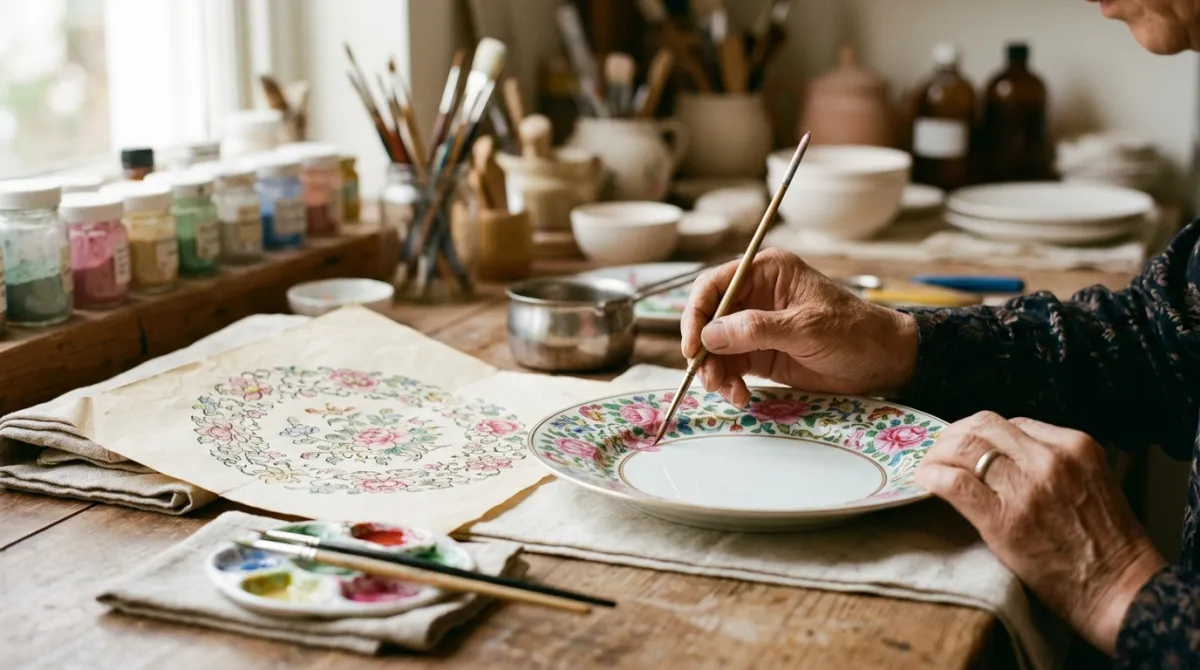
It starts with a conversation, not a form. Tell us the occasion, whether it’s a wedding, an anniversary, or a gift for someone else’s, and share whatever you already have in mind: a photo of a pattern you like, a colour scheme, names or a date, a rough idea of size. Kerry reviews it and tells you plainly whether it’s straightforward or genuinely ambitious for the scale of the piece.
From there you’ll get a price range and a realistic timeline before committing to anything, usually along with a reference sketch so you know roughly what the finished plate will look like. Once that’s agreed, Kerry paints the piece by hand, the same layered process used for traditional 廣彩 porcelain, and it’s fired and finished before shipping.
The single most common mistake we see is timing. A couple reaches out three weeks before the wedding wanting a hand-painted set, and we have to explain that hand-painting doesn’t compress the way a print order does. Kerry’s painting one piece at a time, not running a batch through a machine, so allow real lead time, several weeks rather than days, and build in extra room if the piece is meant to arrive before the actual wedding date rather than after it.
Ready to start that conversation? The commissions page is the fastest way to reach the studio directly with your idea.
What motifs suit a wedding or anniversary piece?
The motifs that suit a wedding or anniversary piece are the ones with wishes built into them, mainly the peony for prosperity, mandarin ducks for a devoted couple, and double happiness (囍) for the occasion itself. These aren’t arbitrary choices; each one carries centuries of conventional meaning in Chinese decorative art.
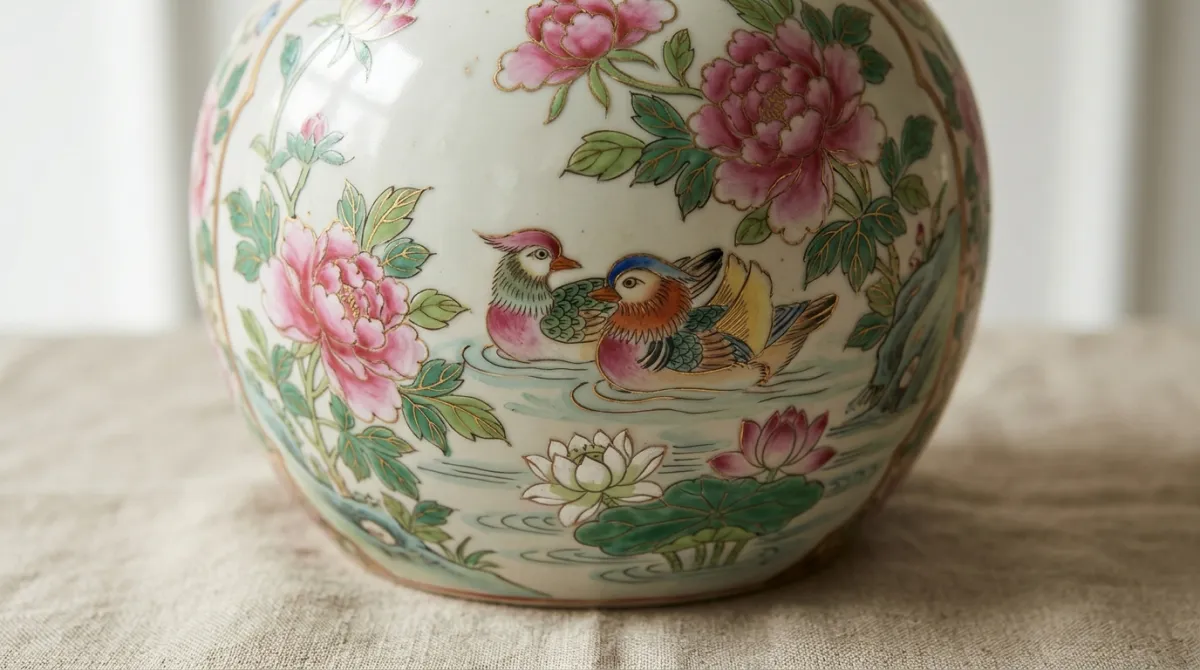
The peony is probably the easiest starting point, since it’s already central to Rose Medallion’s floral reserves and reads as a wish for a prosperous, well-ranked life together. Mandarin ducks are a more pointed choice for a wedding specifically: they’re traditionally read as mating for life, which makes them a fairly direct symbol for a couple starting a marriage. Butterflies add a lighter note, commonly tied to joy and, depending on the pairing, romantic love.
Double happiness, the 囍 character formed from two joined 喜 symbols, is the motif most explicitly tied to weddings themselves rather than porcelain decoration generally. It’s not part of a traditional Rose Medallion border, but it can be worked into a custom piece as a personal addition, a cartouche, a small reserve, wherever it reads clearly without crowding the main design.
What surprises a lot of couples is how well these older motifs pair with modern personalization. A wedding date in a cartouche next to a pair of mandarin ducks doesn’t feel like two eras competing, it reads as one design because the motifs were always meant to carry a message, and a date or a monogram is just another message layered in. Our peony symbolism guide goes deeper into how these motifs traditionally get paired if you want to build a design around more than one meaning.
Is custom wedding china food-safe, or only for display?
New commissioned pieces can be made to modern food-safe standards, which sets them apart from antique Rose Medallion, something we generally treat as display-only. That distinction matters more for wedding china specifically, since a lot of couples want a piece they can actually use on anniversaries, not just admire on a shelf.
Antique porcelain carries overglaze enamel and gilding that can include lead and sit unfused on the glaze, which is why we’re cautious about recommending antique pieces for everyday food use. A new commission doesn’t inherit that problem automatically, but it does need to be built with that goal in mind from the start. If you tell us upfront that you want a plate the two of you will actually eat off on your anniversary, that requirement shapes the materials and finishing Kerry uses, and she’ll confirm exactly what’s gone into the piece once it’s done.
This is worth deciding early rather than after the fact. A showpiece plate meant purely for display can take a slightly different approach than a plate meant to hold food once a year on your anniversary dinner. Neither is more “correct,” they’re just different jobs for the piece. Our plate collector’s guide has more detail on how antique and new pieces differ if you’re weighing an antique find against a fresh commission.
Frequently asked questions
How far ahead should I order wedding china?
Plan for several weeks of lead time at minimum, since each piece is hand-painted individually rather than produced in a batch. Weddings have a fixed date that isn’t moving, so reach out as early as possible, ideally as soon as you know you want a custom piece, rather than a few weeks out.
Can you add names, a date, or a monogram?
Yes, this is one of the most common requests we get. Names, initials, and a wedding date can all be worked into a border panel or a cartouche without disrupting the traditional look of the pattern. Tell us what you’d like included when you first describe the piece.
What motifs suit a wedding?
Peonies, mandarin ducks, and double happiness (囍) are the most common choices, each carrying its own conventional meaning around prosperity, devotion, and celebration. Our peony symbolism guide explains how these motifs are traditionally paired and read.
Is custom china food-safe?
New commissions can be made to modern food-safe standards if you let Kerry know upfront that you intend to use the piece rather than only display it. This is different from antique Rose Medallion, which we generally recommend keeping as display-only.
Can you make a matching set, or just a single showpiece plate?
Both are common orders, and neither is the “right” choice. A single showpiece plate suits a couple who wants one meaningful object, while a small matching set suits a couple planning to actually use the pieces on future anniversaries.
Where to go from here
A registry can give you dinnerware. It usually won’t give you a plate painted around your actual wedding date, your initials, or a motif chosen because it means something specific to the two of you. That’s what a hand-painted commission is for, and it starts with a fairly simple conversation about what you have in mind. If you’re weighing the pattern itself first, our guide to Rose Medallion is a good place to start; if you’re ready to talk specifics, reach out through the commissions page and tell Kerry the occasion.
Simon Iong writes about Rose Medallion history and commissioning. Craft insight in this piece comes from his wife, Kerry Kwok of GoodTime Studio Macau, a working 廣彩 painter trained under master Lei Iat Po.
Keep exploring
More from Rose Medallion
Identification, history, and care guides for Rose Medallion and Canton porcelain. New guides added regularly.
Explore all guides