identify value
Chinese Porcelain Marks: How to Read and Date Them
Key Takeaways
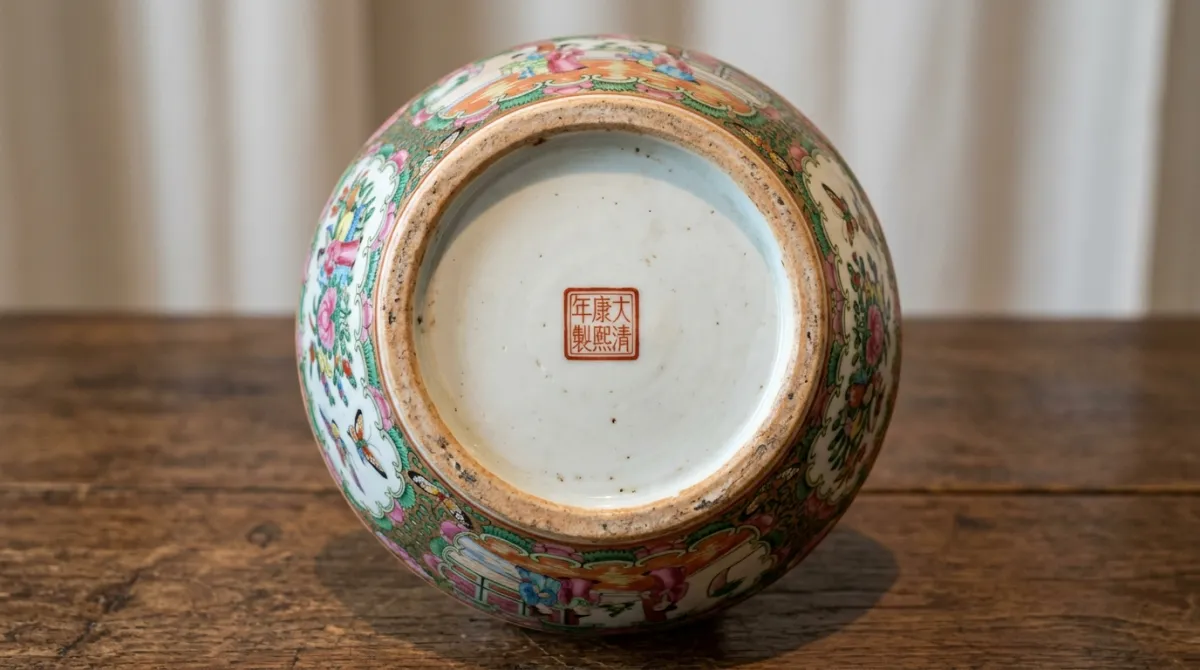
- A reign mark (nianhao) names an emperor, but it’s frequently apocryphal, added to honor an earlier, admired reign rather than to date the piece. See our marks and dating reference.
- Hall marks, symbol marks, and auspicious-phrase marks are common alternatives to reign marks and carry their own, more limited meaning.
- “China” on a base generally points to 1891 or later, and “Made in China” to around 1919 or later, under US import labeling rules, though this is a general guide, not an absolute one.
- Unmarked pieces aren’t automatically older or newer; a huge amount of genuine antique Chinese porcelain, including most Canton export ware, left the kiln without a mark at all.
- Read a mark alongside the body, glaze, potting, and decoration. Never let it stand alone.
Someone flips over a plate, spots four or six Chinese characters stamped on the base, and treats it like a birth certificate. It isn’t one, and that trips up more collectors than almost any other single mistake. A mark is a clue. It’s one of several things you weigh together, not a verdict you read off the bottom of a piece. This guide walks through the main types of Chinese porcelain marks you’ll encounter, what each one can and can’t tell you, and how to use them properly. If you collect Rose Medallion specifically, our companion piece on Rose Medallion marks and markings goes deeper into Canton export ware in particular.
What is a reign mark, and what does it actually say?
A reign mark, or nianhao (年號款), names the emperor and dynasty under which a piece was supposedly made, most often written as a four- or six-character inscription such as 大清乾隆年製 (“Made during the Qianlong reign of the Great Qing”). You’ll see it in kaishu (regular script) or, less often, seal script, and it’s usually painted in underglaze blue, though iron-red and other overglaze enamels turn up too.
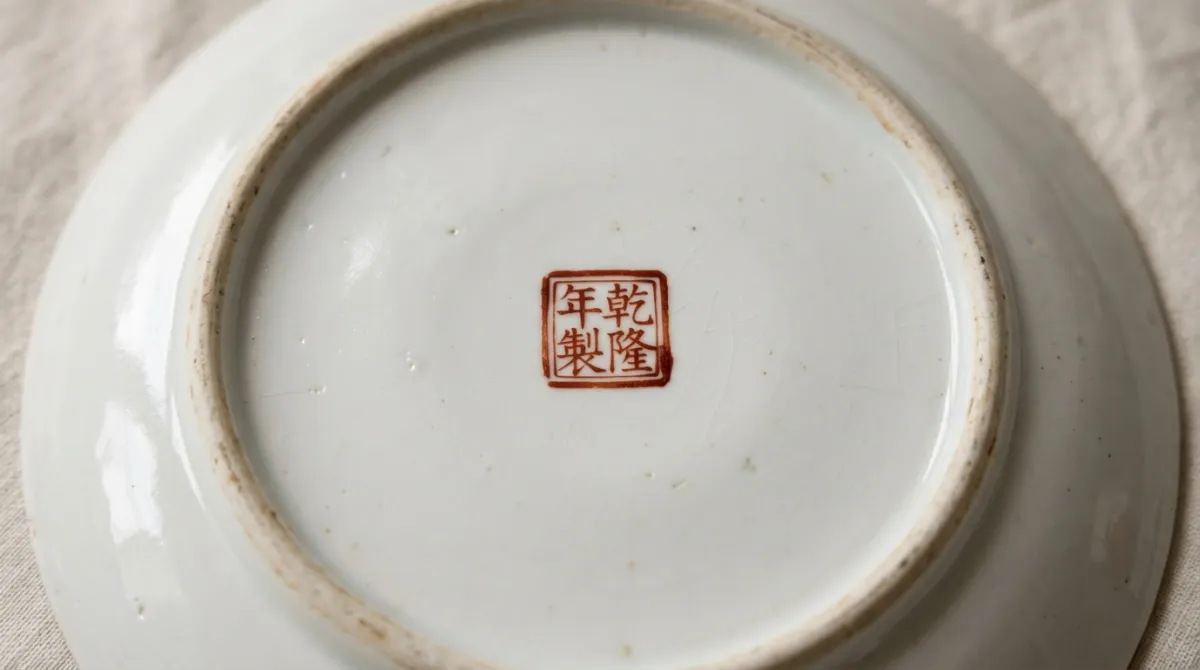
The six-character form typically opens with the dynasty name (大清 for Qing, 大明 for Ming), followed by the emperor’s reign name and the phrase 年製, “made in the year of.” Four-character marks drop the dynasty name and give just the reign and 年製. Both formats appear on genuine imperial ware and on later pieces referencing an earlier reign, which is exactly where the trouble starts.
Reading a reign mark tells you which emperor’s era the mark is invoking. It does not, on its own, tell you when the piece was actually made. That gap between what a mark claims and when a piece was fired is the single most important thing to understand about Chinese porcelain marks, and it’s the whole subject of the next section.
Why are so many reign marks apocryphal?
Reign marks are frequently apocryphal, meaning a workshop added an earlier, admired emperor’s mark as a gesture of respect rather than an honest date claim, and this has been a long-established practice in Chinese ceramics (our marks and dating reference). A piece stamped “Qianlong” might genuinely be Qianlong-period, or it might be Guangxu-period, made more than a hundred years later.
Certain reigns attracted this treatment more than others. Ming-dynasty Xuande (1426-1435) and Chenghua (1465-1487) marks show up constantly on porcelain made generations after those emperors died, because both reigns were prized for their painting and glaze quality. Among Qing marks, Kangxi and Qianlong get borrowed the same way, honoring an era collectors and connoisseurs already admired.
This wasn’t fraud in the modern sense, or at least it usually wasn’t intended that way. Think of it more like a furniture maker today building a “Georgian-style” chair without pretending it rolled out of an 18th-century workshop. The mark signaled taste and reverence for a golden age, not a factual production date. Kerry says she still gets the same reaction from first-time visitors to the studio almost every week: someone turns a piece over, spots a Qianlong mark, and their face lights up before she’s even said a word. She’ll turn it in the light with them and gently explain what the mark is actually doing. It’s rarely the answer people came in hoping for.
So what do you do once you’ve read a reign mark and identified which emperor it names? Treat it as one data point, weighed against the glaze, the body, the potting, and the brushwork, never as the deciding factor by itself.
What other types of marks show up on Chinese porcelain?
Beyond reign marks, you’ll commonly encounter hall marks naming a studio or collector’s hall, symbol marks using an emblem instead of characters, and auspicious-phrase marks wishing wealth or longevity rather than naming an emperor at all. Each type carries its own, narrower meaning than a reign mark. (Marks and dating reference, Rose Medallion)
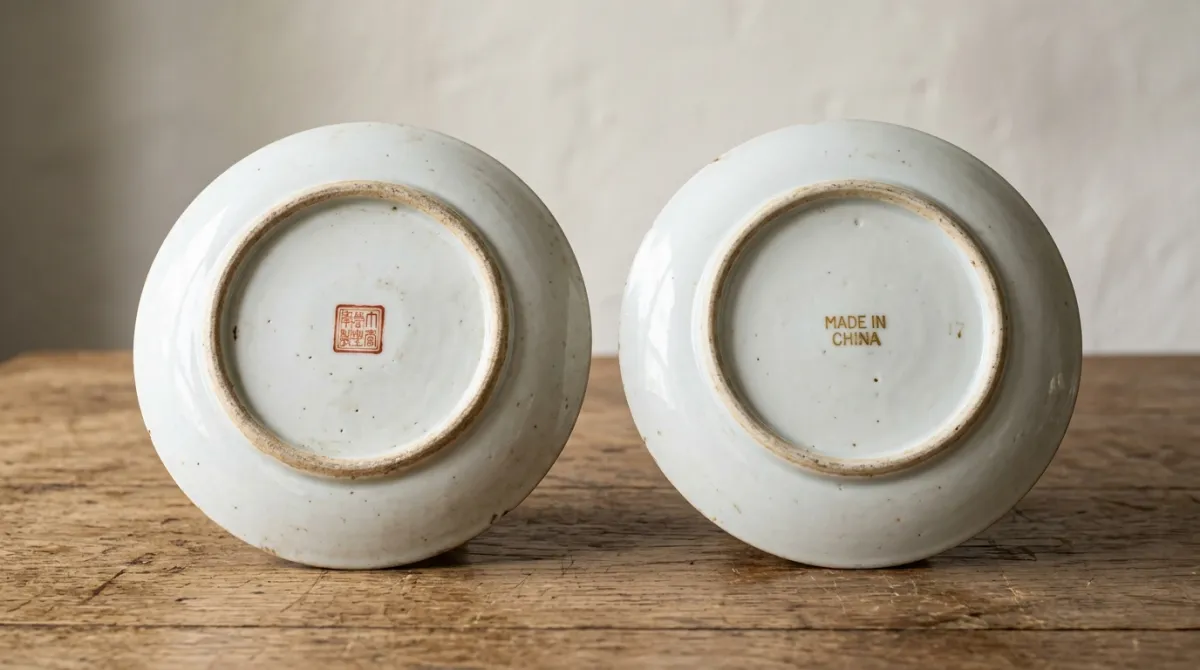
Hall marks (堂名款) name a specific studio, collector’s room, or private hall, such as the various “tang” (堂) names that appear on porcelain commissioned by wealthy patrons or scholars. These tell you a piece was made for or associated with a particular household or collector, not which emperor was on the throne. They’re a genuinely useful clue when you can identify the hall, though many remain difficult to pin down precisely.
Symbol or emblem marks replace characters with a single image: a leaf, a sprig of artemisia, a double ring, a conch shell, or similar motifs. These appear widely on Kangxi-period and later porcelain and generally function as workshop or period indicators rather than formal reign claims. In our experience, collectors often underrate symbol marks simply because they’re not text, but a well-documented symbol mark can actually narrow a date range more usefully than a vague or heavily-copied reign mark does.
Auspicious-phrase marks wish the owner well rather than naming a reign at all, phrases like 長春 (“eternal spring”) or similar sentiments referencing wealth, longevity, or good fortune. Potter’s marks, simple incised or painted marks identifying an individual craftsman or workshop, round out the list, though these are less standardized and harder to research than the categories above.
What does “China” or “Made in China” on the base actually tell me?
“China” stamped on a base generally indicates 1891 or later, and “Made in China” generally indicates around 1919 or later, because of US import labeling requirements, though these are useful general guides rather than absolute rules. Under the 1891 McKinley Tariff Act, imports into the United States generally needed a country-of-origin mark, which is why “China” became common from that point forward.
<img src=“/images/blog/chinese-porcelain-marks-guide-3.webp” alt=“A “MADE IN CHINA” export mark on a base“ loading=“lazy” decoding=“async” width=“1200” height=“675” />
The distinction between the two phrasings sharpens things a bit further. US customs guidance shifted toward favoring the fuller “Made in China” wording over the bare word “China” starting around 1919 or so, which gives you a rough dividing line within the export-mark category itself. A piece stamped “Made in China” is very likely 20th-century, not 18th- or 19th-century.
Here’s the important caveat, and it matters as much as the rule itself. Unmarked pieces aren’t automatically older. A piece could predate 1891 and simply never have needed this kind of mark, or it might have shipped without a retail stamp for reasons that have nothing to do with age. This applies especially to Canton export ware like Rose Medallion, where a large share of genuine antique pieces left the kiln entirely unmarked. Our how to identify Rose Medallion guide covers what to check instead when there’s no mark at all.
How should you actually use a mark when identifying a piece?
A mark only becomes useful once you’ve already formed an impression from the body, glaze, potting, and decoration, and you’re using the mark to test that impression rather than to set it. Read the whole object first; check the base last, not first. (Craft observation, Kerry Kwok, GoodTime Studio Macau)
Start with the weight and glaze tone. Older bodies often feel a touch heavier for their size, with a warm or faintly grey-white cast visible under the glaze where it’s thin. Then look at the decoration under raking light. Hand-painted enamels and underglaze cobalt both show slight texture, pooling, and irregularity that transfer-printed or heavily mass-produced decoration doesn’t replicate convincingly.
Only after weighing all of that should you flip the piece over and read whatever’s on the base. Does the mark’s script style, placement, and color match what you’d expect from the period the rest of the piece suggests? If a piece has crisp, mechanically even gilding alongside a “Qianlong” mark, trust the body and surface over the mark every time. Rose Medallion is a good example of a pattern where marks mislead often. Kerry tells students that Canton export porcelain in particular is frequently unmarked or apocryphally marked, since the pattern and workshop reputation carried far more weight in the export trade than an individual potter’s signature did. Our Rose Medallion marks guide walks through that pattern specifically, and the complete Rose Medallion guide ties marks together with history, form, and care.
If you’re working through blue and white pieces instead, our Chinese blue and white porcelain guide covers cobalt tone and brushwork, clues that matter more than a mark for that tradition too. And our full marks and dating reference lists the individual reign marks you’re most likely to run across, with what each one can and can’t tell you.
Frequently asked questions
Does a reign mark mean my piece is from that reign?
Not necessarily, and often not. Reign marks are frequently apocryphal, added to honor an earlier, admired emperor rather than to report an honest production date. A “Qianlong” mark could genuinely be Qianlong-era, or it could be a century-later piece referencing that reign out of respect.
Do I need to read Chinese to identify a mark?
It helps, but the mark alone can mislead you even if you can read it perfectly. Understanding what the characters say is only step one; knowing whether the mark matches the rest of the piece, and whether that reign is commonly copied, matters just as much.
What does “China” or “Made in China” on the base tell me?
“China” generally points to 1891 or later, and “Made in China” to around 1919 or later, based on US import labeling rules from that period. Treat both as useful general guides, not absolute proof, since exceptions and unmarked pre-1891 pieces exist.
Are unmarked pieces older or fake?
Neither, necessarily. A large share of genuine antique Chinese export porcelain, including most Canton Rose Medallion, left the kiln unmarked, since marking wasn’t standard practice throughout most of that trade’s history. Judge age from the body, glaze, and decoration instead.
Where can I look up a specific mark?
Our marks and dating reference lists common reign marks, hall marks, and export stamps with notes on what each one typically indicates and how often it’s copied or apocryphal, alongside guidance on reading marks in context with the rest of a piece.
The bottom line
A mark is worth reading, just not worth trusting on its own. Reign marks get borrowed to honor earlier eras far more often than most new collectors expect, hall and symbol marks carry narrower and often more reliable meaning, and export stamps like “China” or “Made in China” give you a genuinely useful dating floor when they’re present. None of it replaces looking closely at the body, glaze, and brushwork first. If you’ve got a piece and want a second opinion on what its mark, or lack of one, actually tells you, reach out through our commissions page.
Keep exploring
More from Rose Medallion
Identification, history, and care guides for Rose Medallion and Canton porcelain. New guides added regularly.
Explore all guides